

An MVP can evolve into a stable and scalable mobile product if it meets non-functional validation criteria such as stability under peak load, resilience during network disruptions, and compliance with quality standards such as ISO/IEC 25010 and OWASP MASVS. This also includes implementing phased rollout strategies and using telemetry for continuous monitoring.
Criteria for Scalable Mobile Products
Validating a mobile MVP for wider rollout requires more than feature acceptance alone. It is about ensuring stability, security and performance under diverse conditions. Here are the key considerations for organisations looking to scale their MVP into a fully fledged product.
- Non-functional validation is crucial for ensuring operational stability and performance.
- Scalability requires a robust architecture that can withstand network disruptions and peak loads.
- Using ISO/IEC 25010 and OWASP MASVS frameworks helps assess product quality and security.
- Phased rollout and monitoring are essential for managing risks in production.
From MVP to a scalable mobile product: the strategic boundaries
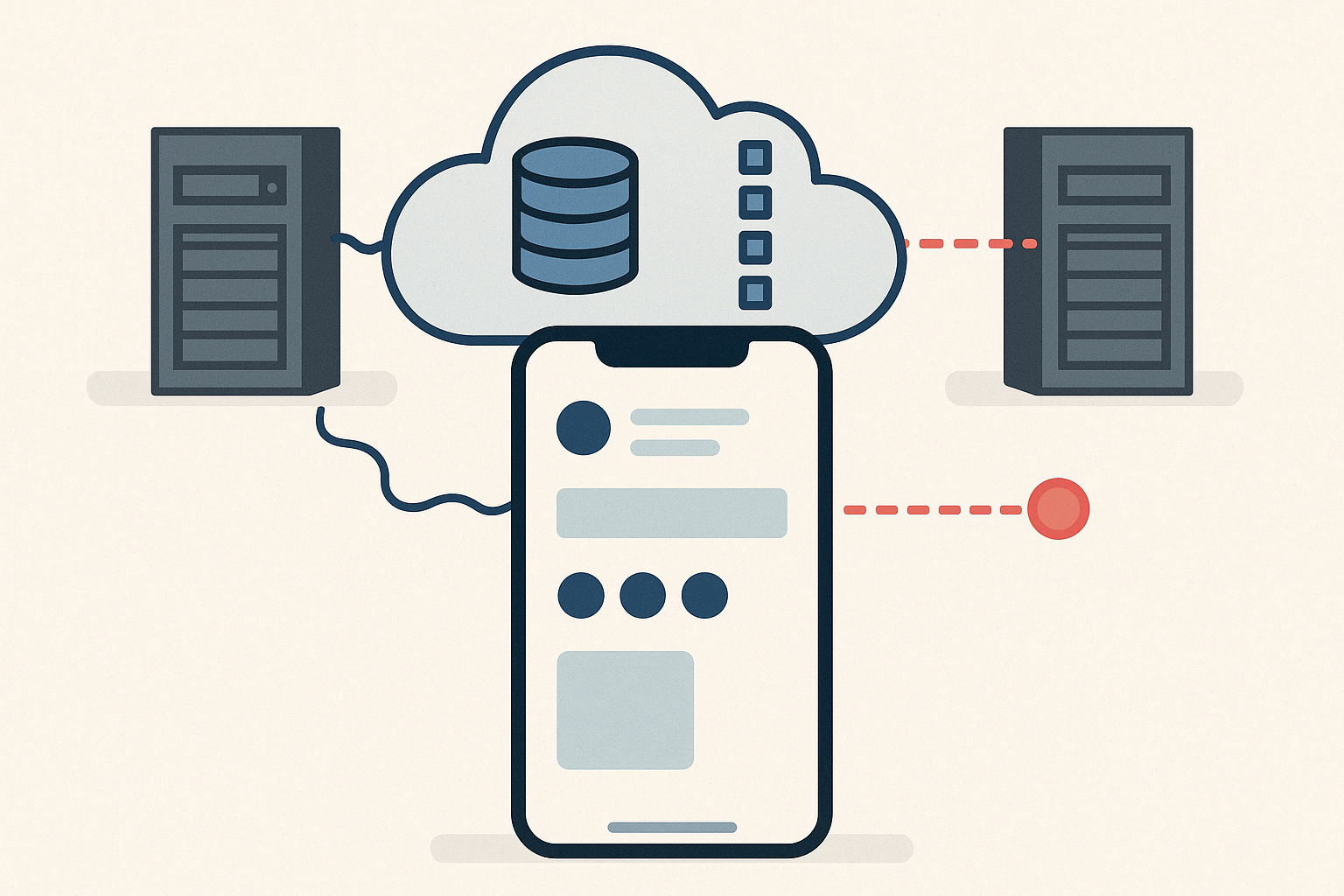
The transition from a mobile MVP to a product for wider deployment is not a simple expansion of existing functionality. An MVP generally proves that a defined user action works. A scalable mobile product must also remain usable and manageable under changing conditions. The strategic boundary therefore lies in non-functional validation: the question shifts from “does the feature work?” to “does the service remain reliable as usage, data flows and dependencies increase?”
This shift affects both architecture and process. In an app connected to complex legacy backends, such as on-premise ERP or CRM systems, overall stability is determined by the least stable link. A mobile user interface may function well technically yet still become unpredictable when an underlying system responds slowly or is temporarily unavailable. In that situation, the transition to wider rollout requires a deliberately isolating layer between the app and underlying systems, with Redis caching and asynchronous queues. This does not remove the dependency, but it prevents every delay from immediately affecting the mobile experience.
Where data is processed is also a strategic choice. Heavy local processing and offline storage can make the app more resilient during network disruptions. On the other hand, migrations and synchronisation of local state become more complex. With centralisation in the backend, the app remains lighter, but dependency on connectivity increases. Both approaches can fit; the choice should follow from the actual working environment and the consequences of temporarily having no connection.
For executives and product owners, this means that scalability is not solely a capacity question. It is a choice about which disruptions are acceptable, where recovery takes place and which dependencies must be under control before the user base grows. An iterative approach only reduces risk when each subsequent rollout stage also produces evidence about reliability and performance, not only about new screens or processes.
The ISO/IEC 25010 software quality model provides a useful quality framework for this. It helps move assessment beyond an isolated demo or acceptance session and focus it on product characteristics that determine whether the mobile application can support a longer-term operational role. The boundary for wider rollout therefore lies where the chosen architecture and release process demonstrably fit the most vulnerable integration and the expected conditions of use.
Sources for this section: sonarsource.com
Why feature acceptance is not enough for scalability
Feature acceptance confirms that users can perform an intended action within the tested situation. That is valuable for an MVP, but it does not yet prove that the same action remains reliable under wider adoption. Hidden quality issues arise precisely when conditions change: users are no longer working solely on fast office Wi-Fi, network latency increases, and responses from underlying systems take longer to return.
A recognisable risk arises when a mobile client aggressively and synchronously attempts to reconnect after slow responses, without exponential back-off. What is barely noticeable during a limited acceptance test can grow into a retry storm among a larger user group. The backend then receives additional load at the moment it is already responding slowly. The consequences extend to the app: the user interface may freeze, with Android ANR messages or hang crashes on iOS as possible outcomes. The feature may have been accepted in functional terms, but it is not operationally suitable for a wider group.
This distinction explains why non-functional validation needs its own place alongside feature acceptance. The assessment is not only about the correct outcome of a process, but also about behaviour during delay, temporary disruption and increasing concurrency. Without this separate test, an organisation remains dependent on the limited conditions under which the MVP was assessed.
The tension often lies in the release approach. Formal automated checks in CI/CD, device testing and security scans require more process discipline than a quick, unvalidated ad hoc deployment. However, that additional discipline is not an administrative addition to the MVP. It creates a control point between a successful demonstration and a release whose stability can demonstrably be monitored under production conditions.
For a management team, this is primarily a distinction between product acceptance and rollout risk. A positive assessment of functionality is a reason to investigate further; it is not, in itself, evidence that the app can handle a greater load, less ideal connections and the consequences of its own error handling. Release readiness begins where these hidden dependencies have been made explicit and are being controlled.
Sources for this section: android.com
When is it time to decide on scalability?
The right time to decide on scalability is before a larger user group becomes dependent on the mobile app for daily operations. That decision becomes concrete as soon as the intended deployment environment has different conditions from the controlled MVP environment. An application for an office process, for example, has a different risk profile from one used by employees in field service or in a warehouse. In the latter context, network handovers and dead zones are part of the normal working situation, not exceptional test cases.
When frequent connection changes or connection loss are expected, assumptions about a continuously available synchronous client-server connection fail. The scalability decision is then not primarily about adding more users, but about whether the process can continue when the connection is temporarily unavailable. An offline-first architecture with persistent storage and conflict resolution is a requirement in this circumstance. Without these properties, operational readiness is limited by current network availability.
Operational readiness also requires a verifiable basis for quality and security. Demonstrable assessment against the ISO/IEC 25010 software quality model and the OWASP Mobile Application Security Verification Standard (MASVS) makes the evaluation less dependent on impressions from a demo. These frameworks provide guidance for explicitly weighing product quality and mobile security before broadening the rollout.
This creates a clear sequence. First, determine where and under what conditions users will work. Next, assess whether the chosen mobile architecture supports those conditions, including the temporary absence of a network connection. Only then can the organisation treat the wider release as operationally responsible. This prevents scalability from being linked solely to growth expectations while the actual working environment sets a different technical and procedural boundary.
The decision therefore does not need to wait until problems occur. It should be on the table as soon as use shifts from limited validation to a process in which interruption, lost input or insecure data processing has direct consequences for execution. In mobile environments with dead zones, a broad rollout without appropriate offline provisions is not a growth step, but an expansion of that operational exposure.
Sources for this section: sonarsource.com, owasp.org
Key evaluation criteria for scalability
Release readiness becomes stronger when criteria are established in advance rather than filled in only after an incident. The table below distinguishes measurable stability from the organisational safeguards around a wider release. The stated crash and ANR values are production metrics for mobile stability; they do not replace an assessment of the organisation's own usage context, but they do reveal whether a release remains below a specific quality threshold.
| Evaluation criterion | What evidence is appropriate? | Meaning for wider rollout |
|---|---|---|
| Crash-free sessions | A stability measurement of at least 99.5% crash-free sessions, with a target above 99.9%. | This shows the proportion of usage sessions that proceed without a crash. The higher target makes clear that “just sufficient” is not the same as a comfortable margin for growth. |
| User-perceived crashes | A user-perceived crash rate that remains strictly below 1.09%. | This criterion focuses the assessment on errors users actually experience, rather than solely on technical error messages without noticeable impact. |
| User-perceived freezes | A user-perceived ANR rate below 0.47%. | An ANR indicates that the app is unresponsive to the user. This criterion makes responsiveness part of the release assessment, alongside whether features are formally available. |
| Telemetry and monitoring | Telemetry and dashboards configured in advance in Google Play Vitals, Apple MetricKit or Sentry. | The organisation can monitor signals after rollout instead of relying solely on user reports. The value lies in visibility configured in advance, not in collecting isolated incidents afterwards. |
| Phased rollout and rollback capability | Documented schedules for staged rollout and rollback protocols. | A wider rollout can take place in a controlled manner when it is clear how distribution will be increased and what happens if stability signals deteriorate. |
Sources for this section: android.com
A structured framework for scalability evaluation
A useful evaluation framework starts with the data flow that the MVP processes today and tests what happens as that flow grows along with the database. The point below makes visible the chain from an apparently minor API choice to the loss of operational input on a mobile device.
- Assess payload growth as part of release readiness. Start with the question of whether MVP API endpoints return unpaginated payloads that grow as the database grows. In the initial phase, this can remain hidden: the dataset is limited, the test user works on a powerful device and the response appears fast enough. With wider deployment, however, the same mobile client may need to process megabytes of JSON, including on budget hardware. This shifts the assessment from “does the response return?” to “can the device process this data without interrupting the active work session?” Relevant non-functional validation follows the full chain. Growing payloads increase the amount of parsing in the mobile client. This leads to higher memory use. When this use exceeds operating system limits, the Low Memory Killer can force the app to close. The direct business consequence is not merely a technical crash: the user may lose local session state and stop entering operational data. This pattern makes clear why a scalability evaluation must not stop at an average response time or a successful API response. The test must determine whether the chosen data format still fits, under growth, the devices on which the app is actually used. Realistic load and stress testing of mobile API backends provides a basis for examining that growth under peak load. The outcome is only useful for a release decision when it is connected to the behaviour of the mobile client: how much data is received, processed and retained before the user completes their process? In this way, non-functional validation is linked to a concrete risk to work progress rather than an abstract performance assessment.
Sources for this section: grafana.com
Frequently asked questions about scalability and validation
The most common doubt is not about the value of stability, but about the point at which allocating time to non-functional foundations is justified. The trade-off becomes clearer when the delay in development is weighed against the likelihood of rebuilding.
- “Does focusing on scalability not slow down the introduction of new features?” That may be the case. Building new features directly accelerates commercial validation in the short term. Establishing non-functional foundations, including offline synchronisation, idempotency and observability, can slow initial feature velocity by 30% to 50% according to this trade-off. This percentage is not a general standard for every mobile product, but an indication of the tension between delivering quickly and building architectural resilience. The right question is therefore not whether that delay exists, but what risk the organisation accepts if the same foundations later prove necessary after all. When the application becomes dependent on stable mobile processing, giving early attention to these properties avoids a rebuild that only becomes necessary after processes and users already rely on the app. Non-functional validation therefore changes the discussion from an abstract preference for technical quality into an explicit choice about sequence: first test commercially on a limited scale with a smaller functional scope, or first establish a foundation that makes further rollout less dependent on later interventions. The OWASP Mobile Application Security Verification Standard (MASVS) also provides a framework for security requirements around mobile apps, API interactions and data storage. This underlines that release readiness is not determined solely by visible features or speed. A product may be functionally attractive and yet still be insufficiently substantiated for a larger group when its underlying properties have not been validated.
Sources for this section: owasp.org
Key insights and decision rules for scalability
A decision on wider rollout becomes more convincing when it is supported by evidence that an independent reviewer can examine. For load behaviour, this means more than stating that a test has been carried out. A report must show which load was simulated, how the service responded in higher percentiles and where the technical limit became visible.
- Treat a load report as a condition for a rollout decision, not as an attachment afterwards. Transparent load and stress test reports include, for example, k6 metrics with P95 and P99 response-time distributions, concurrency limits and database bottlenecks. This makes visible how the backend behaves beyond an average situation: the higher percentiles show the experience of slower requests, while concurrency limits indicate where simultaneous usage puts pressure on available capacity. The test load should also exceed the expected peak. A range of 1.5 to 2 times the expected peak load is a proposed test margin here, not a general external standard. The value of this margin lies in exposing reserves and bottlenecks before the user group is expanded. The decision rule is practical: if a detailed report with these distributions, limits and identified database bottlenecks is absent, then the evidence to link expected peak load to actual capacity is also absent. If the results are available, the organisation can connect the scale and phasing of the rollout to demonstrable limits rather than optimistic assumptions. This reduces the risk that growth reveals only after go-live that delays are accumulating. In a mobile application, this can directly result in interrupted processes, additional recovery work and financial consequences from a release that generates more demand than the underlying service can handle.
Sources for this section: grafana.com
