

Laravel can serve as a reliable integration layer between mobile apps and legacy systems by creating a clear separation between mobile interfaces and existing business logic. It provides domain isolation and data validation, making the mobile app less vulnerable to changes in the legacy system. However, this requires a thorough pre-project discovery audit and a well-considered architecture using asynchronous processing and modern authentication methods.
Laravel as an integration layer for legacy systems
When building a Laravel backend for mobile apps that need to integrate with legacy systems, it is crucial to minimize risks and ensure the stability of business operations. This article provides a checklist for discovering integration requirements and avoiding common mistakes.
- Identify and document all CRUD operations, triggers, and exceptions of the legacy system before development begins.
- Use asynchronous processing and idempotent transactions to prevent performance failures and duplicate postings.
- Implement modern token authentication to ensure secure access without exposing internal networks.
- Conduct stress tests using representative production data to identify hidden dependencies and performance issues.
Why use Laravel as an integration layer for mobile apps with legacy systems?
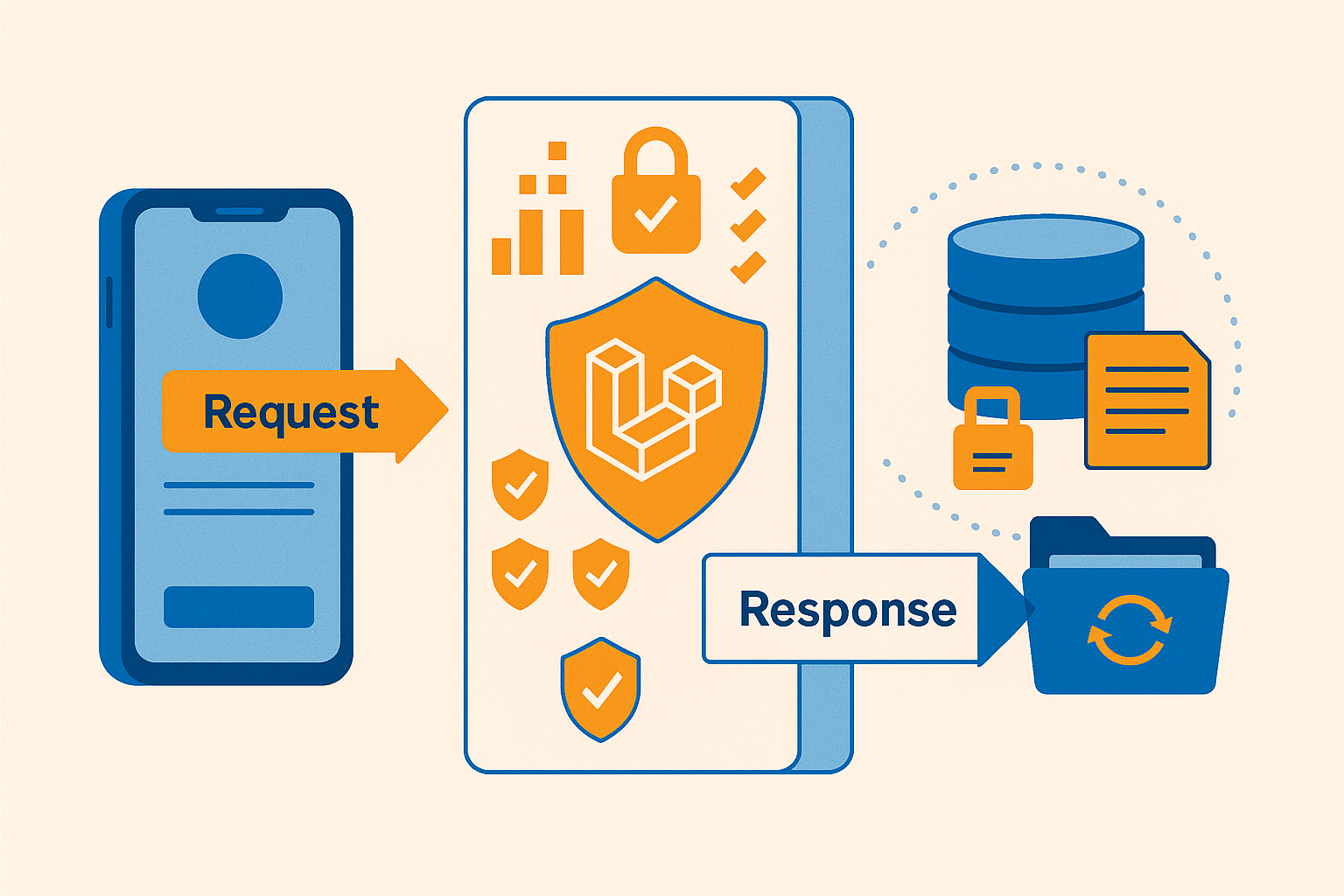
A mobile app places different demands on a business landscape than an existing legacy system can typically meet. The app expects a clear, predictable interface, while the legacy domain has often been shaped around existing database operations, batch files, and exceptions that have evolved in day-to-day operations. Laravel can form a targeted integration layer between both environments: mobile requests arrive at a controlled point, where filtering, token validation, and domain checks can take place before an existing system is accessed.
The business value lies not in simply adding an API, but in separating responsibilities. The mobile app does not need to know how legacy tables are structured or which internal exceptions apply. Laravel can define the external contract and validate data before it reaches the legacy domain. As a result, the app is less directly affected when internal structures change. This domain isolation creates room to develop mobile functionality without treating the internal representation of business data as a fixed contract.
This boundary only works when the existing access methods are first clearly established. Some legacy systems offer no usable interface and can only be accessed through direct database access or batch files, such as CSV files via SFTP. In that situation, the integration layer requires strict change data capture and locking mechanisms. Without these conditions, there is a risk that mobile changes and existing processes affect each other in a way that is not visible from the app. Laravel is then not a replacement for the legacy system, but a controlled access point that takes its limitations into account.
The scope begins before the first sprint. As an internal guideline, a discovery audit should map at least 95% of the CRUD operations, database triggers, and exception states used by the legacy domain. That percentage is not an external standard, but a practical threshold for project preparation: otherwise, unknown operations or states may only become visible once the mobile app already depends on the integration. By linking this inventory to the Laravel layer, an explicit overview is created of which data and actions can safely be offered as a mobile contract.
Laravel is therefore particularly suitable when an organization wants to establish a protective boundary between a mobile interface and an existing domain that was not designed for that interface. The choice does require sufficient insight into the access route, changes, and exceptions; with database-only or batch-only access, change data capture and locking directly determine the scope for a stable integration.
Sources for this section: laravel.com
Risks of missed checks in legacy integration
In legacy integration, authentication can sometimes appear to be a discrete technical component, while in reality it determines which mobile user acts on behalf of which existing identity domain. A missed check at the start of the project may therefore only become apparent later as an unstable mobile experience, unclear access rights, or an integration that does not align with the existing user administration. The risk lies not only in an invalid login attempt, but in an incorrect assumption about where identity, tokens, and authorization are managed.
When an organization uses a central Identity Provider, such as Entra ID or Keycloak, Laravel's intended role differs from the situation with a closed legacy user store. In the first case, Laravel acts as a Resource Server with Sanctum token translation. In the second case, a custom Auth Provider is needed. If this context is not checked before development, a mobile app may be based on an authentication model that does not connect to the actual source of user data. During implementation, this creates dependency on choices in the legacy system that were not previously visible.
The lifecycle of mobile tokens also requires explicit assessment. Mobile token authentication through Laravel Sanctum includes token expiration and the ability to revoke tokens immediately. These properties are relevant when access must no longer be valid while a mobile device is still using a previously issued token. If attention is paid only to issuing a token and not to expiration and revocation, it remains unclear how a change in access affects the mobile app. This increases the likelihood that the app displays a status or attempts an action based on access that should no longer apply.
The stability of the mobile app is related here to predictability. The app needs a consistent response when a token has expired, is revoked, or does not match the available identity source. With a missing discovery check, this uncertainty shifts to the build and testing phase, where it presents itself as inconsistent behavior between mobile users and existing business processes. The pre-project question is therefore not only whether authentication is present, but which identity is authoritative, how Laravel fits into it, and what happens when access immediately expires.
Sources for this section: laravel.com
Essential verifications for stable integration
Stability begins with distinguishing the types of actions a mobile app sends to the legacy domain. Not every change has the same consequences. Real-time financial transactions and inventory transactions require synchronous two-way validation through Laravel middleware with distributed locking. In that case, the mobile action and the response from the existing domain belong together directly, because otherwise the app cannot display a reliable confirmation of the transaction. Status registrations have a different nature: an eventual consistency model through queues may be sufficient for them.
This classification is a verification point before development, not a detail that can only be defined during implementation. For each mobile function, it must be clear whether the user expects immediate confirmation or whether later processing is acceptable. Without that distinction, a status action may be unnecessarily treated as a direct transaction, or a financial or inventory change may be offered without the required two-way validation. In both cases, mobile behavior no longer aligns with the meaning of the business action.
In addition, the authentication model requires a separate fit check. Lightweight token authentication through Laravel Sanctum has minimal overhead and can be deployed quickly for first-party apps. A full OAuth2 server with Laravel Passport is more broadly interoperable for third parties, but introduces additional management complexity. The relevant question is therefore whether the mobile app is an internal, first-party channel or whether third-party integrations justify interoperability. The choice is not solely a security question; it also determines the management burden around the integration layer.
Finally, the form of data exchange should be checked. A data transformation layer can isolate internal data models from clean JSON responses for mobile clients. This prevents the mobile contract from mirroring the internal representation of data without an intermediary layer. The verification focuses on which fields and structures the mobile app actually needs, and which internal details remain outside that contract. This makes transaction type, access model, and data representation separate, testable parts of the same integration.
Sources for this section: laravel.com
Checklist for pre-project legacy discovery
Use this check to make the performance boundary between the mobile app and legacy database explicit in advance. The values mentioned are an internal guideline for the integration layer, not a general external performance standard.
- Assess the response time of read operations separately from the legacy database. For each mobile GET request, map which data the app needs, which data comes from the legacy domain, and how long the underlying database requires for this. When that database requires 1500 to 3000 ms, this is far above the intended handling time of 100 to 250 ms for GET requests in the Laravel integration layer. Discovery should therefore establish whether caching and aggregation can bridge the gap. Caching prevents every mobile read request from being directly dependent on the slow source again. Aggregation then determines which data is combined in a single mobile response, so the app does not create a separate dependency for every component. This check also has an architectural function: the Laravel layer can act as a translation layer to prevent the mobile client from being directly shaped by outdated data models. The mobile interface is thus given its own purposeful contract, while the existing structure remains on the other side of the boundary. The outcome is not a promise that every read action will meet the guideline. It makes visible for which GET requests that objective is realistic, where legacy response time determines the boundary, and which caching or aggregation choice is needed before the mobile app is designed around it.
Sources for this section: microsoft.com
Avoiding common mistakes in legacy integration
The check below focuses on one mistake that can have immediate consequences in mobile connections to existing business processes: processing the same change again after the network connection has been interrupted.
- Do not allow a data-changing mobile request without an idempotency key. POST, PUT, and PATCH requests change data and therefore require a recognizable key that allows a repeated request to be identified as the same action. A mobile app may resend a request after a network interruption while the first processing has already reached the legacy domain. Without this check, there is a risk that one intended action is performed twice, for example as a duplicate posting. The internal guideline is that 100% of data-changing requests from mobile devices contain an idempotency key with a Time-To-Live of at least 24 hours. That period makes repetitions within that window recognizable as the same change. This point belongs in discovery because the meaning of the ‘same’ action must align in advance with the business action initiated by the mobile app. A mobile backend specifically aligned with the client interface can enforce this boundary before repeated requests propagate to the existing domain. The operational limitation remains concrete: without an idempotency key with a minimum 24-hour Time-To-Live, a network interruption can result in duplicate postings.
Sources for this section: microsoft.com
Frequently asked questions about legacy integration with Laravel
The choice between direct database access and a Laravel layer is primarily a trade-off between a quick start and the consequences of long-term dependency.
- Why not connect directly from the mobile app to legacy tables if that initially seems faster?
A direct database connection can shorten the first step because it appears to require less initial modeling. However, that time savings says little about the durability of the mobile integration. The mobile app then becomes dependent on the existing table structure and the way the legacy domain internally represents data. This creates extreme vulnerability when schemas change: an internal change can directly affect an interface already in use on mobile devices. The app and the legacy system effectively share the same data contract, even though they were built for different purposes.
What does Laravel API middleware add then?
Laravel API middleware requires more initial modeling because it must first be clear which data and actions are actually made available as an external mobile contract. In return, it provides domain isolation. The mobile app communicates with the integration layer rather than the legacy tables themselves. As a result, the layer can validate data before it reaches the existing domain, and the app is less coupled to internal schemas. The investment is therefore not in additional abstraction for its own sake, but in making the boundary between mobile use and existing business logic explicit.
Does that choice mean direct integration is never appropriate?
The trade-off in this context mainly shows that a direct connection offers a faster initial start, while vulnerability to schema changes is very high. Laravel API middleware requires more modeling upfront, but provides domain isolation and data validation. For an organization that wants to grow mobile functionality alongside an existing legacy domain, the assessment therefore shifts from lead time alone to the question of which component bears the consequences of internal schema changes: the mobile app itself or a separate integration layer.
Sources for this section: laravel.com
Key considerations when choosing Laravel for legacy integration
The choice of Laravel as an integration layer ultimately becomes visible in one operational design decision: when does the mobile user receive direct confirmation, and when does that user receive a status that changes later?
- Assess synchronous and asynchronous processing based on the meaning of mobile confirmation. Synchronous processing provides direct confirmation from the legacy platform. This suits situations in which the mobile app can proceed only after the existing domain has confirmed the action. The downside is that the mobile app becomes vulnerable to timeouts: the availability of the user experience then directly depends on the response time of the legacy platform. This dependency may weigh more heavily in an existing business landscape than the desire to show an immediate final outcome.
Asynchronous queues through Laravel Horizon place the emphasis differently. They ensure high availability, but require status mechanisms in the mobile user interface. In this variant, the app cannot pretend that processing is already final when it is still in the queue or still needs to be processed by the legacy platform. The mobile user therefore needs a recognizable status that indicates the difference between received, processing, and confirmed. This is not a cosmetic addition; without that status, a discrepancy arises between what the app suggests and what the existing domain has actually processed.
This leads to a clear boundary for project assessment. Direct confirmation is a deliberate choice to depend on legacy response time. High availability through asynchronous processing is a deliberate choice for a mobile interface that can handle intermediate statuses. Laravel provides room for both approaches, but the business action determines which approach is defensible. When a mobile action cannot support a status mechanism in the interface, asynchronous processing remains operationally limited; when the legacy platform cannot provide a timely response, synchronous processing makes the mobile app vulnerable to timeouts.
Sources for this section: laravel.com
