

A phased approach to secure mobile app development without loss of control requires server-side authorization and data storage in native vaults to be implemented from day one. Complex client hardening can be postponed, provided robust backend controls such as rate limiting are active.
Phased Security in Mobile App Development
When planning a phased mobile app release, it is essential to find a balance between speed and security. This article provides insight into how organizations can achieve a Minimum Viable Secure Release (MVSR) without compromising security.
- Ensure server-side authorization and input validation provide a hard security boundary.
- Implement secure storage of tokens and personal data in native vaults from the first release.
- Phase complex client hardening, but ensure strong backend controls such as rate limiting.
- Use proven framework components to accelerate delivery and reduce vulnerabilities.
Security by Design as the Foundation for Secure Mobile App Development
For a custom mobile app, security by design means that security choices are part of the initial release scope, rather than a review layer just before publication. This shifts the central question from “what can we still fix later?” to “which protection is inseparable from this first function and this data?”. This scoping prevents a team from first building a working user flow and only then discovering that storage, access, or auditability must be redesigned. Rework arises precisely when security is added only after data flows, sessions, and screen behavior have already been established.
The classification of business and personal data determines how much room there is for phasing. For healthcare or financial applications, full encryption at rest and audit logging belong in the release from day one. In that case, these measures are not enhancements for a later version, but prerequisites for permissible processing. For an internal task logging app, advanced protection against app tampering can, by contrast, be scheduled for a subsequent phase. The difference is not the desire to deliver faster, but the nature of the data and the risk introduced by the first release.
For maintaining control under time pressure, a predefined baseline works only when it is tested repeatedly. Automated CI/CD security pipelines with Static Application Security Testing (SAST) and dependency checks (SCA) make security control part of every release. This allows a team to continue development without known issues quietly returning to the minimum baseline. It also provides a concrete basis for discussion between product owners and technical teams: a release is not only functionally ready, but must pass the documented controls.
Phasing becomes unsafe when deferral remains unbounded. Missing controls such as rate limiting or session inactivity time-outs cannot simply be placed on a later wish list. If a control is temporarily absent, this requires a server-side mitigating measure, a formally assigned owner, and a binding remediation date. Without these three elements, a temporary choice becomes an unknown operational risk. Security by design therefore primarily provides governability: the organization makes visible in advance what may go into production, what will follow later, and which protection covers the interim period.
Sources for this section: nist.gov, cisecurity.org
The Tension Between Speed and Control in Mobile App Launches
The pressure to launch quickly often arises from a concrete business need: a new mobile way of working must become available, while the organization also wants to retain control over data access and compliance with requirements. With mobile software, this tension is sharper than in an internal environment entirely under the organization’s own control. The client runs on end-user devices. As a result, binary code and locally stored data can be inspected or examined through reverse engineering. The mobile client is therefore not a trusted place to rely on for protection alone.
A Minimum Viable Secure Release makes this reality manageable. The principle is not that every conceivable layer of defense must already be present in the first version. However, an immediately enforceable minimum threshold is needed for the function that is actually released. When that threshold is determined only during the final testing week, there is a risk that functionality and security will obstruct each other. A plan that distinguishes release conditions from later enhancements from the outset prevents speed from being bought through unmanaged exposure.
The handling of tokens and sessions shows why compliance and speed cannot be planned separately. Secret tokens and session keys belong exclusively in native platform vaults: iOS Keychain and Android Keystore. Combined with a short token lifetime through Laravel Sanctum, this limits exposure when a device is lost or affected by malware. A fast initial release that treats such secrets as ordinary local data creates a risk that cannot be resolved by an extra screen later or a subsequent functional iteration.
The choice between existing components and building from scratch also affects lead time. Proven first-party libraries, such as Laravel Sanctum or Passport, can accelerate delivery and reduce the likelihood of vulnerabilities compared with proprietary cryptographic or authentication logic. This is not an argument for blindly trusting a framework. It is, however, a reason to include the available Laravel components in the scope of the first release, so the team does not have to improvise its own security mechanism under deadline pressure.
Sources for this section: owasp.org, cisecurity.org
When Is a Phased Mobile App Release Appropriate?
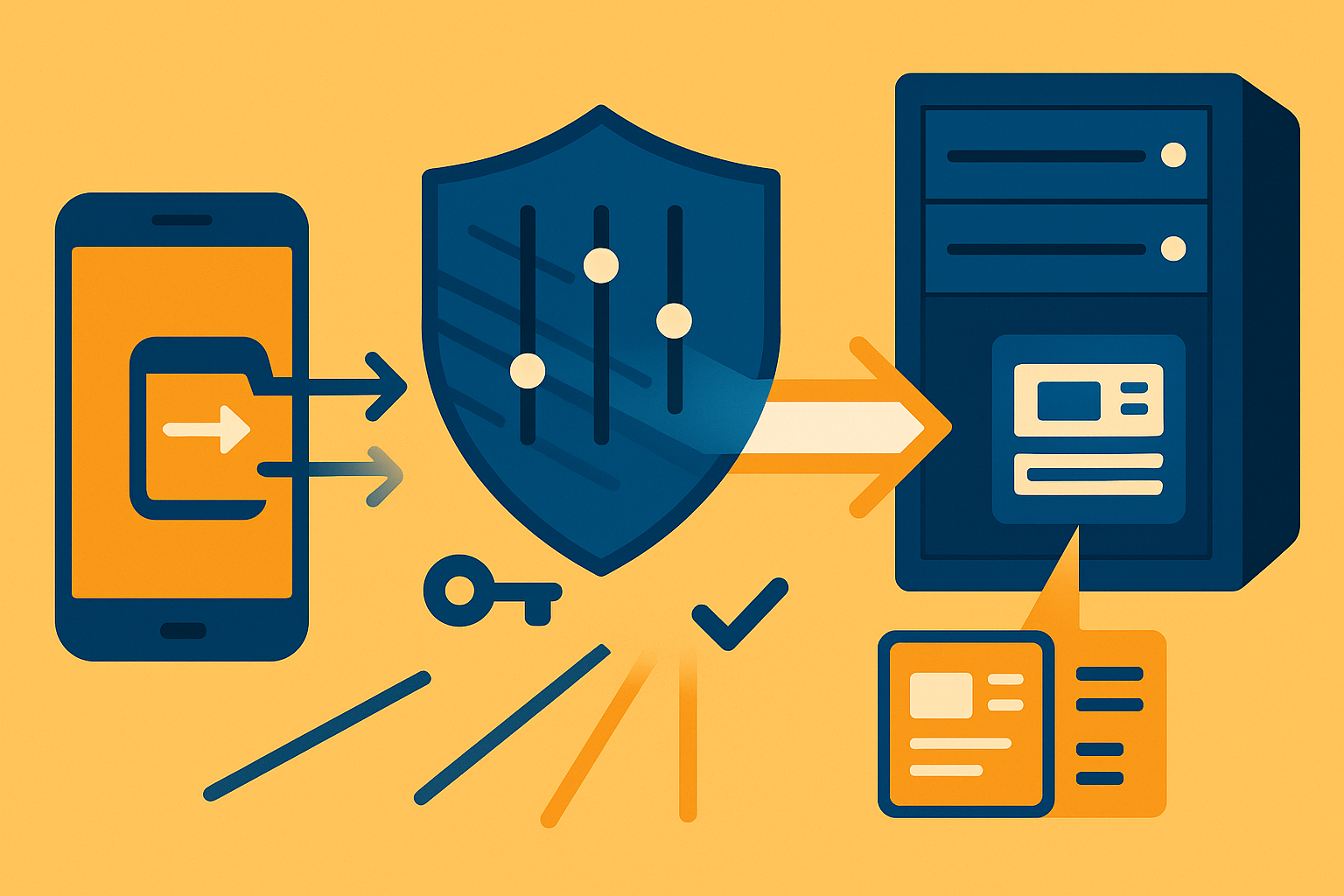
A phased release is appropriate when an organization wants to use the first business function already, but cannot responsibly complete additional protection or complexity within the same delivery. The condition is that the first phase remains manageable on its own. This means that the mobile client does not directly expose a legacy ERP database and that the released function does not depend on unproven assumptions about authorization or data processing. Phasing is therefore not a disguised route to skip controls, but a way to make the boundary of the first production version smaller and controllable.
A dedicated Backend-for-Frontend (BFF) in Laravel can support that boundary. The BFF then forms the layer between the mobile app and the existing ERP environment. With strict token abilities and DTO validation, the organization can determine for each phase which client functionality receives access to which server-side capabilities. The mobile app therefore does not need to know all existing data or processes immediately. New screens and functions can subsequently be added without taking direct access from the client to the legacy database as the starting point.
This setup is particularly useful when the first release deliberately remains limited to a defined mobile task, while the underlying environment is broader and older. The team can then expand the available client functionality in steps, within the rules enforced by the BFF. The technical architecture thus supports the product choice not to release everything at once. Control does not lie in the number of phases, but in whether each phase has clear, separately bounded access.
The opposite risk is the All-or-Nothing syndrome. In this case, demanding requirements around advanced RASP and obfuscation techniques are treated as a prerequisite for the full application. This can bring the project to a standstill, after which management still forces a last-minute go-live. It is precisely then that basic measures such as token expiration and data encryption may disappear. A phased approach breaks this dynamic by making fundamental protection non-negotiable and postponing advanced client protection only when the first phase is adequately bounded through the backend.
Transparency also remains part of the decision after release. A Software Bill of Materials (SBOM), automated dependency management, and clear SLAs for patching zero-day vulnerabilities within 48 hours make visible which dependencies are in use and how an urgent fix will be handled. This gives management an operational reference point alongside the initial release plan: not only what goes live now, but also how the application remains managed afterward.
Sources for this section: owasp.org
Key Evaluation Criteria for a Secure Mobile App Release
Under time pressure, formal criteria provide more guidance for a release decision than a general assessment that the app has been “tested sufficiently.” The criteria below distinguish minimum protection from additional layers of defense and establish how the app is technically assessed before release.
| Evaluation criterion | What the criterion determines | Implication for the first release |
|---|---|---|
| Mobile security baseline | MASVS-L1 defines the non-negotiable baseline for storage, communication, and authentication. | The release is not assessed on functional completion alone. The controls for these three domains form the minimum threshold. This enables a team to determine specifically which outstanding tasks block release and which tasks do not belong to that baseline. |
| Elevated risk profile | MASVS-L2 provides additional defense in depth for apps with an elevated risk profile. | This criterion prevents additional protection from automatically being treated as a condition for every first release without a risk assessment. At the same time, it prevents the opposite error: assessing an app with an elevated profile as though the L1 baseline provides sufficient context. |
| Formal assessment before release | The assessment includes binary analysis, network inspection, and vulnerability assessment. | The review focuses on the mobile application that will actually be distributed and its behavior during communication, not solely on an assessment of source code or design documentation. This gives the release a test point for the form in which users receive the app. |
| Pass/fail threshold | The formal evaluation uses strict pass/fail criteria. | The decision requires explicit outcomes. A finding therefore cannot remain an unclear residual item between product, technology, and operations. The organization can establish in advance which results are required before the app becomes available. |
Sources for this section: owasp.org, nist.gov
A Structured Framework for Phased Mobile App Releases
Use the sequence below to build the first production version from the actual trust boundary. The framework does not start with the app’s screens, but with what the server does and does not accept. This keeps the mobile client and the Laravel backend in their proper places within the security design.
- 1. Establish the server-side trust boundary. Define which authorization is enforced on the server for each mobile action. Explicit Laravel Policies determine whether an action is allowed; Form Requests validate the submitted data. These are controls performed by the backend, even when a request does not come through the intended user interface. This links authorization to the API request actually received, rather than to what a screen in the app does or does not hide.
- 2. Treat client validation as user support, not access control. Validation in the mobile interface can be useful for usability, but it does not form a reliable protection boundary. An attacker can bypass that interface by making direct API requests. Therefore, plan the first phase around server-side Policies and Form Requests. A screen that does not display an action is not evidence that the backend also rejects that action.
- 3. Exclude the pattern in which the client acts as a vault. Make explicit that sensitive API tokens and unencrypted personal data do not belong in local SharedPreferences or in source code. This pattern relies on the incorrect assumption that a mobile binary is inaccessible. Include this exclusion as a hard release condition: what is placed on the device cannot be considered hidden merely because it is packaged in the application.
- 4. Link each phase to a smaller server-side attack surface. In a subsequent phase, add only the mobile actions for which authorization and input validation have already been established. The plan is then not based on an arbitrary division into versions, but on the verifiable expansion of permitted actions. This keeps clear which API requests the current client may perform and which still fall outside the release boundary.
- 5. Assess changes at the boundary between client and backend. A new mobile function is suitable for release only when the corresponding server-side rules and validation are present and the function does not introduce sensitive data or tokens into an unprotected local location. This assessment makes the handover between mobile development and Laravel architecture concrete, without relying on assumptions about the client.
Sources for this section: owasp.org, nist.gov, cisecurity.org
Frequently Asked Questions About Phased Mobile App Releases
Questions about phasing generally concern not the value of a next version, but the boundary within which deferral remains responsible. The answers below distinguish between reducing delivery scope and reducing protection for what already enters production.
- “If the deadline is fixed, can we temporarily reduce security?” Under time pressure, the functional scope can be reduced: fewer screens and fewer API routes in the first release. However, the security of the API routes that are delivered remains part of the first phase. Fast market validation is then achieved by making less functionality available, not by publishing a route with less protection. This keeps the relationship between what the app can do and what the backend protects clear.
- “Does every form of client-side hardening have to be ready before day one?” Not every advanced form of client resilience necessarily needs to fall within the first phase. Active root detection or certificate pinning can be deferred when the backend API enforces strict rate limiting, payload validation, and short token lifetimes in the interim. These server-side measures are then not a replacement for a planned later improvement, but the boundary that makes the first version viable.
- “Does deferral mean the risk disappears as long as the function remains limited?” No. Deferral is only defensible within the stated backend controls. Rate limiting limits the scope for repeated requests, payload validation assesses what the API receives, and a short token lifetime limits the time during which a token can be used. The choice therefore remains dependent on the specific route, the data it processes, and the server-side protection demonstrably active.
- “Doesn’t a first release become too small for useful validation?” A limited initial scope can be a useful boundary precisely when it includes the desired mobile task and contains only a smaller number of screens and API routes. The discussion then shifts from an unrealistic full launch to which specific actions are valuable now and fit within the available security boundary. Further client-side hardening and additional functionality are subsequently given their own place in the plan.
Sources for this section: owasp.org, cisa.gov, cisecurity.org
Key Lessons for Secure Mobile App Releases
The quality of a phased release decision is reflected in the artifacts the organization can provide before production. They make the difference between a plan based on assumptions and a release whose protection, outstanding work, and verification can be traced.
- Make the minimum baseline traceable. In a detailed Security Traceability Matrix, document for each OWASP MASVS-L1 requirement which client-side and server-side measure has been applied in the Laravel architecture. This creates a direct trace between the required control and the selected implementation. It makes visible to management and technical reviewers which measures are actually part of the first release, rather than merely being described as a general security intention.
- Use the matrix for ownership and changes as well. A traceable overview shows where a measure is assigned: on the client side, on the server side, or both. For a new release or modified mobile function, the team can then specifically assess which MASVS-L1 requirements are affected again. This supports control over the iterative approach, because changes are not assessed solely on their functional effect.
- Complete the production launch with independent verification. An independent penetration test report with formal retest attestation provides evidence that discovered High and Critical vulnerabilities have demonstrably been remediated before production launch. This concerns not only the initial findings, but specifically the determination after remediation. This ensures a correction does not remain an unconfirmed commitment in the final phase of the project.
- Apply a hard financial and operational threshold. A release in which High or Critical vulnerabilities remain open without formal retest attestation shifts uncertainty to the production phase. The organization then cannot substantiate the cost of remediation, potential disruption, and consequences for confidential data as an acceptable residual risk. The concrete launch threshold therefore remains: no production version as long as that demonstrable retest is missing.
Sources for this section: owasp.org, nist.gov, nist.gov
