

Connecting legacy systems with a modern web portal can reduce manual work and improve processes, but only when the integration is deep and data quality is high. Direct connections such as REST/RPC can eliminate status enquiries, whereas batch exchanges such as FTP/CSV still require reconciliation. Without good data quality, manual work shifts to troubleshooting.
Evaluating legacy-to-web integration
Integrating legacy systems with modern web portals offers opportunities for process improvement, but requires careful evaluation of integration depth and data quality.
- A direct integration can eliminate status enquiries, whereas batch exchanges still require reconciliation.
- Strict validation in the web portal can expose polluted master data, leading to order failures.
- A successful integration requires data to be immediately usable within the existing ERP structure.
- The absence of an integrated exception workflow can lead to manual troubleshooting.
- A phased approach with a Laravel adapter layer can reduce costs, but retains technical debt.
When is a Laravel adapter layer useful for legacy integration?
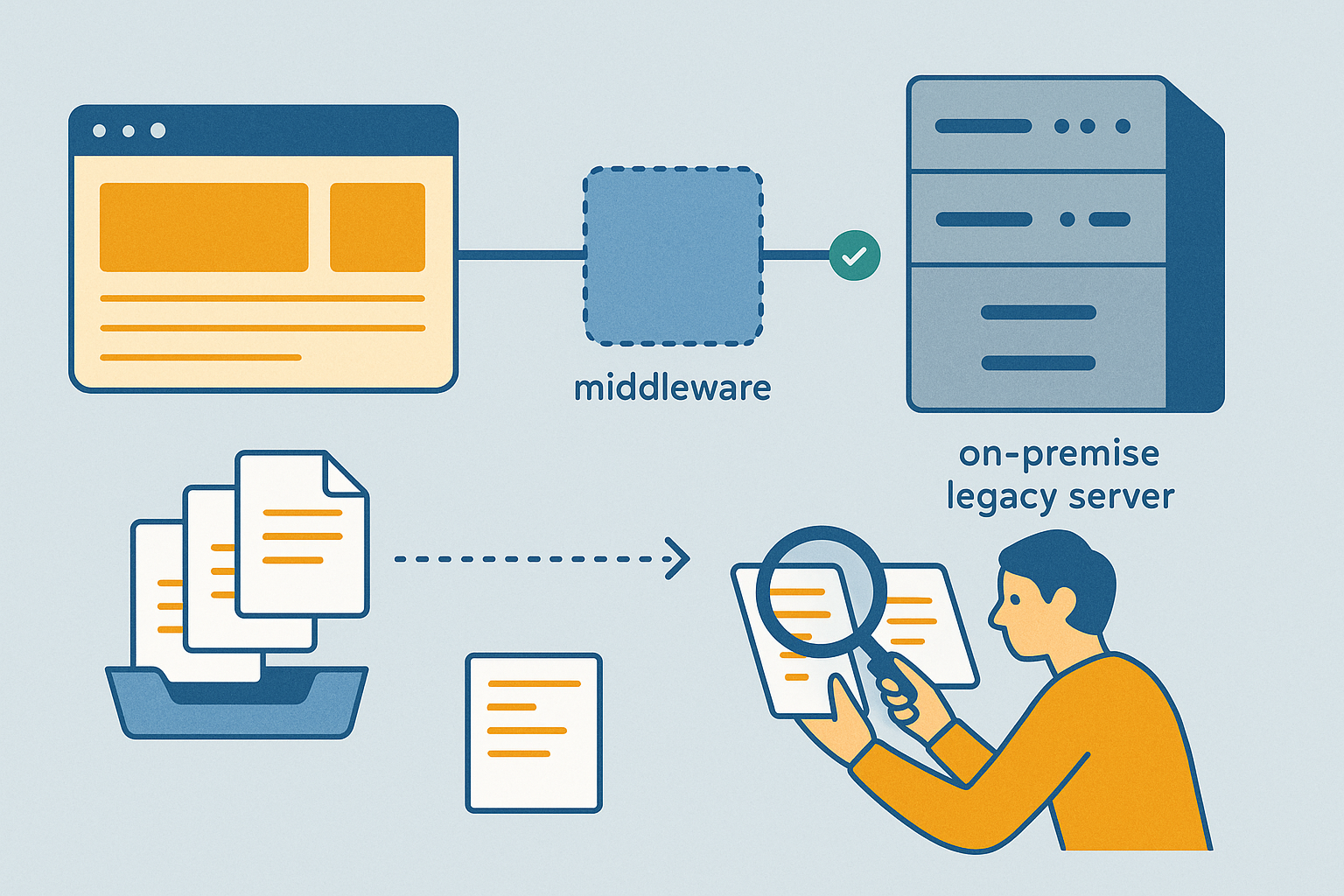
A Laravel adapter layer is useful when an organisation wants to add a modern web portal without immediately replacing the existing legacy system. The layer then forms a bounded connection between the new portal and the existing business logic. This enables phased modernisation: the organisation can make a new process more accessible while legacy assets remain in use for the time being. The business value therefore does not automatically lie in the disappearance of all manual activities, but in the controlled extension of the usability of components that are still needed.
The achievable process improvement depends heavily on the depth of integration. With periodic file exchanges via FTP or CSV, information can move between systems, but urgent orders still require reconciliation. This is a material difference from a direct database adapter or a REST/RPC connection. With these direct forms, requesting and chasing statuses can disappear because the portal and the legacy system are more closely connected. A portal that only collects data but transfers it later through files therefore moves work rather than eliminating all activities.
An adapter layer is especially suitable where replacement is not proportionate at present, while a process still needs to be modernised. The cost of phased modernisation can be a fraction of full replacement. In return, there is an ongoing obligation: the integration layer must be maintained permanently, and the legacy system's technical debt remains. The adapter layer does not solve that debt; it makes it manageable within the selected transition period.
For decision-making, this means the question is not merely whether Laravel can connect the portal. The sharper question is which specific activity disappears through the chosen connection. If it concerns status enquiries, direct integration is relevant. If transfer remains periodic and file-based, reconciliation remains part of the process. A Laravel adapter layer therefore defines the boundary of change: modernisation where it adds immediate value, with explicit acceptance of the maintenance and technical debt that remain for the time being.
Sources for this section: technologyconsultingauthority.com, mit.edu
Why do manual tasks often remain after integration?
A new web portal can simplify input for users while back-office staff still retain the same work. The cause often lies not in the portal screen, but in the quality and usability of the data the legacy system must process. Integration does not automatically create alignment between new input and existing master data. When that foundation is incorrect, a digital input route becomes an additional checkpoint rather than a replacement for manual work.
Consider polluted master data: duplicate customer records or outdated item numbers. A portal with strict frontend validation can reject such values if they do not match the existing structure. Without prior cleansing, this leads to recurring order failures at input. The order is then not processed; someone must assess the cause, correct the data, or have the input submitted again. The manual task does not disappear, but shifts from rekeying to exception handling.
This explains why looking only at the number of digital forms is insufficient. A form can collect data, but process improvement arises only when the data are also usable within the structure in which subsequent processing takes place. Strict validation protects that structure, but immediately exposes imperfections in the available data. In an organisation working with outdated item numbers or duplicate customer records, this is not an edge case but a daily operational constraint.
Built-in auditability, transparent change logging, and real-time monitoring through dashboards such as Laravel Horizon and Pulse provide visibility into what happens during processing. This makes clear which changes have been recorded and where an order or data flow stalls. That visibility does not replace correcting inaccurate data, but prevents the issue from remaining invisible until staff have to intervene manually. For evaluating integration, this distinction is useful: measure not only digital submission, but also how much input passes through the existing data structure without corrective work.
Sources for this section: www.gov.uk
When does a legacy integration have potential for genuine task elimination?
A legacy integration has potential for genuine task elimination only when the new portal not only captures data, but also processes them in a way that aligns with the structure of the existing ERP. The distinction is practical. In one case, the portal serves as a digital front door; in the other, it forms a functioning link in the existing process chain. Only in the latter situation can a back-office input activity genuinely disappear.
A recognisable risk is a Laravel portal that collects data without validating them against the legacy structure. The user may appear to complete a full submission, but back-office staff still have to manually retype the same data into the ERP. The portal has made the request visible, but has not achieved a transfer that the ERP can use. As a result, the organisation has two truths: the data entered in the portal and the manually entered version in the ERP.
The business test is therefore specific: can information from the portal enter the ERP without being retyped? When the answer is no, the intended improvement is primarily partial digitisation. It can still serve a purpose, but it does not substantiate a reduction in administrative processing. When the answer is yes, attention shifts to cases in which the existing structure does not allow appropriate processing. Those cases determine how much manual assessment remains.
This context prevents a new portal from being assessed on appearance or on the fact that data are digitally available. For operational teams, what matters is whether the chain continues after input. The absence of validation against the legacy structure shows precisely why task elimination must not be inferred from a digital form alone: without a usable connection, the back office continues to perform the translation.
Sources for this section: technologyconsultingauthority.com
Key evaluation criteria for legacy integration
Assess the chosen connection based on how the portal responds when the legacy system is available, slows down, or fails. This criterion makes visible what type of manual work may return to the operation.
| Evaluation criterion | What the chosen approach provides | Operational consequence for the portal |
|---|---|---|
| Direct synchronous API transactions | Immediate user feedback during the transaction. | The web portal remains dependent on the latency and availability of the legacy system. In case of delay or failure, this dependency is immediately noticeable in the portal. |
| Asynchronous message queues | Portal uptime, even when processing does not occur immediately. | This approach requires more complex status notifications. The user therefore needs understandable feedback on the processing status. |
| Processing expectation | A synchronous choice suits immediate feedback; an asynchronous choice suits portal availability. | The organisation does not only choose a technical route, but also determines when a user receives confirmation and how unfinished processing becomes visible. |
| Handling legacy outages | With direct transactions, outages affect the portal; with asynchronous processing, the portal remains available. | The assessment shifts from merely “is it connected?” to “which process status can the user see when the source does not respond immediately?” |
Sources for this section: technologyconsultingauthority.com
A structured approach to legacy integration decisions
A phased assessment keeps the intended process improvement testable. The steps below focus on demonstrability: without visibility into operational time savings and FTE reduction, an initiative can lose support from management and sponsors of further digital transformation.
- Define the intended operational time savings. Specify in advance what benefit must become visible in daily operations and whether an FTE reduction is needed for the business case. This prevents a project from being assessed only on delivering a portal, while the intended change concerns the operational deployment of people.
- Make the assessment dependent on demonstrable outcomes. An assessment becomes meaningful only when it distinguishes between assumed and demonstrable time savings. If that demonstrability does not materialise, project fatigue develops. The organisation has then invested time and attention in the change, but lacks a visible basis for supporting the next step.
- Treat support as an outcome of results. Management and sponsors assess follow-on initiatives partly based on whether earlier steps have delivered demonstrable operational value. When time savings and FTE reduction do not become visible, support for further steps in digital transformation declines. A limited or unclear process improvement therefore also becomes a risk to the progress of broader change.
- Use a Proof of Concept as a test point, not as proof without results. A PoC can provide a bounded moment to assess whether the expected improvement becomes demonstrable in practice. The outcome is useful when it makes clear whether the intended operational time savings are actually visible. A PoC without this test maintains the same uncertainty that can later lead to project fatigue.
- Decide on next steps based on the remaining uncertainty. If the expected benefit is demonstrable, a more concrete basis emerges for further digital transformation steps. If that benefit is not demonstrable, the limitation is not confined to the first project component: confidence in follow-on funding and sponsorship also comes under pressure.
Sources for this section: bcg.com
Frequently asked questions about legacy integration
The questions below concern a choice that is often underestimated: how much control do you move to input, and how much assessment remains within the organisation afterwards?
- Why can manual assessment remain, even with a Laravel portal?
This is linked to the chosen validation strategy. Strict validation in the web portal makes Straight-Through Processing to the legacy system fully possible, but raises the threshold for users during input. The user must then meet the conditions of the existing system before the data can proceed. This approach places control at the front of the process.
A forgiving intake places the emphasis differently. It minimises failures at input, allowing users to submit data that do not immediately meet all conditions. In return, internal exception assessment remains necessary. The manual work has therefore not disappeared; it shifts to assessing cases that cannot be processed directly. For an organisation, this is a deliberate trade-off between a higher input threshold and an ongoing internal assessment flow.
Key considerations for successful legacy integration
The most useful boundary between a promising connection and a costly assumption lies in the exception workflow. A standard route shows that data can move; it is the most complex exception that reveals whether the process remains manageable under pressure. A structured Proof of Concept is therefore appropriate before contractual commitment.
- Validate the most complex exception workflow end-to-end in the PoC.
This form of validation does not merely test a separate screen or an individual transfer. The complete exception passes through the chain from start to finish. This makes clear before contractual commitment whether the intended connection also works where daily processing departs from the standard route. The result provides a more concrete basis for contractual scoping than a demonstration that shows only the simple route.
The PoC thus has a financial and operational function. If a complex exception becomes visible only after contractual commitment, additional processing and adjustments may be required within an engagement that has already been commercially agreed. If it is validated beforehand, it is clear which limitation or requirement must be part of the agreement. The test is therefore not a formality, but a boundary for which process promise the organisation can genuinely commit to.
