

Yes, legacy systems can be connected securely without control layers making the integration too slow, vulnerable, or difficult to support. However, this requires careful alignment of security routes, such as using asynchronous middleware and Anti-Corruption Layers in Laravel, as well as wire-level pre-implementation testing and end-to-end tracing to prevent production outages.
Risks and considerations for legacy API integration
When integrating legacy APIs in secure environments, it is essential to find the balance between security and performance. This article provides insight into the challenges and risks of such integrations and offers a checklist for successful implementation.
- Identify all intermediate gateways, WAFs, and proxies to map the complete traffic route.
- Assess the impact of security layers on network latency and protocol compatibility.
- Perform compatibility validations in an environment that reflects the production security context.
- Implement asynchronous middleware to protect legacy systems from overload.
- Ensure consistent correlation identifiers for effective troubleshooting and monitoring.
The challenges of legacy API integration in secure environments
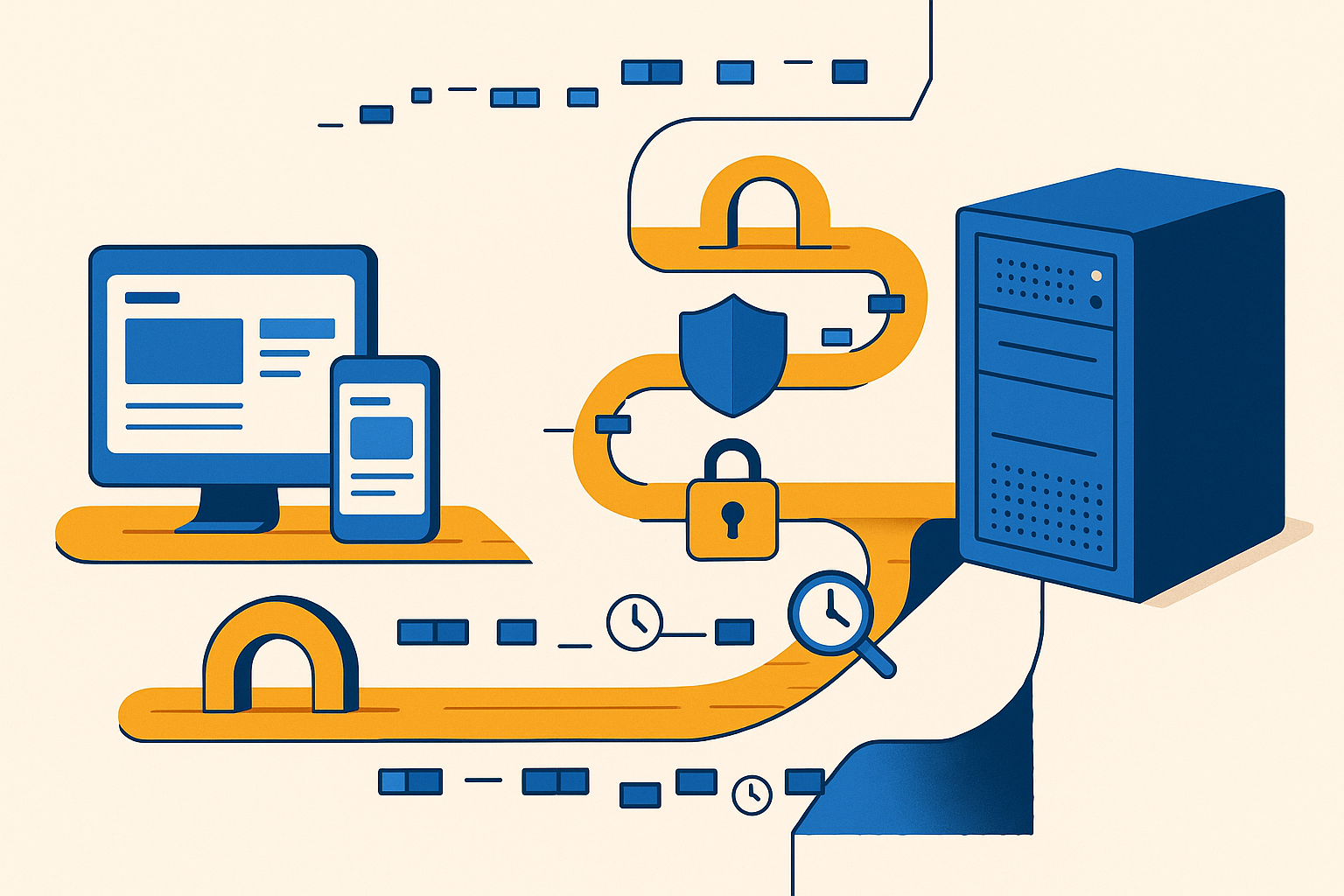
Legacy API integration in a secure environment is not a direct connection between two systems. Gateways, reverse proxies, and encryption or inspection layers may sit between a modern application and a legacy endpoint. Each layer has a role within the traffic route, but at the same time creates an additional point where communication must align with the expected HTTP semantics, headers, and proxy rules. Technical feasibility is therefore determined by the entire route, not solely by the available interface of the legacy system.
The number of intermediate inspection and encryption hops determines cumulative network latency. This is particularly relevant when an application waits synchronously for a response from the legacy endpoint. A route with end-to-end mTLS has a different structure from one in which encryption is terminated at the edge. The distinction matters because each selected route creates different transfer points and protocol expectations. More hops do not necessarily make an integration unusable, but they do increase the number of places where delay can accumulate.
In addition, the likelihood of protocol conflicts increases with the number of layers. A legacy API may expect a particular request, response, or header in a specific way, while an intermediate proxy or gateway forwards or assesses traffic according to its own rules. When those expectations do not align, a compatibility question arises that becomes visible only on the actual route. In that case, the security layer is not a separate component of the integration, but a determining factor in its reliability.
For an organisation, the trade-off is therefore not between security or speed. The relevant question is whether the chosen security route predictably aligns with the behaviour of the application and the legacy endpoint. An integration design only becomes meaningful when it is clear which hops traffic passes through, where encryption takes place, and at which points proxy behaviour may affect the exchange. Without that picture, it remains unclear whether a delay originates in the application, the legacy system, or the secure route between them.
Sources for this section: RFC 9110: HTTP Semantics
Risks of missed checks in legacy API integration
Missed checkpoints in legacy API integration often become apparent only when the connection runs under actual load and security conditions. This makes production not only the environment in which a service must be available, but unintentionally also the first environment in which assumptions about the call chain are tested. This is particularly vulnerable with synchronous integrations: the application then waits for a response from the legacy endpoint while the request may pass through multiple security layers.
In a zero-trust architecture, the cryptographic overhead of successive hop-by-hop mTLS handshakes and token translations can accumulate. The delay does not arise from one individual step, but from the combination of steps within the same synchronous chain. A check that only verifies whether the endpoint is reachable therefore does not provide a complete picture of what the application experiences during a real call. Even a valid connection on its own says nothing about the total time required for all security hops.
When this chain is not assessed in its entirety beforehand, an integration in production may later respond more slowly than expected during limited testing. The direct outcome is a delayed response between the application and the legacy endpoint. This subsequently makes it less clear, from a manageability perspective, whether an incident originates in the legacy system or from delay arising in transit. That complicates determining where investigation should begin.
This risk does not mean that mTLS or token translation should be avoided. It shows that security measures occupy a measurable place in the synchronisation chain. Checkpoints that omit this place test only part of the integration. The practical boundary is therefore whether the expected response time still fits the complete, secure route and not only direct communication with the legacy endpoint.
Sources for this section: Laravel HTTP Client & Resilience Documentation
Essential validations for legacy API integration
Compatibility validation has value only when the test environment represents the relevant security context. A common pattern is for integration tests to take place in a staging environment while WAFs, security gateways, and payload inspection are disabled there. The connection then appears to function correctly, but that outcome proves only that the application and legacy API can communicate without those control layers.
The missing layers may specifically affect how traffic is processed. Protocol and encoding errors then emerge only in production. This is not a minor deviation between two environments, but a different route with different conditions for the same integration. A successful test without these controls is therefore not a complete compatibility check for the intended production environment.
A useful validation explicitly identifies which gateways, WAFs, and forms of payload inspection are present on the route and whether they are active during testing. It can then be established whether the integration still achieves the same exchange with those controls active. This shifts the test from “is the endpoint reachable?” to “does the intended communication remain valid within the actual secure environment?” The latter question addresses the conditions the integration actually encounters in production.
Performance evaluation belongs within the same validation context. Not because a test must produce one fixed threshold, but because differences between a route with and without active control layers must be visible. If a production problem occurs later, there is then a basis for assessing whether it relates to protocol processing, encoding, or the presence of a specific control layer. Validation primarily reduces uncertainty by keeping production conditions within the scope of testing.
Sources for this section: RFC 9110: HTTP Semantics
Pre-integration checklist for legacy APIs
This check focuses on mutating calls for which a temporary error does not automatically mean that prior processing did not take place.
- Retries, idempotency, and duplicate mutations: before integration, establish which calls can be retried in the event of HTTP 5xx errors and under what conditions. Aggressive automatic retries without unique idempotency keys or deduplication logic can cause duplicate mutations in the legacy system. The relevant check is therefore not only whether an HTTP client can retry, but also whether the receiving side distinguishes a repeated request from a new business action. Examine each mutating call to determine whether a unique idempotency key is available, how that key is passed through the complete integration, and where deduplication takes place when the same action is received more than once. Also establish what an HTTP 5xx status means in this context: an error response may indicate failed processing, but without an additional safeguard it provides no basis for assuming that no mutation was performed. This distinction determines whether a retry is justified. The checklist should also make visible who investigates the consequences of a duplicate mutation and who decides on recovery when one occurs. This makes retry configuration part of the operational management of the connection, rather than an isolated application setting. For Laravel-based custom software solutions, the same boundary applies: error handling and retry behaviour must align with the idempotency or deduplication logic of the legacy endpoint. Without that alignment, availability logic can unintentionally alter data processing.
Sources for this section: Laravel HTTP Client & Resilience Documentation
Common mistakes in legacy API integration
The mistakes below can be recognised by missing evidence before an integration is developed or introduced at a larger scale.
- Starting without demonstrable technical validation: a project can scale up too early when no formal pre-integration compatibility checklist, wire-level network analysis, or Proof of Concept is available. Questions about the actual communication between layers then remain implicit, while they still need to be investigated later. The mistake is not the existence of uncertainty, but treating that uncertainty as though it has already been resolved. A formal checklist makes visible which compatibility points have been assessed and which remain open. A wire-level analysis provides a check of the exchange as it actually runs across the network. A Proof of Concept can then be used to test a defined assumption before it becomes the basis for a large-scale development contract. These three forms of substantiation complement one another without having the same purpose: the checklist structures the assessment, the network analysis focuses on the actual traffic flow, and the Proof of Concept validates a specific uncertainty. If one or more of these components is missing, a project decision is more likely to rest on an incomplete picture of the integration. This can result in additional investigation later, scope adjustments, or postponement of further development. Prevention therefore lies in demonstrable preparation, not in assuming that an available API automatically fits within the intended environment.
Sources for this section: RFC 9110: HTTP Semantics
Frequently asked questions about legacy API integration
A recurring question concerns not only the technical possibility of decoupling, but also the evidence that a chosen pattern fits the existing environment.
- What substantiation provides confidence when a legacy connection needs more decoupling?
Documented reference cases can provide a substantive starting point where they apply patterns such as Anti-Corruption Layers, Transactional Outboxes, circuit breakers, and idempotent consumers to achieve legacy decoupling. The value of such documentation does not lie in copying a pattern to a different situation. It makes visible that a pattern has been developed in an integration context and the role it fulfilled there. For an organisation assessing a connection, the question thereby changes from “which pattern sounds suitable?” to “which demonstrable pattern addresses the specific dependency between the application and legacy system?”.
An Anti-Corruption Layer, Transactional Outbox, circuit breaker, or idempotent consumer is not a general substitute for a compatibility check. Each pattern has its own place in how systems are decoupled from each other. Reference cases therefore provide support mainly when they are sufficiently concrete to assess which decoupling was achieved through them. This prevents a name in an architecture proposal from being viewed as evidence without the application context being clear.
For Laravel-based custom software solutions, this documentation can contribute to a phased assessment: first establish which dependency on the legacy system exists, then assess which documented approach aligns with that dependency. The outcome may also be that a named pattern does not fit the available interface or the intended responsibility. That outcome specifically reduces the chance that an integration choice rests solely on terminology. The substantiation remains useful only when it relates to the intended legacy decoupling and not merely to a general architectural view.
Sources for this section: Laravel HTTP Client & Resilience Documentation
Key considerations for secure legacy API integration
The operational management of a secure legacy connection becomes tangible when the technical route is also traceable and governable.
- Make observability and security governance demonstrable: consistent distributed tracing with W3C Trace Context or correlation IDs creates a shared way to record relationships within an integration flow. This makes it possible to assess not only the behaviour of one individual layer, but also to link an event in the chain to the same context. This is relevant for management and investigation when traffic passes through multiple layers and different parties manage part of the route.
Automated monitoring of mTLS certificates belongs within the same management question. Certificates are part of secure communication; their status cannot therefore be viewed separately from the availability of the connection. If this monitoring is not structurally established, an operational risk arises that becomes visible only when the secure route no longer functions as expected. The cost lies not only in technical recovery, but also in time lost determining which link is responsible.
In addition to observability, the connection requires demonstrable alignment with ISO 27001 and NIS2 guidelines. That alignment concerns making visible the relationship between the integration, security governance, and the documented working method; it is not the same as a general claim that an environment automatically complies with a standard or guideline. In an iterative approach, tracing, certificate monitoring, and that alignment can be assessed as separate checkpoints, so that open questions are not concealed within a broad delivery.
The ultimate boundary for manageability is concrete: without consistent correlation IDs, monitored mTLS certificates, and documented alignment with relevant guidelines, an incident in the secure chain cannot demonstrably be linked to an owner and a control point.
Sources for this section: RFC 9110: HTTP Semantics
This article does not provide legal advice. Applicable obligations depend on the purpose, functionality, user context, and risk classification of the system. Have the specific application legally assessed before production use.
