
A stable managed rollout for AI-supported processes requires a parallel run in which the AI application operates alongside the legacy process. This enables validation of reliability, software integration, and user adoption without causing operational instability. Using separate queues in a Laravel architecture prevents production databases from being polluted.
Managed parallel rollout for AI processes
When introducing AI into operational processes, a managed parallel rollout is crucial for minimizing risk and ensuring reliability. This article discusses the need for a parallel run and the evaluation criteria involved.
- Parallel rollout prevents disruption by first testing AI in shadow mode with live data.
- Confidence thresholds determine which transactions are processed directly or with human verification.
- Measurable exit criteria and reconciliation reports prevent an endless shadow process.
- Circuit breakers and fallbacks ensure continuity in the event of API outages.
Why a managed parallel rollout is crucial for AI processes
A parallel rollout is not an end in itself, but a temporary control measure when an AI-supported process needs to be assessed alongside an existing operational approach. The key question is not only whether the new processing produces outcomes, but also whether those outcomes remain usable within the day-to-day context in which employees make decisions, handle exceptions, and intervene manually where necessary. A managed setup enables that comparison without immediately replacing the existing approach.
The form of the parallel run depends on the process. For highly deterministic transactions with unambiguous business rules, a short parallel period of two to four weeks with automated comparison of differences may suffice. The focus is then on demonstrable discrepancies between the existing and new outcome. For context-dependent processes, that limited assessment is insufficient. Circumstances, interpretation, and human corrections may also determine whether an outcome is operationally acceptable. A longer validation with human-in-the-loop then provides room to identify which cases require assessment and how employees respond when the new route differs.
The choice between passive and active parallel processing also affects support during the transition. In a passive shadow mode, the new route is tested alongside the existing process without adding workload for staff. This limits temporary disruption, but does not show how user behavior and manual overrides work out in practice. An active parallel run makes that adoption visible. On the other hand, employees temporarily need additional discipline because the old and new approaches both require attention.
An unmanaged transition leaves precisely these differences invisible. If there is no defined period, no chosen assessment method, and no guidance around deviations, a temporary safeguard soon becomes an unclear duplication of work. It then remains unclear whether a difference results from an unambiguous rule, a context requiring human judgment, or a change in working practices. Managed parallel operation keeps the old route available as a point of comparison while also clarifying which form of validation suits the type of process.
Sources for this section: Continuous Delivery and Operational Release Patterns
The challenges of introducing AI into operational processes
Introducing AI into an existing operational process creates uncertainty at times when the organization needs predictable throughput and stable service levels. This is especially true when the workload is not evenly distributed. A test period that covers only quiet days does not provide a reliable basis for a route that must also function during peak demand. Rare exceptions may then remain out of sight, even though those cases are precisely what put the transition under pressure.
For seasonal peak loads, a parallel run therefore requires a full cycle so that the new processing can be assessed under relevant variation. When waiting for that cycle is not appropriate, historical queue re-ingestion can be used to run exceptional cases through the intended processing again. Both approaches serve the same purpose: not limiting the assessment to the average situation, but basing it on the load and exceptions that the operational process actually experiences.
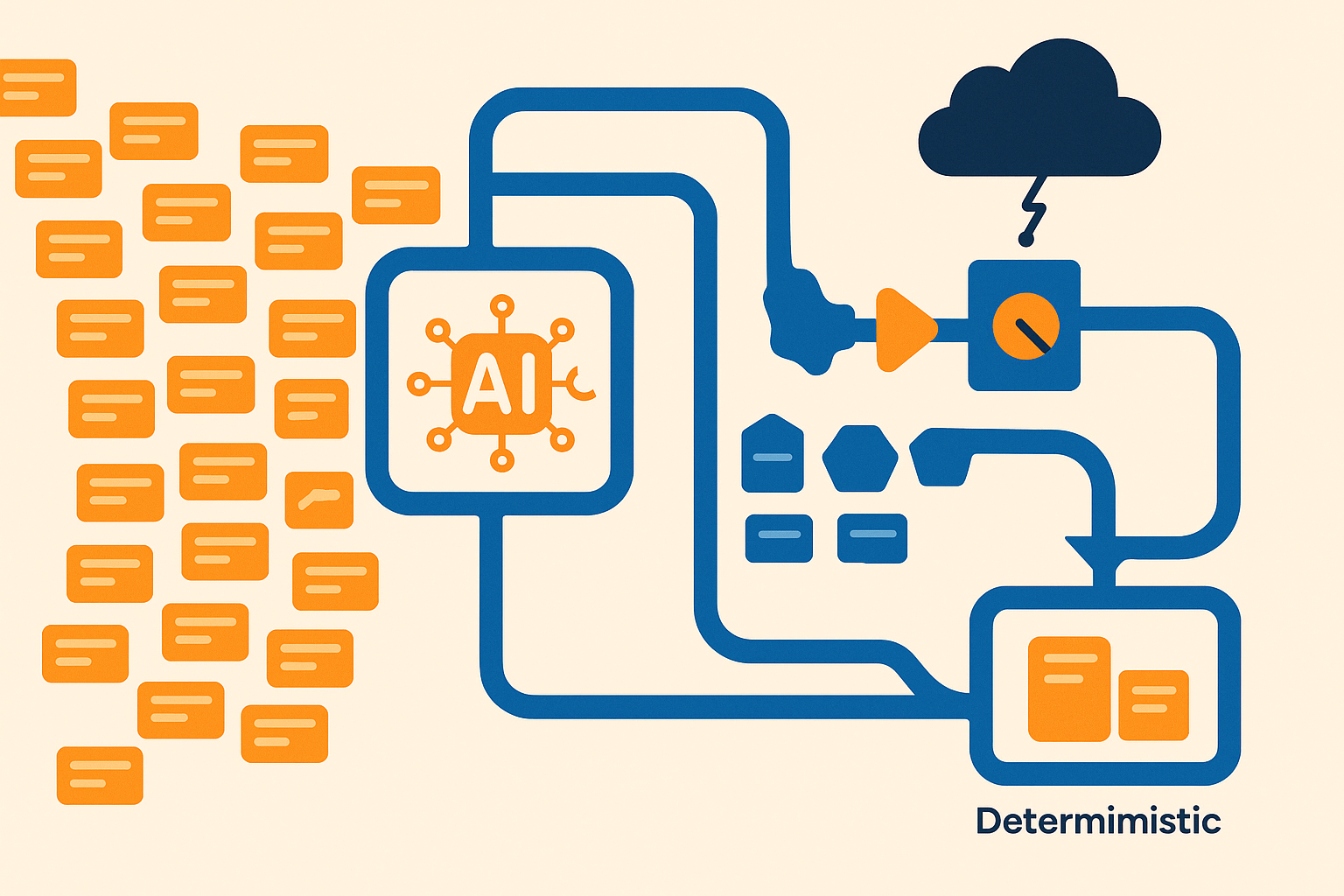
Support during this phase involves more than availability during an incident. The setup must also be able to accommodate a temporarily unavailable external API. In a Laravel environment, Redis and Horizon queues, configured circuit breakers, and deterministic fallbacks can provide a controlled foundation for this. In that case, the fallback provides a predefined alternative route instead of an improvised response when the dependency fails. This keeps the parallel assessment possible without a temporary API outage immediately determining the entire transition.
Operational uncertainty therefore runs in two directions. On the one hand, the new processing must be confronted with representative peaks and exceptions. On the other, the environment must withstand the failure of a dependency during that assessment. An AI integration that does not account for these circumstances may appear convincing in a limited test, yet leave unanswered questions about its behavior when workload increases or a connected service fails. The required support therefore combines an assessment that covers the full process variation with a technical contingency route for disruptions in the chain.
Sources for this section: EU AI Act: Requirements for High-Risk and Operational AI Systems
When is a parallel rollout necessary?
A parallel rollout is appropriate when the new AI route needs to be assessed alongside the existing route without mixing production data. This is especially relevant when the consequences of a differing outcome cannot be separated from the transaction to which it relates. The question is then not only whether the new route technically runs alongside the existing one, but whether it can coexist with the existing processing in a controllable way.
For this situation, a decoupled custom Laravel architecture with separate queues for live and shadow transactions is required. The live queue retains regular production processing. The shadow queue enables a separate assessment. This separation makes parallel operation possible without polluting production databases. This distinction determines whether the organization can investigate new outcomes without altering the existing administrative reality.
A second indication is the need to reconstruct afterward, for each transaction, why an outcome occurred or why an employee deviated from it. Transparent logging and audit trails can record prompt snapshots, model versions, confidence scores, and recorded reasons for overrides. This data turns a parallel run from a general trial into a verifiable period in which individual differences remain traceable.
Parallel operation is therefore necessary as soon as assessment, isolation, and traceability are all required. Without separate processing, there is a risk that a shadow route affects the production database. Without an audit trail, a deviation remains an isolated signal that cannot be interpreted per transaction. For processes where context or verifiability matters, that combination marks the boundary between a limited technical test and a manageable transition to live use.
Sources for this section: Continuous Delivery and Operational Release Patterns, EU AI Act: Requirements for High-Risk and Operational AI Systems
Key evaluation criteria for a parallel rollout
Choosing a parallel rollout requires criteria that make both the temporary workload and support after go-live visible. The points below distinguish a rapid transition with concentrated risk from a controlled period with explicit operational coverage.
| Evaluation criterion | What is assessed? | Implication for the rollout decision |
|---|---|---|
| Concentration of outage risk | In a Big Bang transition, the entire change is moved to a single moment. This approach can immediately deliver theoretical cost savings, but it also concentrates outage risk at that same moment. | When an outage event is unacceptable, a managed parallel run offers a different distribution of risk: the existing and new routes coexist temporarily instead of one switch determining everything. |
| Temporary operational overhead | Parallel operation requires double operational attention for a limited period. That overhead is the price of being able to assess the two routes alongside each other. | The organization weighs the temporary additional workload against the ability to avoid concentrating risk at one transition moment. This criterion prevents theoretical immediate savings alone from becoming the starting point. |
| Monitoring for model degradation | The management function tracks whether the model's performance deteriorates during and after the transition. This is a separate area of attention alongside regular application management. | A parallel run becomes more meaningful when monitoring is part of the support. Without that role, it remains unclear who identifies changes in performance once the new route is used operationally. |
| Incident response | A multidisciplinary local managed services team can combine incident response with proactive monitoring and regular application management. | The rollout is better defined when it is clear how an incident is handled and how that response relates to application management. This also makes the transition organizationally verifiable. |
| Periodic prompt retuning | Under this setup, support also includes periodic prompt retuning, in addition to responding to incidents. | This criterion distinguishes a one-time implementation from a management arrangement that accounts for adjustments during early production use. |
Sources for this section: EU AI Act: Requirements for High-Risk and Operational AI Systems
A structured approach to parallel rollout decisions
A practical approach sets up the parallel run as a choice between speed and control for each type of outcome. The process below makes that trade-off concrete without taking full autonomy as the default starting point.
- Determine which route retains human verification. Full AI autonomy maximizes processing speed, but the impact of errors in edge cases becomes greater because there is no intermediate assessment. A human-in-the-loop layer keeps human control over the cases that warrant it. This is not a general brake on AI use, but a delineation of where autonomous processing fits and where an employee remains part of the process. The parallel phase provides the space to make that boundary visible before the new route replaces the existing approach.
- Link confidence thresholds to the handling route. Confidence thresholds distinguish between outcomes that can continue through the AI route and outcomes that go to human verification. This means not every transaction is handled in the same way. The organization can assess whether the chosen thresholds provide sufficient control for divergent or less certain cases. Instead of an abstract judgment about the AI solution, an operational division emerges: which outcomes follow the fast route, and which remain under explicit human assessment?
- Weigh additional verification time against error impact. The human-in-the-loop layer requires a fraction of additional verification time. In return, it offers maximum control in edge cases, precisely where full autonomy increases the consequences of errors. The rollout decision therefore does not become a choice between only speed or only manual work. It becomes a targeted choice about where limited additional time is used to constrain the impact of exceptions.
- Set up processing so that the routes can be handled separately. Laravel provides queues, workers, and event handling as building blocks for separate processing. In a parallel setup, that separation supports the distinction between a route with operational impact and a route being assessed. This makes it possible to organize the control layer and processing flow as separate components, in line with the chosen thresholds and human intervention.
- Only include the autonomy choice in the transition when the distribution of control is clear. The relevant question is not whether maximum speed is attractive, but whether the organization accepts the greater error impact in edge cases. Where that is not appropriate, human-in-the-loop remains part of the chosen parallel setup. This keeps the temporary rollout focused on a demonstrable distribution of processing and control, rather than an abstract pursuit of full automation.
Sources for this section: Laravel Documentation: Queues and Horizon
Frequently asked questions about parallel rollout of AI processes
The choice between an off-the-shelf AI service and a custom setup is often framed as a choice between starting quickly and refining later. For parallel processing, the trade-off is more specific: the question is how much control is needed over isolation, queues, and fallback routes during the temporary transition.
- “Can we not simply use an off-the-shelf AI SaaS tool for the parallel run?”
An off-the-shelf AI SaaS tool can offer a quick initial start. However, that speed does not automatically say anything about the degree to which the organization can finely control parallel operation and data isolation. When the parallel phase is primarily intended to explore the new route quickly, that initial accessibility can be attractive. When the phase must function as a controlled transition alongside existing operational processing, a different question arises: is the required control over the separate routes actually available? - “Why does a custom Laravel setup require more preparation?”
A custom Laravel architecture requires initial engineering. That effort is related to establishing full control over queues and fallbacks. For a parallel run, this is not a detail, because queues determine how processing is separated and fallbacks determine what happens when the intended route cannot be followed. The additional preparation is therefore connected to the extent to which the organization wants to control these transition mechanisms itself, not merely to the fact that AI is being applied. - “Is full control always the right choice?”
No. The trade-off remains dependent on the role of the parallel run. A quick start with a SaaS tool and a custom architecture with full control are different positions, not an automatic hierarchy. SaaS emphasizes a short initial lead time, whereas custom Laravel places control over queues and fallbacks at the center. The choice becomes clearer when you define what control the transition requires: only an initial start, or a setup in which parallel processing and data isolation must be precisely controlled. - “Does a custom architecture mean that the old route must remain in place longer?”
The available information does not establish a fixed duration. It does show that the initial engineering involved in a custom setup is related to control over queues and fallbacks. The duration of the old route therefore does not follow from using Laravel itself, but from the chosen configuration for parallel operation and the degree of data isolation needed during the transition.
Sources for this section: Continuous Delivery and Operational Release Patterns
Important considerations for a successful parallel rollout
The final decision on a parallel rollout requires a formal transition agreement that establishes in advance when the old and new routes will coexist, when the rollout will proceed, and when it will be stopped. This turns the parallel run from a temporary safeguard into a manageable phase with demonstrable boundaries.
- Define quality gates. A formal transition management plan uses measurable quality gates instead of subjective assessments. This makes it clear in advance at which points progress will be assessed. The discussion shifts from general impressions to verifiable outcomes that do or do not justify a next step.
- Define variance thresholds. Variance thresholds indicate what degree of difference is accepted during the parallel period. Without that boundary, deviations may persist without clarity on whether they still fit within the transition. With a documented threshold, the organization has a basis for assessing differences consistently, rather than weighing every deviation separately and at its own discretion.
- Make stop/go criteria concrete. Concrete stop/go criteria determine not only when the new route may proceed, but also when the parallel phase will not be extended. This prevents the transition from continuing simply because there is no formal moment at which a decision is required. The criteria must be available before the assessment; conditions formulated afterward make the assessment subjective again.
- Treat duplicate overhead as a bounded risk. As long as old and new processes run alongside one another, temporary double operational overhead remains. Without stop/go criteria, that overhead can continue and the financial and operational costs of the transition become more difficult to contain. A parallel run therefore does not end based on familiarity with the new route, but based on the predefined quality gates, variance thresholds, and stop/go criteria.
Sources for this section: EU AI Act: Requirements for High-Risk and Operational AI Systems
This article does not provide legal advice. Applicable obligations depend on the purpose, functionality, user context, and risk classification of the system. Have the specific application assessed legally before production use.
