

When comparing mobile app architecture proposals, you should explicitly consider their assumptions about scalability, such as shared codebases, backend capacity, and integration with existing systems. It is crucial to understand how each proposal handles backend orchestration, such as rate limiting and message queues, and how these aspects contribute to the app's scalability.
Comparison of scalable mobile app architectures
Comparing mobile app architecture proposals requires a thorough evaluation of the technical and operational assumptions underlying each proposal. This includes assessing backend orchestration, the degree of shared code in cross-platform solutions, and the specific requirements of hardware integrations.
- Assess backend orchestration and integration capacity with existing systems such as ERP and CRM.
- Evaluate the shared codebase in cross-platform solutions for consistent functionality on iOS and Android.
- Check specifications for asynchronous processing and caching to manage peak loads.
- Ensure clear acceptance criteria and management protocols for OS updates and framework maintenance.
Key considerations for scalable mobile app architecture
The scalability of a mobile app is not exclusively a mobile property. A proposal may describe a native or cross-platform client, but the operational boundary often lies with the backend and the systems that backend communicates with. A comparable assessment therefore first requires a distinction between the mobile interface and the processing behind it. With a Laravel API backend, this is not only about supplying data to the app, but also about how requests are directed to underlying processes and connected core systems.
This choice becomes critical when the app communicates with ERP, WMS, or CRM systems that can handle only limited concurrent processing. In that situation, backend orchestration is more decisive for scalability than the chosen frontend technology. Rate limiting restricts the inflow to vulnerable integrations. Message queues make it possible to process work outside direct user interaction. Worker throttling prevents background processing from placing more pressure on a core system than it can handle. A Laravel proposal that does not describe these components leaves an essential question unanswered: what happens when mobile usage increases while the capacity of the connected system remains unchanged?
In this context, modularity takes on practical meaning. The mobile app, the Laravel API, and the processing of integrations have different responsibilities and can therefore be assessed separately. A proposal should clearly show which processing responds directly to the user and which processing is deliberately moved to the background. This prevents an expansion on the mobile side from automatically leading to unmanageable load on an ERP, WMS, or CRM integration. The value of a modular setup therefore lies in managing dependencies, not in an abstract architectural label.
For organisations with compact internal teams, the speed of change also matters. When iOS and Android functionality needs to change simultaneously every week, a cross-platform codebase with 75% to 90% shared logic can offer higher change velocity and consistent feature parity than two separate native teams. That percentage is an internal guideline for this situation, not a property that every cross-platform proposal automatically has. The proposal should therefore state which part of the logic is genuinely shared and where platform-specific work remains.
The build cost is not a complete picture of costs either. As a guideline for a healthy software lifecycle, the annual budget for managed services, preventive maintenance, and framework upgrades amounts to approximately 15% to 25% of the initial build investment. An architecture comparison only becomes useful when this management is considered alongside initial development, because growth also creates an ongoing management task.
Sources for this section: Laravel 11 Documentation - API Resources, Laravel 11 Documentation - Queues and Horizon
Why comparing app proposals is complex
Mobile app proposals often appear comparable because vendors all talk about scalability, maintainability, and one app for iOS and Android. However, those words can conceal very different assumptions. One proposal may mean a shared mobile codebase by scalability; another may focus on the capacity of the Laravel backend; a third may assume that existing processes and integrations have sufficient capacity without changes. As long as these assumptions are not set side by side, you are comparing wording rather than the same technical and operational commitment.
The chosen scope can further obscure this difference. A polished UI demo says little about how data is retrieved, processed, and written back when many users are active at the same time. A low initial price may also result from a limited technical scope. A plausible risk arises when mobile screens are directly connected to non-optimised, monolithic controller methods without caching. As usage increases, N+1 queries can exhaust database connections. Response times then rise, and the backend infrastructure can fail during operational peak hours. In that scenario, the visible app is not the source of the problem, but it is where employees experience the consequences.
The term cross-platform also requires precision. For a professionally configured cross-platform architecture, an internal guideline is that 75% to 90% of the codebase for logic, data models, and UI is shared between iOS and Android. A proposal that only states that one codebase is used, without specifying exactly what is shared, therefore provides insufficient material for comparison. The remaining platform-specific parts may be decisive for planning, maintenance, and speed of change.
Network coverage forms a second source of hidden scope differences. In operational environments without continuous connectivity, an offline-first setup requires a local database, conflict resolution, and asynchronous Laravel synchronisation endpoints. This differs from an app that performs only synchronous REST calls. Both can be offered as a mobile app, but they assume an entirely different way of handling data that cannot temporarily be sent.
A comparable proposal therefore describes not only which screens will be built, but also the assumed load, network conditions, and integration boundaries. This makes visible which components are included in the price, planning, and responsibility, and which may only return later as an extension.
Sources for this section: Laravel 11 Documentation - API Resources, Laravel 11 Documentation - Queues and Horizon
When is a specific architectural choice relevant?
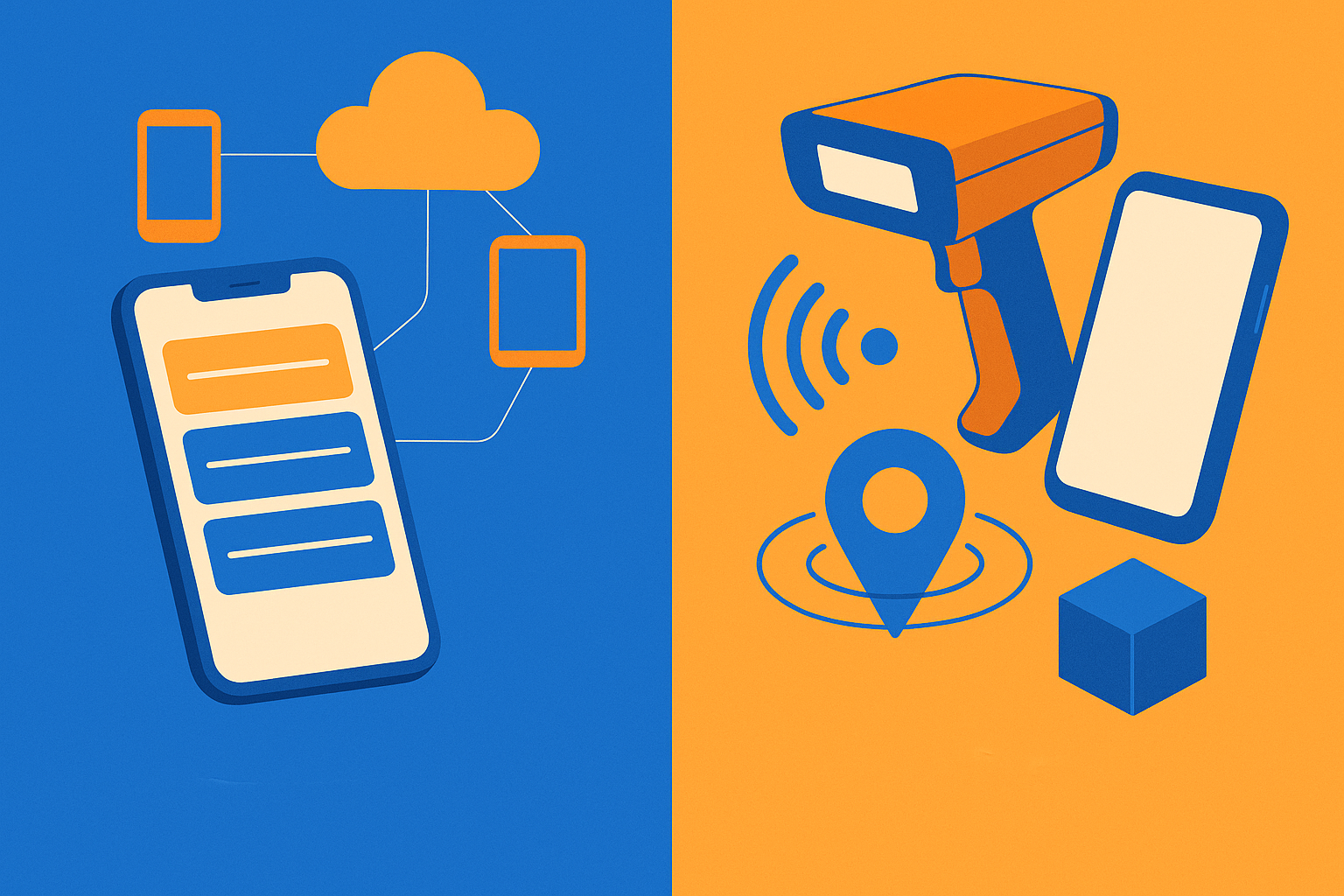
The choice between native and cross-platform only becomes concrete when the mobile app is placed in the conditions in which it must function. Not every B2B app has the same relationship with the operating system or physical equipment. A standard workflow app may primarily display data, record input, and support processes. In that case, the scalability question lies mainly in consistent functionality on iOS and Android and in how the rest of the architecture absorbs growth. In this context, cross-platform frameworks can scale appropriately.
The assessment shifts with deep hardware or OS dependency. Intensive use of Bluetooth Low Energy peripherals, such as industrial scanners, real-time background geolocation, or heavy graphical rendering brings a different integration layer into view. For these conditions, a native Swift/Kotlin architecture offers the lowest integration risks. This does not mean native is inherently more scalable; it means that the technical uncertainty surrounding those specific dependencies differs from that of a standard B2B workflow app. A proposal should therefore state for each feature whether it depends on BLE, background location, or rendering, rather than qualifying the entire app with one general architectural label.
User experience can be tested. Both native and cross-platform interfaces must achieve a stable frame rate of 60 FPS, with a maximum of 16.6 ms per frame, to prevent stuttering during interactions. This value is an internal performance requirement for assessing the interface, not proof that one approach automatically performs better. The distinction lies in whether the proposal explains how this requirement will be tested for the features with the greatest hardware or rendering pressure.
When uncertainty around these features is high, a Proof of Concept or phased MVP provides more information than an architectural claim on paper. Such a phase can make the risky integration and scalability assumption tangible before they become decisive for the full scope of the app. The outcome is then not a general judgement on native or cross-platform, but a substantiated choice for the specific dependencies of your app.
Sources for this section: Flutter Architectural Overview
Key criteria for comparing proposals
Assess proposals against the same, explicitly measurable criteria. The table below distinguishes the quality of the Laravel mobile backend and data transfer. The values mentioned are internal guidelines for evaluating a proposal; they do not constitute a universal standard and require a clear definition of load and testing method.
| Assessment criterion | What the proposal must specifically document | Why this matters for growth and management |
|---|---|---|
| Response time of standard REST endpoints | For a healthy Laravel mobile backend: 95% of standard REST endpoints measured at p95 within less than 150 ms under normal load and within less than 350 ms during peak hours. The proposal must specify which endpoints fall under this agreement and how normal load and peak hours are distinguished. | This makes “scalable” a testable backend commitment. Without a boundary, a vendor can show an average response time while the slow exceptions determine the mobile interaction. The p95 agreement shows whether the performance claim also accounts for the majority of user interactions. |
| Size of mobile JSON payloads | Provide mobile endpoints with targeted Eloquent API Resources and field filtering, keeping JSON payloads below 50 KB on average. The proposal must also state which data the mobile client actually receives and which fields are not sent. | This guideline links API design to mobile processing. A smaller, targeted payload supports fast network transfer and deserialisation on the client side. The criterion prevents a proposal from speaking only about API availability without describing how efficiently data is assembled for mobile screens. |
| Maintainable Laravel API layer | Describe how Eloquent API Resources and field filtering form part of the API layer, and which mobile endpoints consequently receive a defined data representation. Also state who reviews changes to that data representation when mobile features change. | Maintenance is not solely about fixing errors. New app features can change the required data set. An explicit API layer makes that change discussable as a controlled adjustment to the data representation, rather than as an implicit extension of every mobile response. |
| Acceptance and management of performance agreements | Include the response time and payload guidelines as acceptance criteria, including the measurement points at which they are checked. Also state in management that changes to endpoints and fields are reassessed against these criteria. | A performance number without an acceptance point is only an intention. By connecting the same measurement points to delivery and later change, it remains clear which technical quality the mobile chain must retain as the app continues to evolve. |
Sources for this section: Laravel 11 Documentation - API Resources, Laravel 11 Documentation - Queues and Horizon
A structured approach to evaluating proposals
Turn proposal comparison into a limited validation phase in which the assumptions with the greatest operational consequences are tested. The following two components provide guidance for a Proof of Concept or phased MVP and focus on processing that may come under pressure during mobile usage.
- Test the processing of duplicate mutations under unstable networks. A mobile frontend may send uncontrolled retries over an unstable connection. Without idempotency keys, the Laravel backend can then receive many duplicate mutation requests. If distributed locking via Redis is also absent, duplicate mutations and data corruption can occur in connected ERP and CRM systems. This is not a detail that can be filled in after the first release: the PoC or MVP should follow a representative mutation through the entire chain, including an interrupted connection and repeated transmission. The question to test is not only whether the app reconnects, but whether the same business action demonstrably takes effect only once in the connected systems. If this control is absent, developers may add ad hoc hotfixes under time pressure. This causes codebases to diverge and creates structural technical debt. A proposal becomes stronger when it treats this error chain as an explicit validation subject, with a defined outcome showing how duplicate requests are recognised and controlled.
- Measure the start and processing of background work. Push notifications, PDF generation, and ERP synchronisations are examples of work that does not necessarily need to be handled within direct mobile interaction. For Laravel Horizon and Redis, the internal guideline is that such asynchronous background tasks are picked up and processed within 1 to 3 seconds after triggering. In a phased MVP, this can be tested using the background tasks that actually form part of the intended mobile process flow. Define in advance what counts as a trigger, when processing is measured, and which task types fall under the agreement. This makes clear whether the proposed queue capacity fits the expected process, rather than an overall claim about asynchronous processing only gaining meaning as growth occurs. The validation also establishes a concrete boundary between direct user feedback and work that may take place in a controlled manner in the background.
Sources for this section: Laravel 11 Documentation - API Resources, Laravel 11 Documentation - Queues and Horizon
Frequently asked questions about scalable mobile app proposals
The questions below help reduce general scalability claims to verifiable elements of a proposal. They are not about a preference for a type of app, but about the information needed to make technical scope and responsibilities visible.
- Is a lower initial price sufficient reason to choose a proposal?
Not when the proposal does not make sufficiently clear how the mobile client, the Laravel backend, and external ERP or CRM integrations work together. A lower price can be difficult to compare if architecture diagrams and API documentation are missing. These documents should explicitly show how mobile clients relate to Laravel Sanctum, Redis caching, Horizon queues, and external integrations. This does not automatically prove that the architecture can handle every future load, but it does make the dependencies discussable. You can then see which components are involved in data exchange, caching, authentication, and background processing. Without this visibility, it remains unclear whether the price difference results from a different scope, omitted integration components, or a different allocation of responsibility. The price only gains meaning alongside that boundary. - Does native or cross-platform in itself prove that an app is scalable?
No. The architectural label does not in itself indicate how the backend, API layer, and mobile state are managed. A proposal gains credibility when demonstrable Laravel expertise in modern architecture patterns is combined with structured state management in the mobile client. On the Laravel side, this includes Sanctum, API Resources, and queue workers. Sanctum is part of the described architecture, API Resources determine the form in which data is presented to the client, and queue workers process work outside direct client interaction. Structured state management on the mobile side prevents the client from being treated as an undefined collection of screen logic. This combination offers more guidance than claiming that one platform approach would scale universally better. Therefore, ask not only which codebase is used, but also how these components are represented and delineated together.
Sources for this section: Laravel 11 Documentation - API Resources, Laravel 11 Documentation - Queues and Horizon
Key considerations when choosing an app architecture
The final choice becomes manageable when a proposal is not only a build plan, but also establishes the conditions under which the mobile service must remain operational. This shifts the discussion from an abstract scalability promise to verifiable agreements about edge cases, management, and the financial consequences of missing scope.
- Define non-functional acceptance criteria before assessing the architecture.
A proposal may mention response times without making clear when the app will be accepted. Specified criteria for response times, offline synchronisation, central error monitoring, and API rate limiting make that boundary visible. Central error monitoring can, for example, be implemented with Sentry or Bugsnag, provided the proposal explicitly describes how this forms part of the operational setup. Rate limiting belongs in the same set because it defines how the API responds when demand exceeds processing capacity. Offline synchronisation deserves a separate criterion: the assessment is then not only about displaying data without a connection, but about the agreed behaviour when data needs to be processed again later. These criteria make backend orchestration testable as a whole. They prevent problems from being treated as incidents only after the mobile app has already become dependent on connected processes. - Include continuity and dependency lifecycle as a management component of the proposal.
The initial delivery does not mark the end of architectural responsibility. Annual breaking changes in iOS and Android and management of the dependency lifecycle require explicit management protocols. A proposal that includes operational continuity therefore describes how these changes are monitored, assessed, and implemented within the app and its dependencies. This applies alongside the build phase and requires a recognisable place in managed services, preventive maintenance, and release planning. Without this boundary, an OS change or a dependency that no longer fits the existing app can lead to unplanned remediation work. The financial uncertainty then lies not only in the cost of a change, but also in a possible disruption to the mobile process. The concrete limit is therefore: no architecture proposal without documented acceptance criteria and management protocols for annual OS breaking changes and dependency lifecycle management.
Sources for this section: Laravel 11 Documentation - API Resources, Laravel 11 Documentation - Queues and Horizon
