

Managed support is essential for validating and continuously supporting BI outputs in legacy systems. It provides an operational framework for monitoring and management, enabling unexpected changes in data structures to be detected and resolved quickly. This prevents outdated or incorrect data from ending up in dashboards, which is crucial for reliable executive decision-making.
Managed Support for BI validation in Legacy Systems
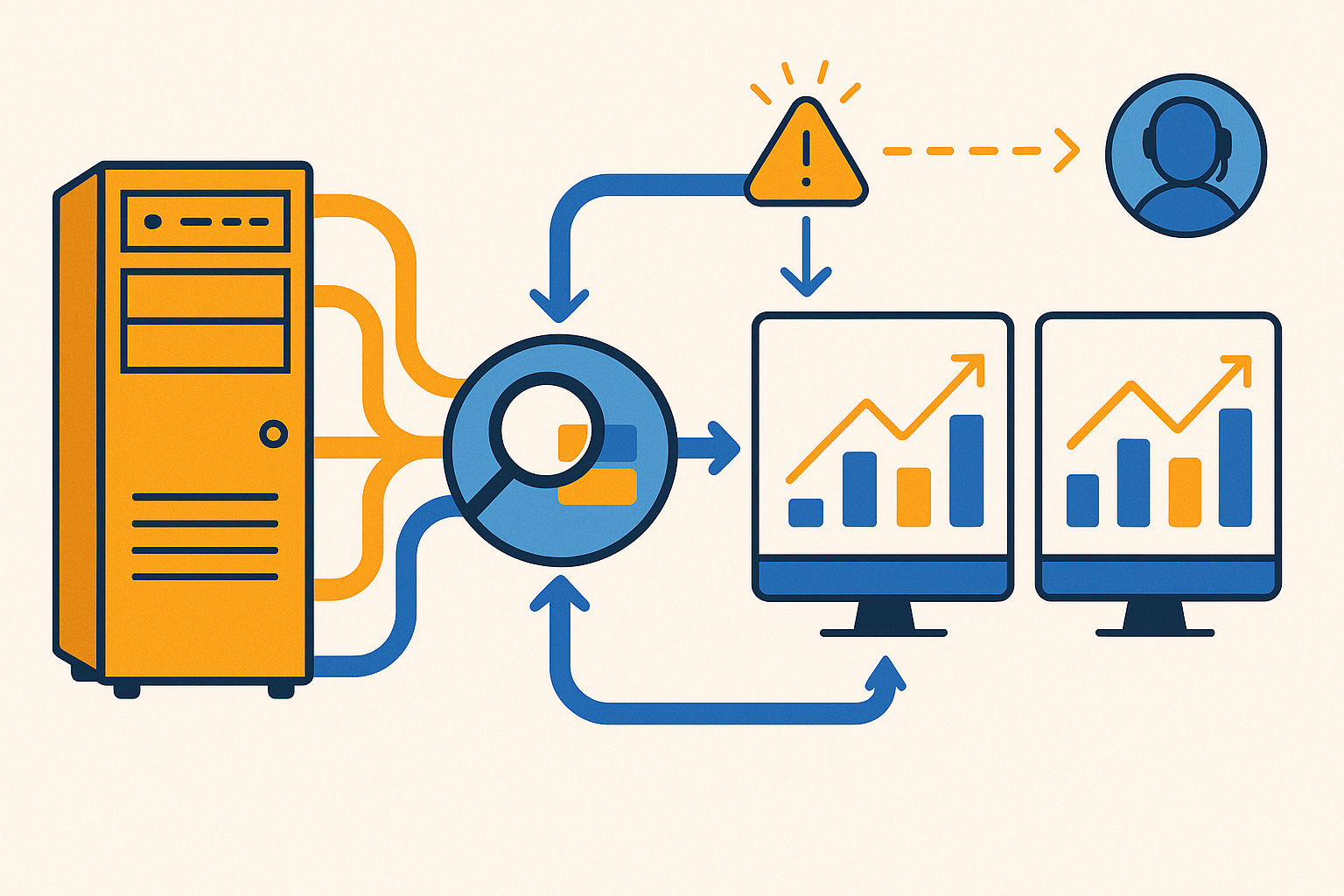
Validating and supporting BI outputs in legacy systems requires a structured approach to ensure continuity and reliability. Managed support plays a crucial role in this.
- Ensure continuous monitoring of data flows to detect unexpected changes in legacy systems quickly.
- Implement parallel reporting tests to identify differences between new dashboards and legacy reports at an early stage.
- Explicitly define responsibilities for data integration and semantic transformations to prevent misunderstandings.
- Use a structured BI reconciliation plan to support the transition from validation to management.
The role of managed support in BI integrations
In BI integrations with legacy systems, managed support is not an optional addition but a necessary condition for continuity and reliability. The source environment of legacy systems continues to evolve, which means unexpected changes in data structures or relationships can occur. Without structured monitoring and management, these changes may go unnoticed, causing extraction processes to stop or dashboards to display outdated information without anyone realising. This risk is increased because overnight extractions can fail silently when schemas change, while the dashboard provides no direct alert. As a result, operational or financial decisions may be made based on incorrect data without the problem being immediately visible in the reporting environment.
Managed support provides an operational framework in which not only the availability of connections is monitored, but also the traceability and timeliness of reports are continuously checked. This includes actively monitoring extraction jobs, identifying data anomalies and responding quickly to incidents resulting from changes in the source environment. The degree of relational integrity in the legacy landscape also determines whether reconciliation can take place directly at KPI level, or whether more in-depth data profiling is first needed to identify source contamination or missing constraints. This makes it quicker to determine, when a discrepancy occurs, whether its cause lies in the source, the connection or the reporting logic.
Sources for this section: easy.bi, datafold.com, nitorinfotech.com
Why BI validation and support are essential
A dashboard can be technically available yet still provide an insufficient basis for executive reporting. That risk is significant when the reporting logic of a legacy system has not been fully documented. Existing reports may contain implicit filters: conditions that affect the outcome but are not documented. When a new dashboard is built on assumptions, a difference emerges only when users compare specific figures side by side.
The consequences extend beyond a correction round. End users may discover discrepancies during ad hoc checks, after which management does not grant formal approval. Outdated Excel shadow systems then remain in use alongside the new dashboard. The organisation is left without a single reporting solution, but with two competing interpretations of the same business information. The discussion shifts from the content of the KPI to the question of which overview is authoritative.
Superficial sample validation does not provide a sufficient basis here. A team may check a few obvious records and find alignment, while situations involving year-end adjustments, split invoices or credit notes remain out of view. These very exceptions can lead to differing outcomes after go-live. A validation process should therefore accommodate cases in which historical processing differs from the most common pattern.
Ongoing support becomes meaningful once validation is treated as a repeatable control rather than a one-off test before delivery. It helps the organisation identify new differences, trace them back to the reporting logic used and assess them before they grow into a trust issue. For management teams, this means that not only the presentation, but also the origin and assumptions behind a KPI remain open to discussion and verification.
Sources for this section: dataexcellence.nl, nitorinfotech.com
When is BI validation necessary?
BI validation carries greater weight as soon as a new dashboard starts delivering the same management information as an operational legacy report. In that case, a comparison at a single point in time is insufficient, because differences can also arise from batch timings or different filter application. Parallel reporting tests provide a concrete assessment in that situation: the new dashboard is placed directly alongside the operational legacy report across consecutive closing cycles. This makes discrepancies visible before the new output is used as the basis for management reporting.
This approach is particularly suitable when an organisation does not merely want to establish that individual values appear plausible, but wants to know whether both reporting paths support the same outcome and interpretation during recurring closings. A difference is then not an abstract quality issue; it becomes a point for investigation with a clear context: batch timing or the application of filters.
The order of approval also determines whether validation becomes useful for governance. A structured sign-off methodology has technical data validation by IT precede substantive validation by business controllers. Final executive approval follows. This way, each party assesses the area it can oversee: first the technical alignment, then the meaning of the figures and only then acceptance for management purposes. BI validation is therefore necessary when a dashboard takes over an existing reporting function and when formal approval depends on demonstrable alignment between technology, content and governance.
Sources for this section: easy.bi, a1qa.com
Key criteria for BI validation
The following criteria make clear whether a validation process not only identifies differences, but also clearly defines what a discrepancy means and who can assess it.
| Criteria | What is assessed | Decision implication |
|---|---|---|
| Alignment with historical reporting | Whether new BI outcomes must align exactly with existing legacy reports, including their calculation logic. | Exact alignment can reduce user resistance because the outcome remains recognisable. At the same time, this choice may perpetuate historical calculation errors. This criterion therefore requires an explicit choice: should the dashboard primarily serve as a faithful continuation of existing reporting, or as the starting point for corrected formulas? With the second approach, temporary acceptance discussions may arise precisely because the new outcome differs from what users are accustomed to. |
| Definition of responsibility | Whether it is clear which work falls under data integration and semantic transformations, and which limitations originate from the quality of the legacy source system. | A contractual definition prevents source limitations from being treated unnoticed as a shortcoming of the BI layer, or transformation choices from being incorrectly regarded as an unchangeable characteristic of the source. This creates a verifiable distinction between responsibility for the integration and the inherent quality and limitations of the legacy system. That distinction also supports the assessment of identified discrepancies: not every difference points to the same cause or requires the same follow-up action. |
These choices guide the reconciliation plan: they determine which historical comparisons are needed, who assesses differences and what is documented during the handover to management.
A structured plan for BI reconciliation
A structured BI reconciliation plan consists of a series of steps that make the transition from validation to management controllable, particularly when dashboards depend on legacy systems. The following components together form a practical framework:
- Formal comparison of historical periods. Before go-live, carry out a systematic comparison between key figures in the new dashboard and those in existing legacy reports across several closed quarters. This prevents discrepancies from emerging only during management meetings and provides an objective basis for documenting and assessing differences. Record the results as part of the decision-making file.
- Documenting sign-off by relevant stakeholders. Ensure that both technical and business owners explicitly approve the reconciliation results. This makes clear who has assessed which discrepancies and under what conditions the dashboard is considered reliable for operational use.
- Ongoing monitoring and incident handling after go-live. After the formal handover, the reporting chain remains dependent on active monitoring of data pipelines, checks on data timeliness and clear agreements on response times for incidents in batch jobs or API connections. These agreements should cover not only response times, but also the diagnostic, recovery and escalation procedures to follow. This shifts attention from demonstrating alignment to managing changes and incidents in the daily reporting chain.
Sources for this section: nitorinfotech.com
Frequently asked questions about BI validation and support
Frequently asked questions about BI validation in legacy systems focus on the duration of parallel test periods and the role of managed support after go-live.
- “Should a parallel test period last as long as possible to build sufficient confidence?”
A longer parallel test period can increase management confidence because new dashboards and legacy reports can be compared directly across multiple closings. However, this comes with an operational burden: key users perform duplicate checks throughout the test, and legacy licences remain active for longer. The duration is therefore an explicit trade-off between the desired level of assurance and the additional daily workload. Without clear agreements on what additional evidence an extension should deliver, a test process can continue unnecessarily long. Conversely, a period that is too short may cause relevant differences to go unnoticed. A period of 60 to 90 days can serve as a benchmark range when multiple closings and exceptions need to be assessed; however, the appropriate duration depends on the reporting cycle and the cases the validation must cover.
“What changes after the transition to managed support?”
After go-live, the focus shifts from running operations in parallel to actively monitoring discrepancies in the reporting chain. Managed support focuses on identifying incidents, following up exceptions and ensuring continuity. The chosen test duration remains relevant, because unexamined differences may still become visible after go-live. Managed support can identify and resolve incidents more quickly, but it does not remove the need for a well-substantiated validation phase beforehand.
Sources for this section: a1qa.com
Key considerations for BI validation and support
The handover of BI to management becomes stronger when approval is not only recorded as a decision, but also remains available as a verifiable file.
- Turn validation into a transferable evidence file. A formal evidence file, sometimes referred to as an Evidence Package, brings together the validation artefacts that managed support needs after go-live to understand and manage the reporting chain. It may include data mappings, automated reconciliation scripts, test results for each historical period, exception logs and signed sign-offs for each metric owner. Each component serves a different purpose. Data mappings show how source data has been incorporated into reporting. Reconciliation scripts document how the comparison was performed. Test results for each historical period show which periods were assessed. Exception logs retain differences that could not be dismissed as normal outcomes. Finally, signed sign-offs for each metric owner link acceptance to an identifiable responsibility. Together, this file makes the transition from project validation to ongoing support manageable: later questions about a figure, a discrepancy or the status of a previously investigated case do not have to rely solely on verbal knowledge. It also marks the boundary of what has been validated and accepted. As a result, managed support can build after go-live on documented mappings, checks, historical test outcomes and exceptions, rather than having to reconstruct that context. This keeps it clear in subsequent questions which checks were performed, which exceptions were accepted and who was responsible for them.
Sources for this section: dataexcellence.nl