

For a fast, controlled start with AI personalization, it is best to choose one type of suggestion at one customer moment in one channel. Choose a context in which an error has no direct legal or irreversible financial consequences, determine in advance what level of uncertainty is acceptable, and ensure there is a fixed standard experience when personalization cannot be applied.
Strategies for a phased AI personalization roadmap
When implementing AI personalization, it is crucial to define a roadmap that delivers visible results quickly without increasing operational risks. This requires a strategic approach in which a visible customer moment does not immediately require a broad system change.
- Start with a defined decision context: one suggestion type, one customer moment, and one channel or user group.
- Use a predetermined standard experience when personalization is not usable or reliable enough.
- Ensure data readiness and validate data before implementation.
- Assess technical feasibility and weigh rapid external integrations against long-term manageability.
- Determine the acceptable uncertainty tolerance and the consequences of errors in advance.
How to define a phased personalization roadmap
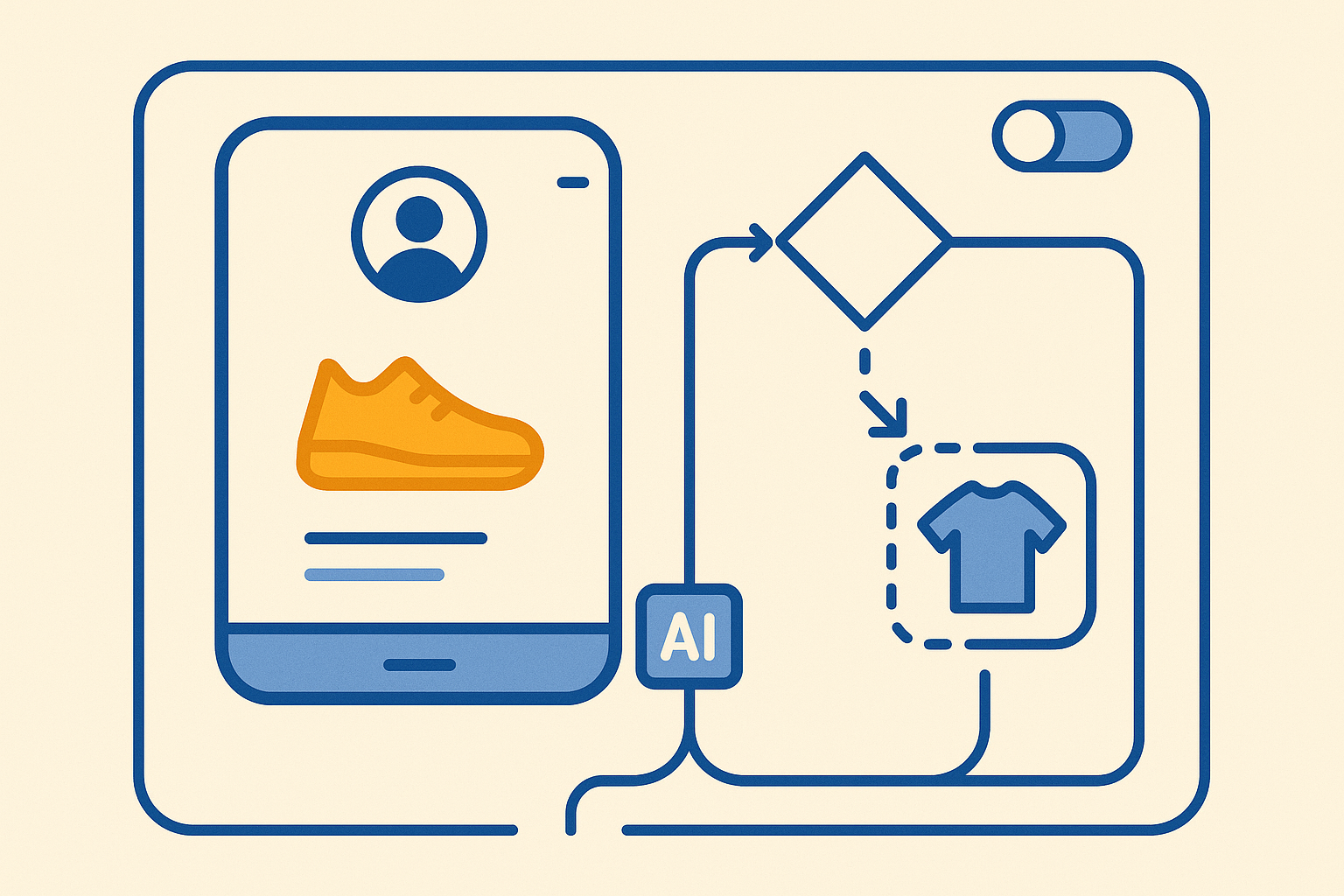
A phased personalization roadmap does not begin with the question of which AI model can do the most, but with the question of which decision in phase one is limited enough to be visible without broadly affecting the business process. Leadership often wants to see a demonstrable result within the quarter. However, that result does not need to come from personalization across all channels, for all customer groups, or at every commercial step.
In practical terms, this means phase one includes one type of suggestion, one moment in the customer journey, and one limited user group or one channel. Personalization then remains a proposal within a controlled context, rather than becoming a layer that affects numerous existing processes at once. This creates room to assess the quality of the outcome before additional dependencies are introduced. Choose a decision for which an incorrect prediction does not cause direct legal, compliance, or irreversible financial harm.
That boundary is more than a risk category; it determines what constitutes a suitable first use case. When a personalization outcome directly executes a decision with lasting consequences, it is less suitable for a fast initial phase. When the same outcome only produces a limited suggestion and a safe default remains available, the margin for error is more manageable. Therefore, define in advance what degree of uncertainty is acceptable and which consequences fall outside that tolerance. This prevents a highly visible demonstration from quietly becoming an operational obligation.
The standard experience is a fixed part of the design. If personalization is not sufficiently reliable, the customer does not receive a random outcome after all, but a predetermined regular suggestion. The customer interaction remains available, while the AI outcome is not the only route to a decision.
For further phasing, an deployment approach is appropriate in which model updates, data validation, and rollback options are handled reproducibly. Continuous Delivery for Machine Learning provides principles for automatically deploying changes without downtime. This enables an organization to expand purposefully after phase one, because boundaries, acceptance conditions, and recovery options are already included in the roadmap.
Sources for this section: martinfowler.com, bhaskarboruah.com
The tension between speed and diligence in AI personalization
A limited initial scope not only prevents technical complexity; it also makes clear where data issues surface in the customer interaction. Missing fields, duplicate profiles, or outdated transaction history can produce a suggestion that does not fit the customer’s current context. If such data is immediately used across multiple channels, teams must assess outcomes afterward, correct exceptions, and explain interactions that do not align with the customer’s actual situation.
The practical question is therefore not only whether data is available, but whether that data is suitable for the exact customer moment selected. Targeted validation beforehand can, for example, reveal which data source is authoritative, which data is missing, and when a profile does not provide a sufficient basis for a personal suggestion. As a result, speed is defined as a controllable launch with a limited learning task, rather than connecting as many channels and data sources as possible at the same time. What is learned at this stage about data quality and exceptions then becomes input for the next expansion.
Sources for this section: martinfowler.com
When is the right time for AI personalization?
The right time for AI personalization is not determined solely by a quarterly deadline or the desire to show a visible demo. It depends on whether the first application can operate with a limited, available, and validated starting point. When the organization needs to combine data from multiple silos, multiple channels, and varied processes for an initial use case, the actual challenge shifts from personalization to a broad integration effort. That may be appropriate for a later phase, but it offers little certainty for a controlled short-term launch.
A more suitable starting point arises when there is one channel in which historical transaction data is directly available and validated. This limitation reduces dependence on other data flows and makes the question more concrete: can this one form of suggestion be presented in a valuable and responsible way under known conditions? Evaluation of the outcomes also remains closer to the original business objective, because fewer factors change at the same time.
The timing is only defensible when an alternative also exists for situations in which the reliability of personalization is not high enough. With confidence thresholds, predefined reliability boundaries, it can be determined when the application does not show a personalized outcome. Cold-start heuristics are simple default rules for customers with too little historical data, such as a suggestion based on category trends or popularity. This keeps the experience useful without suggesting that every recommendation is equally personal or reliable.
This also makes an initial launch suitable when the customer base or available historical data does not yet have the same depth everywhere. Rather than delaying deployment until every customer group has sufficient data, the application can start in a limited way where the conditions are present. The standard route remains available for other situations. That route is not an emergency measure afterward, but a preselected part of the customer interaction.
The practical timing rule is therefore: start when one channel with validated historical transaction data is available and when the application can automatically fall back to a useful standard when reliability is insufficient. If either condition is missing, preparation is more meaningful than a broad initial rollout.
Key criteria for AI personalization in phase one
When selecting an AI personalization use case for phase one, four criteria help make a choice under time pressure that delivers visible results and remains manageable within the existing organization and infrastructure.
- Customer impact and correctability. Choose an application that is noticeable to the customer, but where an incorrect outcome does not immediately lead to irreversible consequences. It should be a customer moment that is visible to leadership, without incorrect personalization immediately damaging a process or customer relationship. The ability to correct or revise outcomes is more important at this stage than maximum reach.
- Technical feasibility versus demonstration speed. A rapid demo through external cloud APIs may be appropriate when speed, limited integration, and a temporary or clearly defined application take priority. Custom integrations within the organization’s own backend can offer more control when management, data processing, and future expansion carry greater weight. Costs and dependencies differ by volume, contract, and maintenance burden; therefore, assess both routes based on the selected scope, not only on the speed of the first demo.
- Integration effort as a boundary. Clearly identify which connections are genuinely necessary for the selected customer moment. The more systems that must be directly involved, the greater the risk of delays caused by dependencies outside the immediate scope. Limited integration in phase one makes deployment more manageable and prevents too many process changes from having to be coordinated at once.
- Organizational readiness and data accountability. Ensure it is clear where user data is processed and how it can be traced through the system. Transparency regarding data location and data lineage supports the assessment of data-processing obligations, including the GDPR, and helps substantiate internal decision-making. Insufficient clarity can result in a technically functioning solution still becoming stalled by questions about data use and accountability.
Sources for this section: martinfowler.com
A structured framework for AI personalization decisions

Use this framework to design a personalization decision in a way that prevents a probability-based outcome from becoming a customer action without control. The framework separates suggestion, assessment, and execution.
- 1. Treat the model outcome as a proposal, not as the action itself. A personalization outcome is probabilistic: it provides an estimate, not an established fact. Therefore, place a clear boundary between the output and what the customer ultimately sees or receives. API isolation layers are intermediaries that keep the model outcome separate from the executing application. This creates a separate point at which the organization can determine whether a proposal may be used within the agreed context.
- 2. Set validation logic in the web application. The application layer is where rules are applied before a proposal results in a customer action. In Laravel service layers, validation logic can prevent invalid data or price deviations from being passed on. This prevents personalization from acting outside the agreed business boundaries. The issue is not refining the model itself, but determining which outcomes may affect the customer journey at all.
- 3. Link every validation outcome to a fixed standard route. When validation blocks a proposal, the customer interaction should not become unclear or come to a halt. Therefore, determine in advance which regular suggestion or action follows. The organization can assess that route for customer-friendliness and operational consequences, even when price, data quality, or other business conditions exclude a personalized proposal.
- 4. Make changes testable before they have broad impact. Continuous Delivery for Machine Learning links the deployment of personalization to automated regression tests, model version control, and ongoing monitoring for data drift. Regression tests support checks that previously working components continue functioning after a change. Version control makes it traceable which model variant is active. Data-drift monitoring keeps track of changes in the data used by personalization.
- 5. Assess expansion against the agreed boundary. Expand only when the separation between proposal and execution remains intact, validation rules prevent undesirable outcomes, and the standard route is usable. This makes growth a decision based on demonstrable control, rather than an automatic continuation of a working demo.
Sources for this section: martinfowler.com
Frequently asked questions about AI personalization in phase one
The following questions concern a recurring objection to an initial personalization phase: does a limited approach deliver sufficient results, or does the organization remain stuck with a temporary solution?
- “Is a hybrid approach not too limited to show real results?”
A hybrid scoring model combines personalization with fixed business rules. This limits the extent to which the application responds fully autonomously and dynamically, but it makes the boundaries predictable. For an initial rollout, this can be useful: the organization shows a personal experience where the outcome is appropriate, without making every customer interaction dependent on an autonomous decision. - “Why not choose fully autonomous, dynamic personalization straight away?”
Full autonomy can seem attractive when leadership expects speed and innovation. However, it also carries a greater risk of failure: an unsuitable outcome reaches the customer without predefined rules first limiting the action. The choice is therefore not between progress and stagnation, but between broad autonomy with more uncertainty and a controlled application that can be expanded later. - “Will guardrails become a permanent brake on further development?”
Not when they are treated as explicit conditions for customer actions. Fixed rules make visible which outcomes the organization does and does not want to allow through. This provides a basis for assessing later expansion in a targeted manner: a new application receives more room only when it is clear which rules still apply and which boundaries can responsibly change. - “Is a standard route for customers without suitable personalization a sign that the solution falls short?”
No. In an initial phase, that route prevents the application from simulating a personal suggestion when the underlying score provides an insufficient basis for it. The customer still receives a predictable interaction. This means the goal of a more personalized offer does not depend on an outcome that may appear arbitrary or unsuitable. - “What concession are we actually making in phase one?”
The organization does not immediately choose the most autonomous form of personalization. In return, it gains an initial application in which the boundaries of customer actions are known in advance. The trade-off is therefore between speed with control and radical innovation with a greater risk of failure.
Important considerations for AI personalization in phase one
An initial rollout is stronger when it is clear not only what is shown, but also how an undesirable outcome is immediately removed from the customer journey. The considerations below make reversibility concrete.
- Make the rollout independently switchable. Feature toggles make it possible to activate and deactivate personalization by channel or user group. This means a change does not have to be visible everywhere at once. An organization can limit the application to the group or channel intended for the first phase, while other customer interactions remain unchanged.
- Treat rollback as part of commercial usability. An explicit rollback architecture makes it possible to deactivate personalization immediately and without downtime. This is not only relevant for managing the application. When personalization does not fit the customer context, continuing it can lead to remediation work in commercial and operational processes. The ability to switch back limits the period during which an undesirable outcome remains visible.
- Determine in advance who makes the switching decision. A feature toggle only has value when it is clear under which circumstances it will be used. The responsible person must be able to determine whether a deviation falls within the acceptable boundary or is a reason to disable personalization for a channel or user group. This prevents the technical ability to roll back from existing while decision-making about it only begins during an incident.
- Use channel- and group-specific control as a bridge to subsequent phases. Being able to activate and deactivate personalization separately makes expansion less all-or-nothing. The organization can assess differences between channels or user groups individually and retain a separate recovery option for each new scope. This keeps the impact of a customer-facing error limited, even as the roadmap continues to grow.
Sources for this section: martinfowler.com
This article does not provide legal advice. Applicable obligations depend on the purpose, functionality, user context, and risk classification of the system. Have the specific application legally assessed before production use.