

A maintenance retainer for Laravel applications provides support based on individual requests. An operating model for managed support focuses on the application's ongoing operation, with planning, version management, and explicit governance. The difference is therefore not only in available hours, but above all in how recurring risks and maintenance work are organised.
Choosing between a maintenance retainer and managed support for Laravel
The choice revolves around the allocation of ownership, the internal capacity required, and the desired predictability of changes.
- A maintenance retainer suits occasional changes and organisations that can manage priorities, risks, and releases themselves.
- Managed support reserves attention for planned maintenance, version management, and structured follow-up.
- Ad hoc support can burden internal IT teams with coordination, prioritisation, and escalations.
- Internal management requires sufficient technical capacity; managed support can take over operational tasks within an agreed scope.
- Controlled release processes increase predictability but leave less room for immediate ad hoc changes.
What distinguishes a maintenance retainer from an operating model for Laravel?
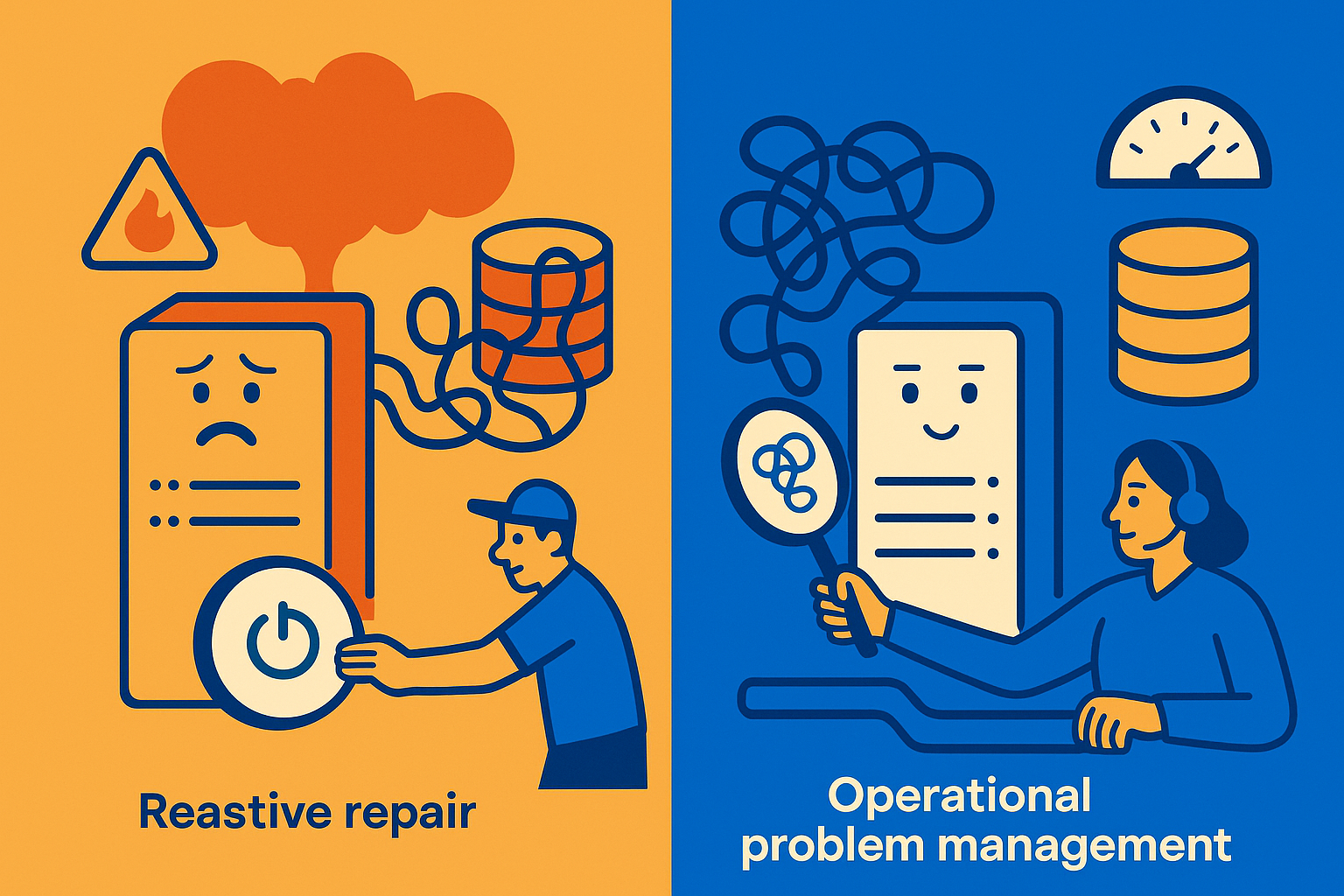
At its core, a maintenance retainer for a Laravel application is an agreement on available capacity. The organisation reports a bug, a desired update, or an outage, after which the supplier uses hours to handle that specific task. That model can be appropriate when the application is straightforward, the internal organisation manages priorities, risks, and release decisions itself, and support is mainly needed occasionally. The supplier then primarily works on request: without a ticket, there is generally no reason to intervene structurally.
An operating model for managed application support shifts the focus to the application's ongoing operation. This includes a distinction between incident management and structural problem management. An incident requires the restoration of service; problem management investigates why the incident could occur and which underlying cause may allow recurrence. A root cause analysis (RCA) can help not only restore recurring disruptions, but also plan them as improvement work.
Operational ownership does not mean that the organisation transfers its business responsibility. Functional choices, priorities, and risk acceptance remain decision points for the organisation. However, responsibilities for technical operation are explicitly assigned and made manageable. Governance makes clear who handles an escalation, who assesses changes, and how progress on structural actions is tracked. This creates a fixed rhythm for managing dependencies and balancing restoration work against improvement work.
The distinction becomes clear in a hypothetical example. Suppose a Laravel worker fails because of a memory leak. A reactive intervention may consist of restarting the worker and increasing the available memory limit within the ticket budget. If an unoptimised query remains the real cause, the load can increase as data grows until database connections are exhausted during a peak. The first report is then closed, but the cause of a broader disruption has not been removed. An operating model provides room to investigate the cause and schedule this structural work.
This difference affects the internal IT organisation. With ad hoc support, coordination, prioritisation, and crisis escalations can easily remain with the internal team. That burden can take time away from digitalisation projects and makes continuity dependent on individual availability. The choice is therefore not only about the number of development hours, but also about who safeguards operational coherence.
Sources for this section: itsm.tools, atlassian.com
Why is the choice between maintenance and managed support important?
For organisations with limited internal IT capacity, the choice directly affects continuity and risk management. In a purely reactive maintenance arrangement, the supplier waits for tickets, and updates often receive attention only when an urgent report is made. Without fixed lifecycle planning, Laravel, PHP, and dependency updates can therefore remain pending longer than desired. When an upgrade eventually has to be performed under time pressure, the likelihood of disrupting production integrations and internal planning increases.
The absence of release planning can also have consequences. If maintenance work is continuously combined with functional changes, security patches or necessary dependency updates may be delayed. Unexpected rollbacks and emergency interventions can then put the initial simplicity of a reactive model under pressure. This is especially relevant when no one internally systematically monitors the relationship between updates, releases, and incidents.
A managed support model instead establishes a work process for structured planning, version management, and governance of maintenance work. Rather than assessing upgrades only after an incident, relevant changes are periodically reviewed and scheduled based on the application situation and available testing and acceptance capacity. For organisations without their own development team, this makes maintenance more predictable because it is not entirely dependent on occasional capacity.
Sources for this section: securinglaravel.com, atlassian.com, nist.gov, iflair.com
When is a comparison between maintenance and managed support relevant?

A comparison between basic maintenance and a structured managed support model becomes relevant once operational requirements go beyond resolving individual incidents. With corrective maintenance alone, patterns can remain out of sight: the same error is fixed, while the internal IT manager has to notice that reports are recurring. That indicates a need not only for restoration capacity, but also for analysis and follow-up.
The need for a structured model becomes clear when work expands to adaptive maintenance, such as dependency and PHP upgrades; preventive maintenance, such as security scans and code quality; and perfective maintenance, such as performance improvements and refactoring. These activities can easily compete with urgent tickets and new functionality. A fixed management scope makes visible which work is scheduled, which risks are waiting, and who decides on them.
The same applies when changes can no longer take place without formal control. Automated release validations and clear change processes can increase predictability, but require predefined authorities and acceptance points. The consideration is then less about the label of the service and more about whether the internal team can sustainably maintain this management discipline itself.
Sources for this section: iteh.ai, itsm.tools, atlassian.com
Comparison of maintenance retainers and managed support models
Service names differ by supplier. The comparison below therefore does not provide a fixed product definition, but specific points for assessing scope, ownership, and governance. A retainer may include additional arrangements; managed support is only recognisable when the operational components are also explicitly assigned.
| Aspect | Maintenance retainer | Managed support model | What to assess |
|---|---|---|---|
| Management of work | Work generally starts from an individual request or ticket. The client decides for each issue whether hours are used. | The application is monitored according to a fixed management scope, alongside the handling of reports. | Ask which activities are scheduled even without a new ticket and who directs them. |
| Ownership | In practice, the internal organisation retains substantial control over priorities, follow-up, and escalation. | Technical platform ownership, functional management, and compliance are explicitly allocated. | Record the allocation in a RACI matrix, so it is clear for each activity who performs, decides, is consulted, and is informed. |
| Governance | Consultation can take place as needed and often focuses on outstanding work. | Periodic service reviews, formal escalation routes, and clear responsibilities are a fixed part of the service. | Assess whether reviews lead to decisions, follow-up, and a shared view of open risks. |
| Version and dependency monitoring | Updates receive attention when requested or when an incident forces them. | Laravel, PHP, and Composer dependencies are periodically reviewed and scheduled in coordination with each other. | Ask how the partner tracks relevant support information and prevents necessary updates from waiting unnecessarily. |
| Release decision-making | Functional requirements, dependencies, and security work can end up in one workstream. | Changes are assessed separately and scheduled in a controlled manner. | Determine whether necessary dependency and security updates can proceed independently of outstanding functional requirements. |
| Risk of delay | When updates are held up in acceptance because of other changes, exposure to security risks may continue. | Release governance makes visible which change is waiting, why it is waiting, and who makes a decision. | Ask not only about response time, but also about the process for blockers, escalation, and approval. |
Sources for this section: securinglaravel.com, itsm.tools, atlassian.com, nist.gov, iflair.com
What are the trade-offs between maintenance and managed support?
The models allocate ownership, control, and risks differently. The main trade-offs are not only in speed, but also in the quality of the change process and the visibility of management activities performed.
- Immediate change flexibility versus controlled releases. A maintenance retainer makes it easy to carry out changes as individual assignments. Without a fixed validation route, however, it is less certain that maintenance changes will be thoroughly tested before going into production. In a managed support model, CI/CD test pipelines, staging validation, and rollback procedures can form part of the management agreements. This helps assess the impact on critical integrations, such as ERP or CRM systems, in advance. The downside is that changes follow an established process and therefore cannot always be implemented immediately.
- Outsourcing management versus transparency. Managed support can take over operational tasks, but the organisation retains governance responsibility. When a supplier promises broad relief without insight into patch levels, availability, or tested backup recovery, a black box emerges. Transparent reporting therefore makes clear which activities have been performed, which risks remain open, and which decisions are still needed. With a retainer, this administration more often remains internal; with managed support, execution shifts to the partner, but the need for insight and oversight does not.
Sources for this section: atlassian.com
Frequently asked questions about Laravel maintenance and managed support
The following questions concern the allocation of control and capacity, not a technical comparison of frameworks. The answers help translate contract language into the practical operation of the support model.
- Do I lose all control over the Laravel application with managed support?
Not necessarily. The difference lies in which operational decision-making authority and patch authorisation are delegated to the partner. If the organisation retains full internal control over the use of hours, this also requires substantial technical capacity for backlog management. Someone must then determine which maintenance takes priority, which change is authorised, and what consequences a delay has. In a managed model, the partner can make operational decisions and carry out patch authorisations within an agreed scope. This does not replace the organisation's governance choices, but it reduces the need to organise every technical step separately internally. A useful arrangement explicitly states which decisions the partner makes independently, which require prior approval, and how deviations are escalated. - Can we focus all available capacity on new features and schedule maintenance later?
That may seem attractive in the short term, but feature development displaces stability work when capacity is not structurally reserved for preventive maintenance, refactoring, and dependency upgrades. The question is therefore whether both types of work are given an explicit place in planning. A retainer can provide this when the organisation consistently monitors that reservation itself. In a managed model, this can form part of the operational scope, provided that there is also room for preventive and improvement work.
Sources for this section: iteh.ai, atlassian.com
Key considerations when choosing a Laravel support model
A useful selection starts with evidence of how management is carried out, rather than the name of the package. The criteria below make it possible to assess the difference between available development capacity and a managed operating model. They link technical control to the question of which financial and operational risks the organisation still bears itself.
- Assess the release chain rather than only the promise of maintenance. Ask whether automated CI/CD test suites have been set up, for example with Pest or PHPUnit, and how a staging environment is used before a change is deployed. Also ask how deployment and rollback procedures are documented. The aim is not to prescribe a particular tool, but to establish whether a partner has a reproducible route from change to production and back. Without that route, it remains unclear how an error in a release is addressed.
- Make reporting and improvement measurable. Service reporting can provide insight into application performance, response times, queue stability, and outstanding technical debt items. More important is what happens next: ask whether recurring incidents receive an RCA, how improvement actions are tracked, and at what fixed review cadence progress is discussed. This gives continual service improvement (CSI) a practical interpretation: not as a standalone promise, but as a repeatable process of identifying, deciding, and following up. A support model is manageable when data, decisions, and responsibilities align.