

Optimization is suitable when bottlenecks are local and the relational data model still supports the business processes. A rebuild is better when structural limitations obstruct the roadmap or require extensive integrations.
Optimization versus Rebuild for Laravel Growth
When choosing between optimization and a partial rebuild of a growing Laravel application, costs and risks play a crucial role. The decision depends on the nature of the constraints and their impact on business processes.
- Identify whether bottlenecks are local or form a structural obstacle to growth.
- Assess whether the relational data model still aligns with business processes.
- Consider a partial rebuild for modules that block strategic growth or require extensive integrations.
- Use DORA metrics to track the impact of architectural debt on delivery speed and reliability.
- Apply the Strangler Fig pattern for phased modernization without a full rebuild.
When should you optimize or rebuild a growing Laravel application?
The choice between optimization and a partial rebuild does not start with the age of a Laravel application, but with the location and nature of the slowdown. An application may contain technically outdated components and still continue to grow in an economically sound way, as long as the constraints are local. Consider slow queries or missing indexes: such bottlenecks are contained and can be addressed through targeted optimization or local refactoring. This route remains financially defensible when the relational data model still accurately represents current business processes. The core of the system does not then need to be questioned; the effort focuses on the components that demonstrably limit lead time or performance.
The boundary shifts when a problem is no longer a local performance issue but a structural obstacle to the roadmap. A specific module may, for example, change so often that every change affects many dependencies. That module may also block strategic growth or require extensive external integrations that are difficult to fit into the existing structure. In that case, a partial rebuild is often more logical than continuing to optimize within the same constraints. Stable modules with a low rate of change can remain in place. This directs investment capacity toward the domain where business pressure is highest, without the continuity risk of replacing the entire application.
Delivery metrics can make the conversation more objective. DORA metrics are indicators of the speed and reliability of software delivery, including Lead Time for Changes and Change Failure Rate. Use these metrics primarily to track your own progress over time: are lead times increasing, or do changes more often result in rework? The outcomes are not an automatic instruction to rebuild, but they can reveal that slow delivery and failed changes are not only a development problem. They may point to an economic tipping point that requires further investigation.
For management teams, the relevant question is therefore not “optimize or rebuild” as two absolute options. The question is which part of the Laravel application is holding back the intended growth, whether that part is sufficiently contained, and whether the existing data structure still fits the processes the organization wants to support. Local shortcomings require local interventions. A changing or integration-intensive core domain requires a contained replacement, while the rest of the landscape remains operationally available.
Sources for this section: dora.dev, martinfowler.com, microsoft.com
Why invest in Laravel scalability now?
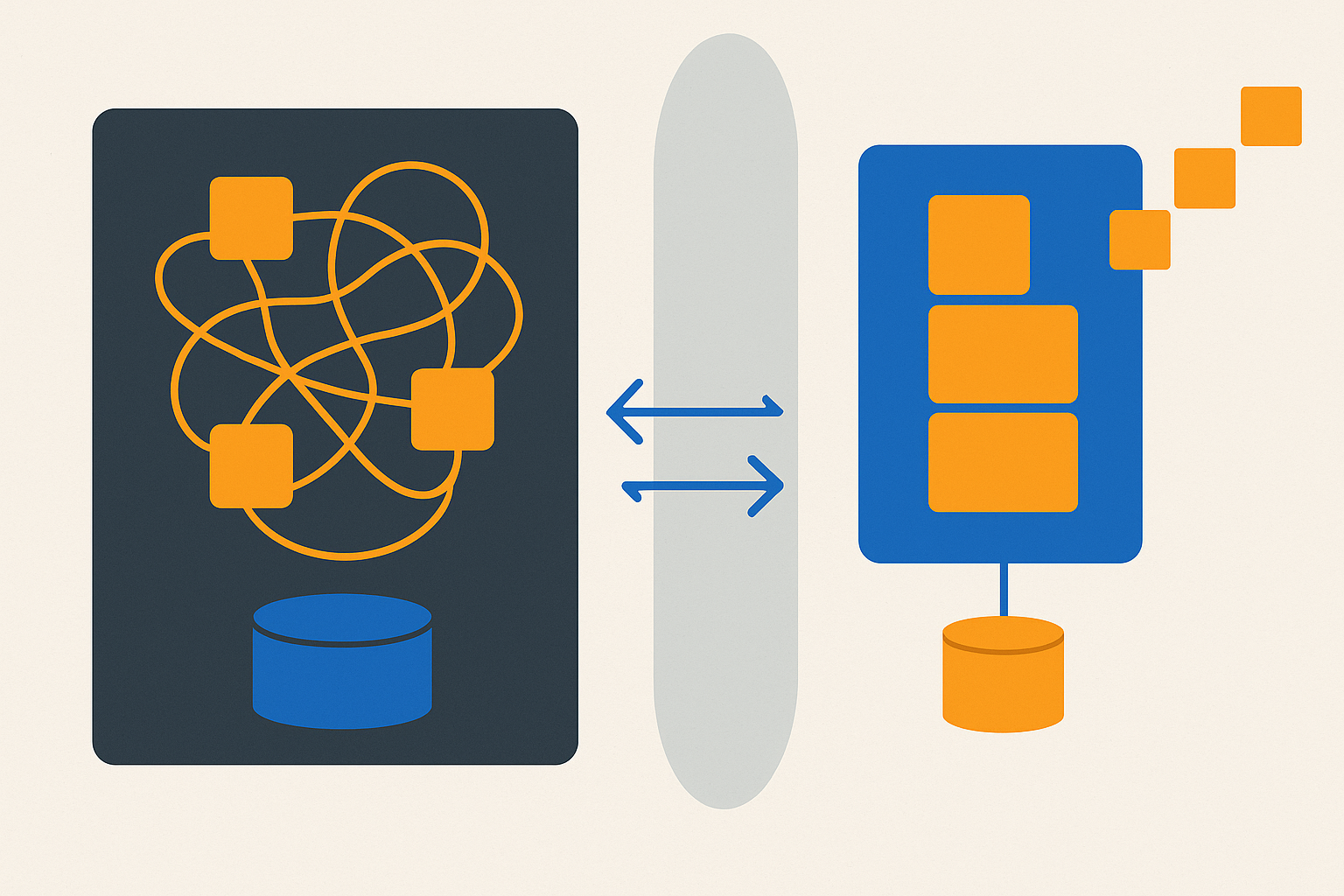
The reason to invest in Laravel scalability rarely arises from an immediate outage, but rather from a gradual shift in development practice. As an application grows, maintenance, bug fixes, and dependencies in the codebase consume a larger share of planning. This leaves less capacity for new functionality and makes releases less predictable. Technical debt only becomes truly relevant when it noticeably displaces product development and process improvement.
When temporary workarounds and fixes become a standard part of nearly every change, an invisible cost emerges: the actual price of feature delivery becomes unclear. No single isolated problem is decisive; rather, it is the recurring pattern in which teams must first understand or compensate for outdated dependencies before they can deliver value. The budget thus shifts from product development to maintaining existing structures, without this always being visible in project planning.
Phased modernization can provide a solution in this situation. With the Strangler Fig pattern, a specific domain is contained behind a façade or API layer, after which new functionality can be developed outside the legacy codebase. An Anti-Corruption Layer can protect the translation between old and new, preventing limitations from the existing model from being automatically carried over. During the transition, this requires strict control of architectural boundaries and data synchronization, because both parts temporarily continue to function together.
The time to act is determined by the balance between maintenance pressure and the ability to change. Waiting until the application visibly fails increases the likelihood of expensive and urgent interventions. By choosing targeted modernization earlier, an organization can keep the impact of technical debt manageable, free up development capacity, and safeguard the continuity of roadmap development. Investing in scalability is therefore not an abstract technical goal, but a condition for predictable growth and manageable costs.
Sources for this section: stripe.com, martinfowler.com, microsoft.com
When does optimization become insufficient?
A telling signal is when an apparently limited change repeatedly leads to adjustments in multiple modules, unexpected rework, or delays in integrations. Then it is no longer only about performance optimization, but about an architecture that limits the system’s ability to change and capacity for growth. In that case, every new feature carries a recurring development premium because teams must first navigate existing dependencies and workarounds.
The business impact becomes clearer when that delay structurally reduces feature velocity. If a domain repeatedly slows delivery speed, the question is no longer how to make one change possible after all, but which underlying constraint makes every subsequent change expensive. The consequences of incidents also belong in that assessment: in the event of severe outages, downtime costs can rise to €250,000 to €500,000 per hour according to the available benchmarks. This makes it relevant to assess both the cost of building and the operational vulnerability of the existing domain.
A partial rebuild becomes relevant as soon as a contained business domain demonstrably blocks growth and can be modernized independently enough. The new part needs its own domain model, protected from outdated database schemas and inconsistencies in the existing Laravel monolith. The previously described boundary and translation layer help prevent the modernized domain from inheriting the same structural limitations.
This approach is not aimed at replacing the entire Laravel application, but at restoring the ability to change and growth potential where economic and operational pressure is greatest. The part to be replaced receives a clear boundary, while the existing monolith remains available for processes that still function stably. In this way, technical debt is addressed in a targeted manner before costs and operational risks rise further.
Sources for this section: stripe.com, techdebtcost.com, martinfowler.com, microsoft.com
Risks and conditions for a Laravel rebuild
The decision to partially rebuild a Laravel application becomes relevant when the risks of further optimization within the existing structure no longer outweigh the structural constraints and operational consequences. Two factors deserve particular attention:
- Declining delivery speed due to recurring rework. Not every maintenance problem justifies a rebuild. However, it becomes a risk when the same dependencies repeatedly delay changes, cause rework, or make releases difficult to predict. The relevant question is then whether the delay is concentrated in a contained domain that can be addressed independently.
- Delays to strategic initiatives due to dependencies in the monolith. If expansions such as ERP integrations or B2B customer portals are delayed by complex dependencies in the existing Laravel monolith, the Cost of Delay increases. The risk is not only technical: new channels or processes become available later, which may put the execution of the business strategy under pressure.
Sources for this section: stripe.com, techdebtcost.com, martinfowler.com
Applying decision logic to a Laravel rebuild
A practical assessment connects the costs of continuing with the operational consequences of change. The steps below provide a phased evaluation without assuming a full rebuild as the starting point.
- Map the tipping point in feature costs. The Design Stamina Hypothesis describes how quick workarounds may initially appear faster, but how their productivity curve is overtaken after several quarters by that of thoughtful architecture. From that point on, every new feature becomes more expensive without structural refactoring or a partial rebuild. Therefore, look beyond the next change and examine the pattern over multiple quarters: are effort, dependencies, and rework per feature increasing? When that pattern is visible, it provides a business case for structurally addressing a contained domain.
- Link architectural choices to release effects. Change failure rates and production disruptions during releases introduce a direct operational risk. They can burden support departments, cause SLA breaches, and damage the reputation among business end customers. Include such consequences in the assessment of a module: not only the build costs, but also whether changes in that part disproportionately often cause rework or disruption. A partial rebuild can then be assessed as a measure for a specific risk, with a contained impact on delivery and continuity.
Sources for this section: dora.dev, martinfowler.com
Frequently asked questions about Laravel optimization and rebuilding
The assessment becomes more concrete when the transition is tested against the boundaries of the chosen domain and the way progress is monitored.
- Which component should be considered first for a partial rebuild? Do not automatically choose the oldest or most technically difficult component. Start with a domain that demonstrably slows the roadmap, affects many dependencies, and can at the same time be sufficiently contained independently. Stable components that change little do not need to be included in the first step.
- Which criteria must be clear before the transition? Define in advance which business function the new domain will take over, which data and processes cross the domain boundary, and how success will be assessed. Then track whether lead time, rework, and disruptions in the selected domain actually decrease. This keeps the rebuild tied to a concrete problem rather than an abstract desire for modernization.
- When does in-place refactoring remain the better choice? If the data model still aligns with business processes, dependencies are manageable, and problems remain local, targeted refactoring is often sufficient. A partial rebuild only becomes proportionate when those local interventions continue to work around the same bottleneck without removing its cause.
Sources for this section: martinfowler.com, microsoft.com, microsoft.com
Key considerations for Laravel optimization and rebuilding
The financial comparison becomes more reliable when it includes not only the development assignment, but also the boundary of the domain to be changed. In a partial rebuild, that boundary does not have to coincide with the entire Laravel application. Modularity through decoupling a specific domain can offer a middle ground: the organization limits investment to the part where change is needed and retains the rest of the existing operation.
- Assess financial exposure by domain. Costs do not arise only when building a new part, but also when old boundaries continue to burden every subsequent change. A contained domain makes it possible to link investment to a concrete business function rather than an abstract replacement of the entire system. This prevents stable components from being included in a change initiative without a demonstrable need.
- Make internal API contracts a firm prerequisite. Modular decoupling requires strict discipline around internal API contracts. Without that discipline, the old interdependencies merely shift into a new form. Clear contracts define which data and communication may pass between domains and therefore form the basis for a manageable transition.
- Consider the alternative: no full transition to microservices. Modular decoupling can avoid the excessive network and data-consistency overhead that a full transition to microservices may entail. This keeps the architectural choice proportionate to the problem: an isolated growth bottleneck does not automatically require a complete architectural transition.
- Focus execution on a contained risk. In a Laravel-focused analysis of existing custom software and desired digital development, an iterative, risk-reducing approach may be appropriate. Integrations, custom software, and managed services can form part of the scope when they are relevant to the selected domain. This is a possible approach, not a predetermined outcome. The operational constraint remains that contracts, translations, and data consistency must be managed while old and new function alongside each other.
Sources for this section: microsoft.com, microsoft.com