

BI modernization can be justified by first identifying and prioritizing data risks through data readiness profiling, and then applying phased decision-making. This links investments to validated source data and limits financial exposure when unexpected data contamination is found.
BI modernization with legacy data
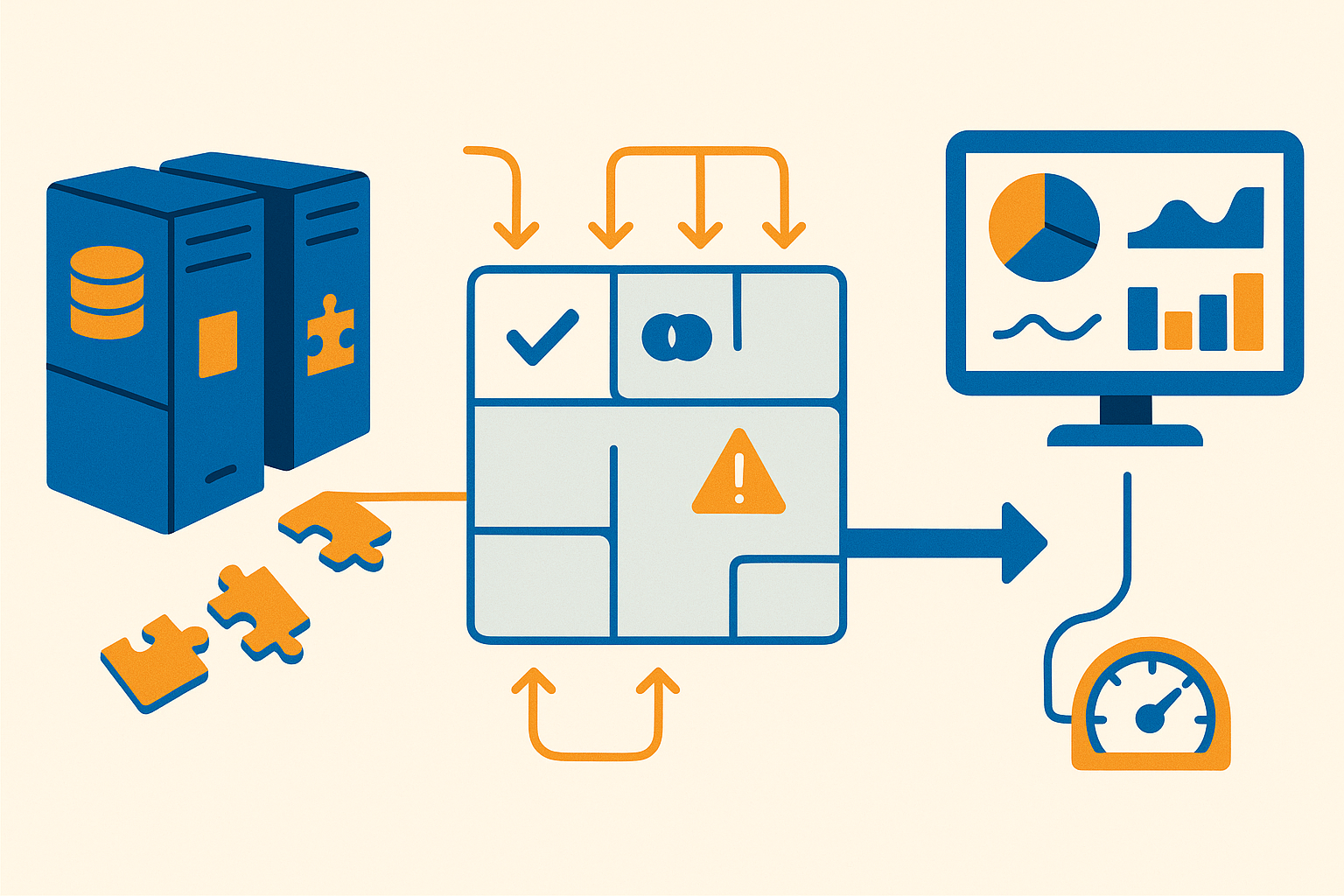
A business case for BI modernization with legacy data requires an approach that makes data quality and integration complexity visible from the outset.
- Identify and prioritize data risks through structured assessments of completeness, consistency, validity and uniqueness.
- Apply phased decision-making so that investments align with validated source data.
- Use a modular integration layer to accommodate legacy deviations and missing API structures.
- Implement automated reconciliation and monitoring to identify deviations early.
- Assess the accessibility of legacy databases and schema documentation to determine integration capacity and discovery lead time.
Why BI tooling alone is not a business case for legacy data
An investment in BI tooling is not a standalone business case when legacy data is involved. A reporting environment can present, combine and make data accessible, but it does not automatically remove uncertainty about what that data means, whether it is complete and whether the same entity appears in the same way across different sources. When these questions remain unanswered, an organization moves an existing information problem to a new reporting layer. The visual quality of a dashboard may then exceed what the underlying reliability justifies.
The business rationale therefore starts with data readiness: the extent to which available source data is usable for a defined reporting purpose. Data is sufficiently ready for that purpose only when the required fields are accessible and understandable, relevant quality assessments have been performed and known limitations have been explicitly recorded. A structured assessment of completeness, consistency, validity and uniqueness makes data risks visible and prioritizable in advance. Completeness concerns whether the required values are present. Consistency concerns whether data does not conflict internally. Validity tests whether values comply with the agreed format or meaning, while uniqueness prevents the same entity from being counted multiple times unintentionally. This translates a vague suspicion of poor data into concrete issues that can be managed.
This distinction has direct consequences for the business case. The starting point is not the purchase or implementation of tooling, but the question of which reports can responsibly be used based on which source data. A reporting domain with consistent, valid and sufficiently complete data has a different priority from a domain where duplicates or missing values can distort the outcome. Modernization is assessed by the usability of information, not solely by technical delivery.
Legacy environments add a second uncertainty. The accessibility of existing databases and the availability of schema documentation partly determine how much integration capacity and discovery time are needed. If structure or documentation is only partially available, the effort required to understand the source may be greater than initially expected. That is not a reason to postpone BI modernization, but it is a reason to explicitly include this uncertainty in the investment.
A defensible business case therefore reserves attention for both data risks and the actual accessibility and understandability of the sources. Only then is it clear which reporting promise can be made within the available data.
Sources for this section: dama-nl.org, microsoft.com, cleverrepublic.com
The tension between reporting needs and data quality
What happens when management asks for rapid insight, but nobody can say with certainty whether the relevant data is reliable enough? This question determines the investment decision in many legacy environments. A proposal that presents dashboards as a fixed end result ignores the risk that source data does not meet the required standards. At the same time, postponing all reporting until every data quality issue has been resolved often leads to prolonged standstill and missed value.
Legacy systems intensify this tension because data may be recorded inconsistently, incompletely or in different ways. As a result, it is not always clear in advance which reporting domains can be used immediately and where additional validation or cleansing is required. By separating data discovery and dashboard development, it can first be established which data is genuinely suitable for reporting purposes. This prevents budgets from being allocated based on unproven assumptions about data quality.
Financial phasing belongs to that separation. Funding per domain follows validated findings from the discovery phase, so a domain that proves sufficiently reliable can proceed to implementation and uncertain research is not automatically carried into every subsequent step. For domains where uncertainty remains, the effort is limited to the necessary investigation. This keeps the business case realistic without making reporting ambitions wholly dependent on uncontrollable factors in legacy systems.
Sources for this section: amazonaws.com
When is a phased BI approach needed?
A phased BI approach is needed as soon as the reliability of a report cannot be inferred from the existing data. This is the case, for example, when it is uncertain whether BI aggregations provide the same view as the relevant source tables. Without that comparison, deviations may only become visible after end users consult the reports. The key question is not whether all historical data must be addressed first, but which portion must be demonstrably suitable for the next reporting decision.
Automated reconciliation and monitoring form the checkpoint here. By continuously comparing source tables with BI aggregations, deviations can be identified before a report reaches end users. Validation therefore remains more than a one-time assumption at the start; it applies for as long as data is processed. This is particularly relevant when the source and the BI layer contain different representations of the same information.
The historical scope also requires a conscious choice. Not every archive period needs to be included in the initial reporting scope. When outdated, non-critical archive data remains outside the validated period, the organization does not have to immediately bear disproportionate remediation costs for it. This limitation must be visible in the reporting scope: the outcome is usable for the validated period, not automatically for every historical comparison.
If, by contrast, an entire reporting domain is already stable, verifiable and available within the desired historical scope, phasing adds less value. Where that certainty is absent, a phased route provides a clear boundary between a verifiable data foundation and later expansion.
Sources for this section: soda.io
Key evaluation criteria for BI modernization
The choice to modernize BI is not only about the speed at which reports can be developed. Hidden transformation logic, source changes and integration complexity also determine whether the investment remains manageable. The table shows which questions must be answered in advance and their business implications.
| Evaluation criterion | What to assess | Business implication |
|---|---|---|
| Data quality and interpretation | Can the data required for the reporting objective be interpreted and processed reliably? | The value of reports depends directly on the reliability of the underlying data. Insufficient insight into data quality makes outcomes difficult to defend, even if the presentation is technically correct. |
| Hidden transformation logic | Is the amount of processing required to make outdated ERP tables suitable for reporting being underestimated? | Structural underestimation of this logic leads to unexpected integration effort. This results in technical debt that becomes visible only when old structures are translated into reporting needs. |
| Integration complexity and schema changes | Which deviations in existing data structures must be accommodated, and how are schema changes identified before data is used for reporting? | Complexity is not merely technical; it also determines how many dependencies and how much maintenance must be included in the proposal. This affects the predictability of future expansions. |
| Location of transformations | Are necessary translations placed in an integration layer or resolved through source remediation? | An integration layer can deliver value faster by shielding deviations, but requires strict maintenance. Without this maintenance, technical debt shifts to a permanent intermediary solution. |
| Maintenance responsibility | Is the organization able to manage the selected transformations on an ongoing basis? | The choice for rapid value through an integration layer is sustainable only if future maintenance is explicitly part of the investment. Otherwise, the management burden remains insufficiently visible after the initial delivery. |
Sources for this section: microsoft.com
A structured approach to BI modernization
The preceding considerations determine why phasing may be necessary; the following work steps translate those principles into day-to-day execution. The sequence connects the data foundation, the integration choice and reporting delivery, so that a dashboard design does not get ahead of unknown limitations in the source.
- Start with data discovery around a defined reporting objective. First identify which legacy sources are relevant to that objective, which deviations become visible and which data is not available through existing API structures. The result is not a general inventory of everything ever stored, but a substantiated boundary around the data required for the selected BI domain. This replaces assumptions with evidence before reporting models are developed.
- Design an intermediate transformation and harmonization layer where the source requires it. A modular integration layer can accommodate legacy deviations and missing API structures before data reaches the BI models. This separates the peculiarities of the existing environment from the analytical structure the organization wants to use. The layer is not an end in itself, but a manageable location for necessary translations. A modular design also supports expansion by domain: a new domain does not automatically require all earlier choices to be reconsidered.
- Validate the analytical structure against the findings from discovery. Reporting requires a data model that organizes concepts and relationships, while legacy bottlenecks must be resolved in the integration layer. This combination prevents analytical models from being directly burdened with unexplained source deviations. Validation here concerns whether the chosen structure can correctly support the data within known limitations, not a promise that every historical source is immediately fully usable.
- Deliver per validated domain and expand afterwards. The first delivery follows from the defined data foundation and controlled integration layer. For a subsequent domain, the related source deviations and required translations are assessed again. This keeps scope, risk and maintenance visible at every step.
- Assess the required partner capacity across two related disciplines. This route requires both insight into analytical data models and experience in resolving legacy bottlenecks through custom integration layers and API architecture. If either is absent, there is a risk that either the reporting structure becomes disconnected from source reality, or the integration works mainly technically without providing a usable analytical organization.
Sources for this section: microsoft.com
Frequently asked questions about BI modernization in legacy environments
When assessing BI modernization, questions about usability, investment scope and expectations recur. The available history and the choice between a connector or customization directly affect the reliability of reports and the manageability of legacy integrations.
- “Can we start when historical data is not fully available or reliable?”
Yes, provided the limitation is not hidden behind a general reporting promise. Transparent documentation of known limitations makes it clear which historical data is and is not available to end users. Users can then see where a historical series begins, which data falls outside the scope and what interpretation therefore cannot be made. Without such an overview, a report may be used as though it covers a longer or more complete period than is actually the case. - “Is a generic connector sufficient for our legacy source?”
A standard connector may become operational quickly, but may fall short when the legacy model is complex. That early speed says little about whether the required validation can be enforced later. A custom integration layer requires a higher initial investment, but can support robust validation when the source structure warrants it. The choice is therefore not a matter of a principled preference for standard or custom solutions, but follows from the complexity of the data model and the extent to which the organization must be able to manage reporting validation.
Sources for this section: microsoft.com
Important considerations for BI modernization in legacy environments
A dashboard only becomes a usable report when it is also clear who has assessed the data foundation and which concepts apply within it. Therefore, the governance question in BI modernization is not only about which information must become available, but also about the point at which a result is sufficiently substantiated for use. Explicit acceptance criteria between phases give uncertainty about legacy data a place in planning, budget and responsibilities, rather than making it visible only once visualizations are already complete.
- Formally establish data ownership in advance. A control gate only has meaning when it is clear who may confirm the source data substantively. Formal sign-off makes it visible that the relevant owner accepts the data foundation for the next step. This prevents a technical delivery from being implicitly interpreted as substantive approval for which nobody has demonstrably taken responsibility.
- Make semantic definitions part of acceptance. A report can be technically correct and still prompt discussion when concepts are interpreted differently. By formally signing off semantic definitions before delivery, not only the data flow is assessed, but also the meaning assigned to the visualization. This limits the risk that different departments use the same outcome for different purposes.
- Link delivery to a formal control gate, not only to visible dashboards. Contractually included stage gates make clear which confirmations are required before visualizations are delivered. This places not an unlimited promise about all legacy data at the center, but a series of demonstrable acceptance moments. Financial risk remains linked to the data foundation that has actually been confirmed.
- Treat unsigned definitions as a concrete boundary on delivery. When data ownership or semantics have not yet been formally confirmed, there is no basis for delivering visualizations as accepted reports. Proceeding without that confirmation increases the likelihood of rework and discussion about responsibility, while the costs of that uncertainty have already been incurred.
Sources for this section: amazonaws.com