

To connect legacy ERP or CRM systems without confusion about authority, it is essential to use a Source-of-Truth matrix that defines which system has authority for each field and workflow phase. This prevents different systems from overwriting each other and ensures clear ownership rules.
Source-of-Truth matrix for ERP and CRM integrations
A Source-of-Truth matrix is crucial when integrating legacy ERP and CRM systems to prevent confusion about data authority. It provides a structured approach for determining which system is leading at which moment.
- Assign authority at field and process-phase level rather than monolithically per system.
- Use an Anti-Corruption Layer within Laravel to decouple outdated ERP structures from modern applications.
- Address asynchronous latency with explicit state machines and visible synchronisation status in the interface.
- Ensure explicit state transitions and field-specific authority rules where multiple channels can make changes.
- Implement an intermediary layer with Redis for resilience against temporary ERP outages.
Why a Source-of-Truth matrix is essential for legacy ERP and CRM integrations
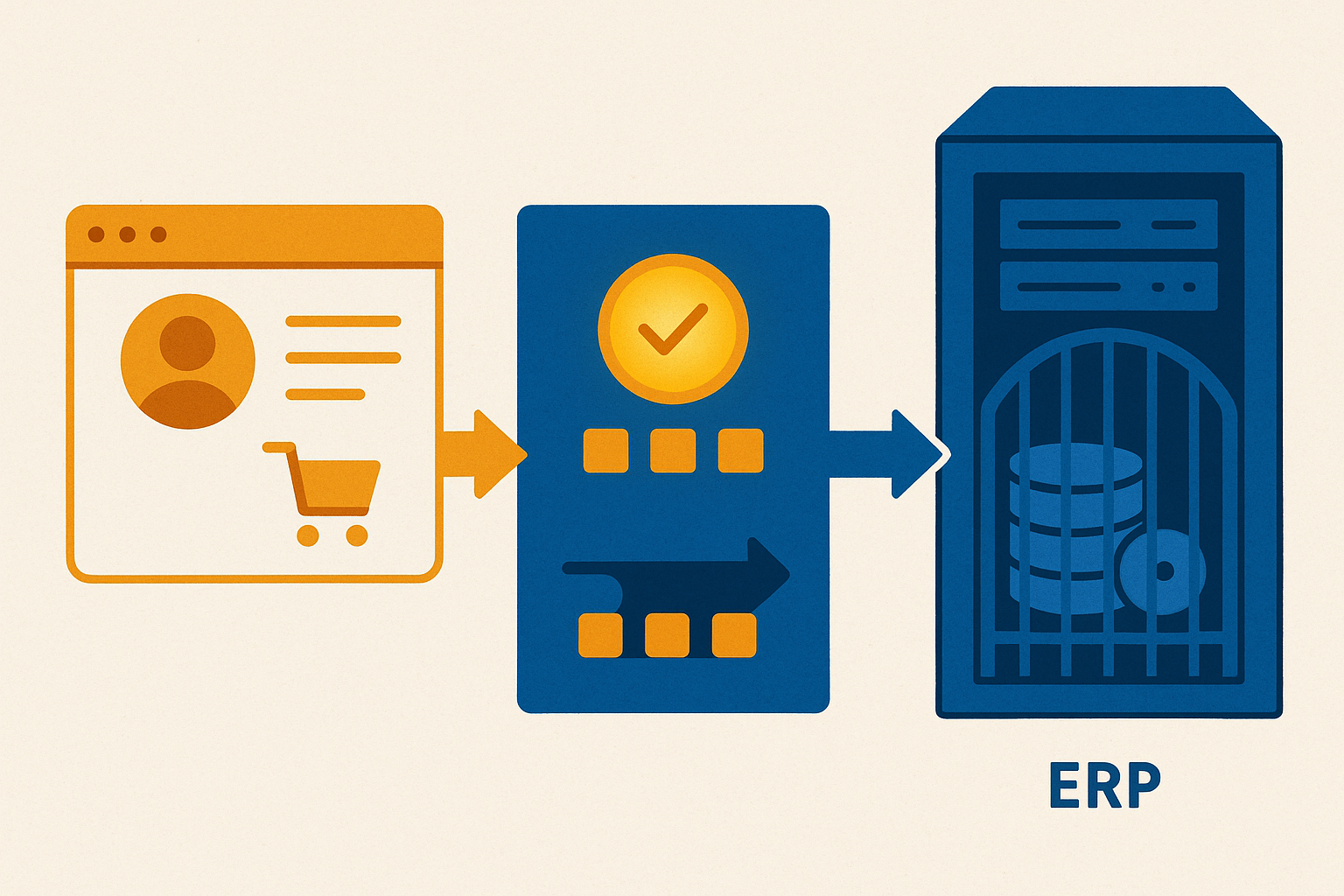
A legacy ERP or CRM integration becomes unclear as soon as employees, applications, or processes are allowed to interpret or modify the same data from different systems without established authority. A Source-of-Truth matrix makes that authority explicit. The matrix not only records which system contains a business object, but above all which system is the leading source at a particular time and for a particular use. This creates a shared reference point for determining where a value, status, or decision should come from.
That precision is needed because a source that records data is not automatically the source another process can rely on for every workflow phase. The matrix therefore allows for temporarily authoritative ownership. When a legacy ERP supports only periodic batch synchronisation, for example every hour or overnight, an intermediary layer can temporarily act as the authoritative source for real-time inventory reservations. In that specific situation, the intermediary layer prevents a new channel from waiting for an ERP change that only becomes visible later. Authority has not been transferred without limits; it is tied to the real-time reservation and to the period in which the ERP has not yet been updated.
Such a boundary prevents teams from mistaking a technical connection for a workable process agreement. Without a matrix, the sales environment may treat a reservation as available, while the ERP only shows a different picture after batch processing. The discussion is then not about a faulty connection, but about the unanswered question of which record counts for that workflow step. By defining authority for each situation, it becomes clear when a system writes, when it only reads, and when an intermediary layer has a temporary decision-making role.
The matrix gains more weight when discrepancies must remain explainable afterwards. Detailed audit trails show which step took place and when. Idempotency tracking per payload helps determine whether a message has been processed again without unintentionally causing a second change. Continuous monitoring of queues and latency within managed services reveals whether the temporary information provision still aligns with the agreed processing. As a result, the matrix is not merely documentation: it forms the boundary within which authority, processing, and auditability come together.
Sources for this section: ibm.com, salesforce.com
The gap between technical integration and process clarity
A technically functioning integration does not automatically answer the process question of who may interpret or modify a piece of data. Legacy ERP systems often contain table structures and embedded business rules that do not directly describe the meaning of a customer, order, or status for a modern application. When these internal structures are adopted directly, a new system may technically receive data while users have insufficient guidance regarding its meaning in their own work process.
This is where the gap between technical integration and process clarity emerges. A connection can transport data, but transport does not explain which data value is leading within a workflow. Processing a field from an older table structure may have a different business meaning than the same label in a new application. Hardcoded rules in the legacy system can also affect how a status is interpreted. If that meaning silently seeps into a modern application, the new layer becomes dependent on assumptions that remain outside the process's field of view.
An Anti-Corruption Layer within a Laravel backend provides a focused architectural boundary here. This layer acts as a semantic translator and validation barrier between cryptic legacy ERP table structures and modern domain events. The modern application therefore does not need to reason directly from the ERP's structure. Instead, it receives a translated representation that fits the domain for which the application was designed. At the same time, the validation barrier provides a point at which it can be assessed whether information from the legacy system can be passed on with the expected meaning.
This does not replace agreements about ownership. The layer can translate meaning and block data that does not meet the expected form, but it does not independently determine which department or system may authorise a change. Process clarity arises only when the translation aligns with established source responsibility. The Anti-Corruption Layer keeps the older data model and hardcoded rules at a distance from the modern application layer; ownership agreements then determine which translated information counts as valid in a workflow. This makes technical compatibility and business authority two separate, testable design questions.
Sources for this section: microsoft.com
When is a Source-of-Truth matrix crucial?

A Source-of-Truth matrix becomes immediately important as soon as more than one channel can modify the same data. Consider a combination of a self-service customer portal, e-commerce, mobile apps, and an ERP back office. In that situation, the question is not only which system knows a customer or order, but also which channel may change which parts of that information at which moment. Without explicit boundaries, multiple channels can each act as an owner from within their own process.
The need therefore lies not only in the number of systems, but in the number of routes through which changes can be made. A channel that only reads introduces a different type of dependency from a channel that changes status, conditions, or master data. As soon as different routes can initiate a change, there is a risk that later processing overwrites an earlier change or that two systems interpret the same status differently. Data corruption is then not an abstract risk: the dataset can become a combination of changes for which unambiguous authority can no longer be established.
In such environments, field-specific authority rules require an explicit choice. The matrix therefore does not treat a business object as one indivisible piece of data. For each field, it records which channel or system has authority. This can, for example, limit a change from a customer portal to the fields for which that portal is authorised, while other values remain outside the scope of that route. This granularity prevents an allowed change from being implicitly read as permission to control the entire object.
In addition, channels that make changes require explicit state transitions. A status is then not merely considered a text value that any system can replace, but a transition with a recorded origin. The matrix makes clear which route may initiate a particular transition and which routes follow the resulting status. This makes an integration design usable when processes intersect: not because all systems receive the same role, but because the boundaries between their roles are demonstrable.
Sources for this section: salesforce.com
Key factors when designing a Source-of-Truth matrix
The design does not begin by designating one leading system for each business object. The factors below help prevent a broad assignment from unintentionally replacing valid data from another process domain.
| Factor | Question in the matrix | Why this factor limits confusion |
|---|---|---|
| Scope of ownership | Does the authority apply to the entire object, or to separate parts of it? | A universal System of Record for a complete object can be too broad. A customer or order object often contains data with different functions. When one system is designated as the owner of the entire object, a change that appears logical from one function can also affect parts that fall outside that function. The matrix must therefore explicitly limit the scope of ownership rather than automatically linking authority to the entire object. |
| Nature of the change | Which data may be changed by a non-financial channel, and which may not? | Non-financial CRM changes can unintentionally overwrite ERP-validated payment terms or VAT statuses when both systems treat the same object as one changeable collection. This pattern shows that the origin of a change alone is insufficient. The matrix must distinguish which fields the CRM may change and which fields remain under ERP authority, even when they technically appear alongside one another in the same object. |
| Validation status | Which data value remains leading when another application submits a change? | Payment terms and VAT statuses validated in the ERP have a different position from a general change from the CRM. If the matrix does not make that validation status visible, an integration may treat a CRM change as though it has the same authority as a validated ERP value. The result is not merely a difference between systems, but an overwrite of information whose status differs in processing. |
| Write direction per field | May a field be written back from multiple systems, or is there one permitted writer? | The warning against one universal source does not imply that all systems may write freely. The opposite applies: as soon as multiple systems can modify at object level, the matrix must indicate for each field where writing is permitted and where a system only follows information. This boundary prevents a CRM edit from changing more data through broad synchronisation than the process permits. |
Sources for this section: ibm.com, salesforce.com
A practical framework for implementing a Source-of-Truth matrix
When point-to-point integrations have no central queues, implementation of the matrix can be developed as an operational chain around temporary legacy ERP outages. The focus is then not on an additional direct connection, but on an intermediary layer that carries established ownership rules through the outage period in a controlled way.
- First examine the processing boundary of the existing connections. The starting point is an environment in which point-to-point integrations offer no central queues. In such a setup, there is no central location that can hold changes when the legacy ERP is temporarily unavailable. This is relevant to a Source-of-Truth matrix because authority must not only be described on paper: during an interruption, it must also remain clear which change is waiting, which information has not yet been processed by the ERP, and which process step therefore cannot be treated as final. Then establish the intermediary layer as a bounded execution layer. A Laravel intermediary layer with Redis can provide the necessary resilience in this situation. The intermediary layer forms a separate point between the existing connections and the legacy ERP. As a result, temporary ERP unavailability does not have to be immediately translated into the loss of information awaiting processing. The matrix can link to this layer which changes fall within the queue and which authority rule remains applicable until processing is possible. Treat reprocessing as part of the process agreement. Exponential backoff means that new processing attempts are not sent to the temporarily unavailable ERP as an uninterrupted stream. The time between attempts increases. This gives the legacy ERP room to become available again and prevents a temporary failure from automatically resulting in an ongoing burden from repeated attempts. In the matrix, this phase can be linked to a recognisable state: the change has been received and is awaiting processing, but is not yet confirmed as ERP processing. Make the outage boundary visible in working agreements. The added value of Redis and exponential backoff is not limited to technical resilience. They make it possible to distinguish between what a new channel has submitted and what the ERP has processed. This prevents the design from having an employee equate a queued item with a completed change. The Laravel intermediary layer therefore supports an implementation in which temporary ERP downtime is assigned a defined processing status, rather than becoming an unexplained difference between systems.
Sources for this section: salesforce.com
Frequently asked questions about Source-of-Truth matrices
A formal matrix before technical implementation answers recurring questions that would otherwise only arise during development, testing, or operations.
- “Isn't a Source-of-Truth matrix too administrative for an integration?” The matrix is not a separate document alongside the technology when it is created for each business object, field, and workflow phase. These three levels make clear what an integration decision concerns. An agreement at object level, for example, may be insufficient when different fields within the same object have a different origin or authority. The workflow phase adds the time dimension: a value can have a different role within an earlier step than within a subsequent step. “Can't we determine the ownership rules when the connection is built?” The formal matrix should be available before the technical integration implementation begins. This makes ownership and authority a starting point for the work, rather than a correction after systems are already exchanging data. When these choices only emerge during implementation, technical assumptions can quietly begin to determine the process agreements. Rules established in advance reveal which questions remain open before they are built into the connection. “Why must the matrix be per field rather than only per customer or order?” A business object is often too broad to assign one authoritative source. By using a matrix per field, authority can be linked to the specific information a process uses. This prevents a general statement such as “the CRM manages customers” or “the ERP manages orders” from being unintentionally interpreted as unlimited write permissions. “What does a workflow phase add?” A workflow phase places a data value in the context in which it is used. This means the matrix contains not only a list of systems and fields, but also a record of the step in which a source counts as authoritative. Teams can then discuss differences based on a concrete phase, rather than broad system labels. The matrix reduces confusion because it answers the same questions in advance and at the same level of detail.
Sources for this section: ibm.com, salesforce.com
Key considerations when designing a Source-of-Truth matrix
The matrix only gains practical value when the architecture also protects the boundaries around legacy systems. Three design questions connect ownership with that protective function.
- 1. Does the legacy data model remain outside the modern domain layer? A demonstrable application of an Anti-Corruption Layer (ACL) is a concrete consideration when a new application works with an older system. The ACL forms a boundary where the older representation can be shielded from the modern layer. For the matrix, this means authority rules do not need to rely on the internal structure of the legacy system. The ownership agreement can be linked to the meaning made available at the boundary, while the legacy structure remains protected on the other side. 2. How is status information passed on without directly burdening the legacy system? The Transactional Outbox pattern is a second architectural pattern that can be included as part of protecting legacy systems. This consideration draws attention to the way changes or status information are passed on from a transaction. The matrix describes which status has authority; the pattern forms part of the architectural implementation through which that status propagation is not treated as an uncontrolled direct burden on the legacy system. 3. Who oversees execution when processing takes place through queues? Queue orchestration through Laravel Horizon is the third concrete consideration. When authority is described for each workflow phase, execution requires visibility into the processing that takes place between those phases. Laravel Horizon is applied here as part of queue orchestration to protect the legacy system. Without that protective boundary, changes that are correctly assigned according to the matrix may still reach the legacy ERP at a time and in a volume that puts operational continuity under pressure.
Sources for this section: microsoft.com