

A company can modernize legacy workflows without a risky big-bang rollout by deploying Laravel in phases. The Strangler Fig pattern supports incremental replacement, while an Anti-Corruption Layer shields the new system from legacy data. Parallel execution and monitoring reveal discrepancies early, keeping operational risks manageable at each transition.
Strategies for safe Laravel modernization
Modernizing legacy systems with Laravel requires an approach that safeguards continuity and limits the impact of every change.
- Use the Strangler Fig pattern to gradually replace legacy processes without downtime.
- Implement an Anti-Corruption Layer to protect new Laravel models from legacy data contamination.
- Run parallel tests to validate the integrity of new workflows before they go live.
- Start with read-only workflows to safely test integrations and data models.
Boundaries of phased modernization with Laravel
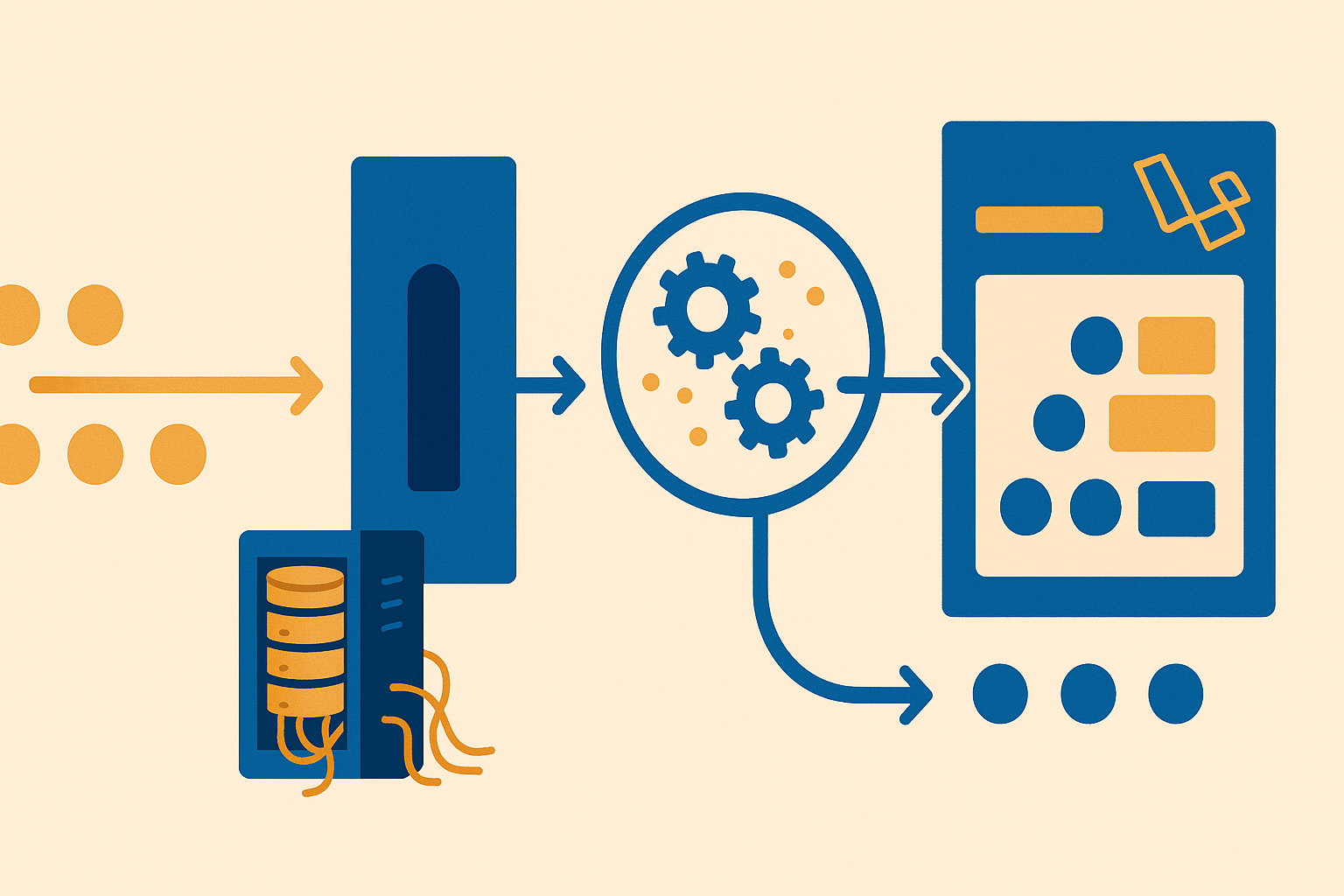
Phased modernization with Laravel focuses on replacing outdated workflow components without abruptly disrupting operations. In this context, a 'workflow' refers to a series of business processes or manual steps that are often captured in spreadsheets, old applications, or disconnected interfaces. The Strangler Fig mechanism makes it possible to migrate these processes step by step: a central reverse proxy or Laravel API Gateway analyzes incoming traffic and routes only the modernized components directly to Laravel, while non-migrated processes continue to operate within the legacy system. This prevents an all-or-nothing moment in which all users and integrations must switch at the same time.
An important architectural tool in this process is the Anti-Corruption Layer. This layer forms a clear boundary between the new Laravel domain and the existing legacy data. By translating and validating incoming data before it enters the new system, you prevent unstructured or outdated data types and status codes from the old system from contaminating the new application. Adapters, DTOs, and translation layers define which data and meanings may cross the domain boundary.
The choice of where data is cleaned up is a strategic consideration. Cleaning it up at the source can disrupt existing legacy functionality and delay the initiative. By placing cleanup and transformation in the transition layer, modern interfaces can be rolled out faster, but the complexity of the Laravel adapters increases. Therefore, each transition must clearly define which responsibility remains with the old system and which lies with Laravel. At this stage, Laravel serves as the new process domain for selected workflows, without directly taking over poorly understood legacy data.
Sources for this section: microsoft.com, microsoft.com
Why fast but safe modernization is crucial
The desire to modernize legacy workflows quickly with Laravel often arises from operational pressure, but an overly fast approach without thorough preparation increases the risk of disruption. When the discovery phase is shortened to meet deadlines, hidden dependencies—such as those in stored procedures or Excel macros—go unnoticed. New Laravel interfaces are then built on assumptions that prove incorrect only during integration testing, potentially resulting in unstable hotfixes or data corruption around go-live.
Temporary parallel execution gives key users the opportunity to identify differences between the old and new route in daily practice. This additional coordination is not optional, but it prevents all uncertainty from converging in a single go-live. This makes it possible to determine at each stage whether the new workflow aligns with the organization’s actual way of working.
Sources for this section: microsoft.com, amazon.com
Essential conditions for a successful start
Before the first replacement step, the boundary between the new process and the legacy source must be explicit. The starting condition is not that all historical data is immediately rebuilt, but that it is clear where the new Laravel architecture ends and where translation to the existing environment begins.
- A clearly defined transition layer. Define which data, statuses, and exceptions are processed through the Anti-Corruption Layer. This boundary prevents old data conventions from inadvertently becoming part of new processes and makes the scope of the first replacement testable.
- Demonstrable architectural isolation. When assessing an implementation partner, what matters is whether that isolation can also be designed as a protective measure: with idempotent queues through Laravel Horizon, automated integration tests, and Contract Testing for agreements between Laravel and legacy backends. This is not a detail to address after the start, but an indication that the transition is not focused solely on visible screens. The new workflow must be able to work with the existing environment without placing unnecessary strain on it or allowing repeated processing to have uncontrolled consequences.
Sources for this section: microsoft.com
Step-by-step approach to modernization
A practical sequence does not begin with building screens, but with making every transition manageable. The steps below translate this into concrete decision points around dependencies, acceptance, and fallback.
- Make dependencies explicit in advance. For the intended workflow component, identify which data structures and relationships from the legacy environment are affected. The goal is to prevent Laravel models from being directly linked to a schema with contaminated data types and missing foreign keys. A direct link allows these shortcomings to seep into the service layer and increases the risk of regression errors in later releases.
- Determine a testable transition point. Define an explicit Go/No-Go decision for every phase. That decision is based on measurable acceptance criteria for synchronization integrity, rather than on an optimistic expectation that delivery will probably go well. Also limit the Blast Radius: choose a transition whose effects, in the event of discrepancies, remain within a defined process component.
- Document the fallback before the transition. A rollback scenario is part of the phase decision, not an emergency measure devised only when problems arise. Define when fallback is needed, which data flows are stopped or restored, and who decides. Parallel execution then makes it possible to keep the legacy route available until the agreed outcomes have demonstrably been achieved.
Sources for this section: microsoft.com
Validation of modernization outcomes
Validating modernization outcomes when replacing legacy workflows with a Laravel application requires a clear definition of the scope for each phase. When the scope of the first release is expanded to immediately include all historical exceptions and edge cases, the project risks becoming a comprehensive migration after all. This makes it difficult to determine whether the new workflow component itself functions within the agreed boundaries. Therefore, assess usability, stability, and the agreed data exchange at each stage before proceeding with further expansion. Management and process owners can then specifically determine whether this particular component is ready for the next step.
Sources for this section: martinfowler.com, martinfowler.com
Common mistakes during modernization
Suppose a new order-processing route immediately replaces the old route during an operational peak. Without parallel execution or a rollback runbook, synchronization queues can fill up and discrepancies can arise between the two systems. This can delay orders and cause employees to resort to uncontrolled shadow processes.
- A forced transition without controlled fallback. The error is not only in the cutover itself, but in the absence of a safe route back when the data exchange deviates. A pre-established fallback scenario and a limited initial scope do not prevent every incident, but they keep the consequences of a discrepancy within the selected workflow component as long as the legacy route remains available.
Sources for this section: microsoft.com
Frequently asked questions about modernization with Laravel
The most common concern is that a formal transition layer delays the first delivery. That concern is understandable when speed is measured solely by the point at which the first screens become visible. For a legacy workflow, it also matters which dependencies this establishes for future releases.
- “Why not connect directly to the existing database if that delivers results faster?”
A direct link between legacy database schemas and Laravel Eloquent models can produce screen-level results quickly in the first sprint. However, the new workflow is then built around the old schema and inherits its data conventions as functionality grows. A clearly defined transition layer requires additional work at the start because data transfer and translation are deliberately specified. The trade-off is therefore not only “how quickly can the first interface be delivered?”, but also “which dependency are we establishing today for all future releases?”.
Sources for this section: microsoft.com
Key lessons for safe modernization
The quality of a modernization initiative is visible even before the first time estimate: in how dependencies, responsibilities, and transition boundaries are investigated. For organizations considering a Laravel workflow layer, the following criteria provide guidance when assessing the approach.
- Request a structured dependency analysis before the plan is finalized. Systematically map upstream and downstream dependencies, batch processes, and authorization matrices. This clarifies which process boundaries actually exist and where an initial replacement affects other parts of the operation. A time estimate without this analysis can leave hidden dependencies out of scope.
- Treat architectural isolation as a testable delivery criterion. Assess the new workflow layer not only on visible features, but also on whether legacy influences remain contained as the replacement grows. Contract tests and explicit agreements on data translation make that boundary verifiable.
- Make transition decisions reversible. A Go/No-Go moment is meaningful only when it is clear in advance how a phase will be rolled back and who makes that decision. This keeps a discrepancy limited to the selected phase, rather than affecting processes that were not selected for the transition.
Sources for this section: microsoft.com