

Optimization is better than a full rebuild when the core of the web application functions reliably and the issues are limited to specific functional domains with high technical debt or tight coupling. In such cases, targeted refactoring according to the Strangler Fig pattern can be effective.
Strategies for Laravel web application growth
When scaling a Laravel web application, the choice between optimization and rebuilding revolves around the stability of the application core and the nature of the bottlenecks. Not every performance issue requires the same investment.
- Identify whether issues are limited to specific domains with high technical debt.
- Consider targeted refactoring if the application core is stable.
- Use caching and database tuning for quick, cost-effective solutions to acute slowdowns.
- Assess the risks of phased modernization versus a full rebuild.
- Plan investments in phases with clear Go/No-Go decision points.
When to optimize and when to rebuild?
The choice between optimizing and rebuilding is primarily a choice about business continuity and investment risk, not just about the state of the code. A growing Laravel web application does not need to be fully replaced because certain parts are under pressure. When the application core functions reliably, it is wise to first determine whether the obstacle is limited to specific functional domains. Consider a domain where billing, complex integrations, technical debt, tight coupling, or incompatible data structures converge. Such a domain can be separated and renewed in a targeted way without requiring the rest of the application to change at the same time.
Optimization is especially suitable when the immediate problem is clear and contained. Caching and database tuning, for example, can reduce acute slowdowns with a relatively limited investment. Recurring timeouts in a specific chain or pressure on database connections can also indicate that the relevant bottleneck should be investigated first. Such measures create room to keep the commercial and operational consequences of growth manageable while the existing application remains available. However, they do not prove that the underlying structure is sound. If the data model itself contains fundamental architectural issues, optimization can make symptoms temporarily less visible without removing the cause.
Targeted rebuilding comes into view when a separate domain can no longer be reasonably improved within the existing constraints. High technical debt, hard dependencies, and data structures that do not fit what the domain requires are relevant signals. The question is then not whether the entire web application deserves a clean slate, but which component is actually hindering business operations and can safely be addressed separately. This limits the scope of change and prevents well-functioning parts from being unnecessarily included.
A full rebuild is therefore not the standard end point of scaling growth. With an ongoing roadmap, the focus is on a distinguishing question: does an intervention solve the problem, or does it merely shield a fundamental error in the data model? That assessment determines whether optimization buys time or whether a defined domain needs to change structurally.
Sources for this section: theartofcto.com, techment.com
Why invest in scalability now?
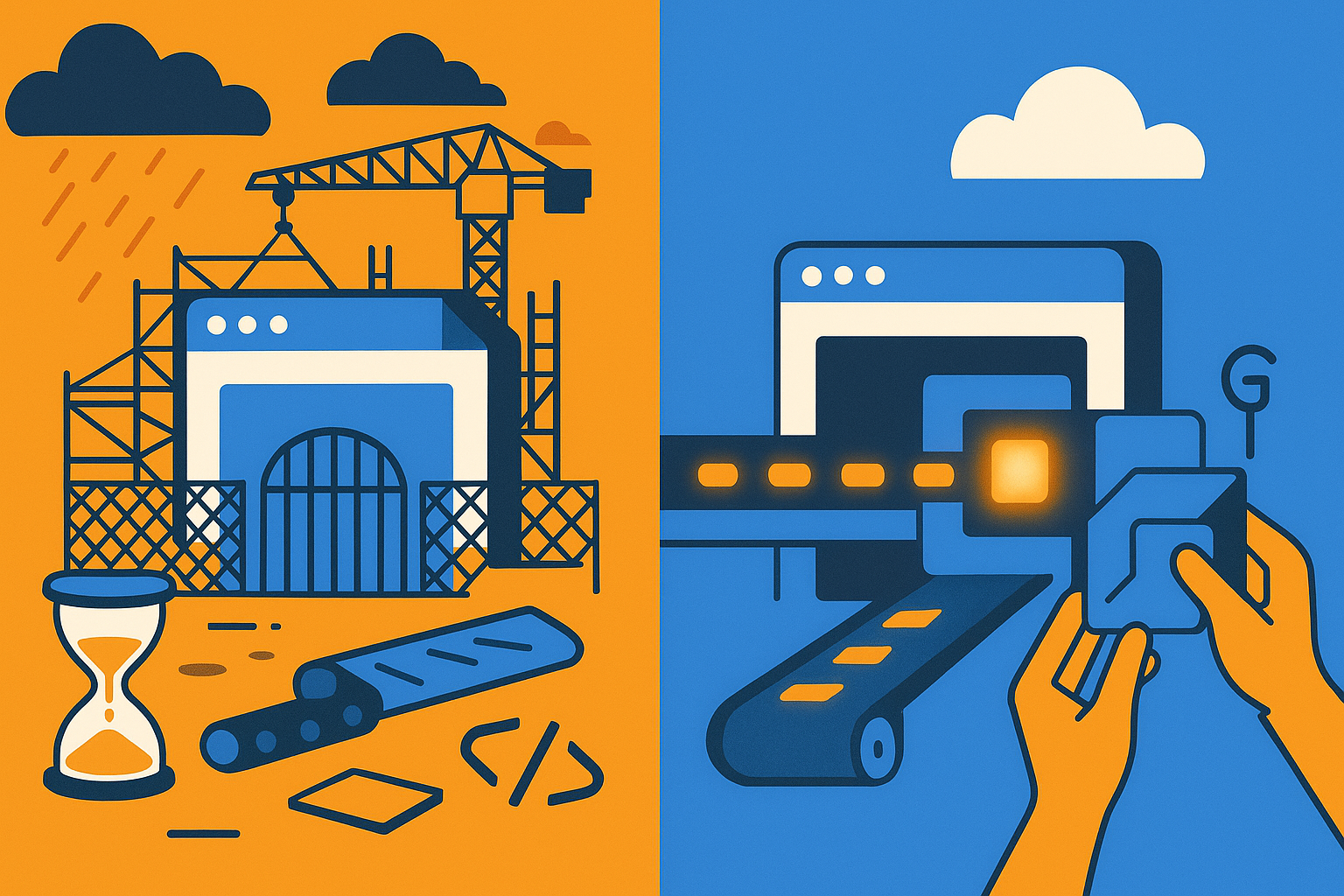
The fact that a Laravel web application still largely functions today does not mean that postponing scalability investments is without consequences. When growth, changing market requirements, or new regulations converge, pressure on the existing platform increases. A complete redevelopment may then seem attractive, but a Big Bang approach carries significant risks. Further development of the existing application is often put on hold, while the specifications of the new platform may be overtaken by changing requirements during the process. If budget and time run out before the new system is production-ready, there is a real risk of disruption to business operations and a loss of adaptability.
Postponement also increases the impact of technical debt. Unresolved debt can raise operational costs, extend lead times, and make it harder to implement new functionality safely. This reduces the ability to respond to market opportunities or necessary adjustments.
A phased investment plan offers an alternative that keeps these risks manageable. By incorporating clear Go/No-Go decision points for each phase, the organization can invest based on demonstrable results and current needs. This prevents all resources from being committed to a single trajectory and keeps the option open to adjust course when circumstances change. In this way, scalability work becomes a series of substantiated decisions rather than an all-or-nothing choice.
Sources for this section: theartofcto.com, bssw.io, dsinnovators.com
Requirements for phased modernization
Phased modernization only gains a useful starting point when scalability pressure can be traced back to a concrete process. For heavy background processes, Laravel offers a defined route: work can be handled asynchronously through Redis workers and Laravel Horizon. This moves heavy work from the direct handling of an HTTP request to separate tasks that remain traceable. The condition is therefore not an abstract intention to modernize, but a recognizable work process in which it is clear that synchronous execution affects the predictability of response times.
- A clearly defined heavy background process. Determine which tasks can safely be performed as jobs and how failed tasks are identified and retried. This not only relieves direct HTTP handling, but also creates a controllable component for the first phase. It makes such a process suitable as a separate modernization component rather than a reason to replace the entire application at once.
Sources for this section: laravel.com, laravel.com
Step-by-step plan for phased modernization
A phased investment plan turns a broad modernization challenge into a series of manageable changes. The essence of this route is not to renew all components at the same time, but to carefully isolate a heavily used functional domain. The Strangler Fig pattern provides a sequence in which old and renewed components can temporarily coexist. The steps below describe how this approach can be structured as a change path without broadly freezing application development.
- Determine which functional domain will be defined first. Choose the heavily used component that is sufficiently independent to isolate. The focus is on a bounded context, not on a general desire to renew the entire application. By making the boundary of that domain explicit, it becomes clear which part of the change is actually the subject of the phase.
- Place a controlled transition around the chosen domain. The Strangler Fig pattern uses an API Gateway or proxy to gradually place the defined domain behind a new boundary. That transition is not an end in itself; it makes it possible for existing and renewed components to function alongside each other while the chosen domain changes.
- Renew the isolated component gradually. Within the new boundary, the heavily used domain can gradually be replaced or adjusted. The rest of the application does not need to change along with it. This shifts the investment from a full rebuild to a targeted change with limited operational scope.
- Leave room for ongoing functionality. Because the approach allows old and new to coexist, the organization does not have to choose a broad feature freeze. New functionality and modernization do not automatically become the same trajectory. This distinction keeps the roadmap more flexible than in a project where all development waits for a single production release.
- Repeat the approach only for domains where the load justifies it. Phased modernization is not an obligation to replace every part immediately. The next step follows only when another defined domain is under enough pressure to justify the same isolation and change. This keeps the scope of modernization linked to the components where operational risk is concentrated.
Sources for this section: theartofcto.com, techment.com
Validating the results of phased modernization
Validation in a phased trajectory goes beyond establishing that a change has been delivered. It determines whether the organization has sufficient basis to make a subsequent investment. An audit-first approach can be used to first establish the starting position and then assess whether an initial change phase actually reduces the intended uncertainty. Its value lies in the sequence: the direction of change is assessed before the organization commits to further new development.
Review points are needed because the risks of a full rebuild otherwise accumulate in one large trajectory. Instead of only discovering at final delivery that assumptions are incorrect, the organization can assess after an initial phase what the audit and the change actually demonstrate.
An initial phase can therefore serve as a limit on investment. The relevant question is no longer “does everything need to be redone?”, but whether the results sufficiently support giving the next component the same treatment. This keeps the decision tied to what became visible in the preceding phase rather than to the promise of a single final platform.
The practical outcome is not automatic approval for further rebuilding. Validation may also be a reason to limit the scope, change the sequence, or not start a next phase. This makes course correction part of the investment process, rather than an emergency measure at the end.
Sources for this section: theartofcto.com, bssw.io
Common mistakes in scalability investments
A common mistake is treating scalability as something that only receives attention when visible functionality no longer demands priority. This sequence may seem commercially logical because a new feature can deliver immediately noticeable value. However, the result can be that technical debt accumulates and later releases require more time and remediation work. The investment then shifts from a manageable improvement to remediation under greater pressure.
- Structurally prioritizing visible functionality. Short-term feature speed can deliver immediate commercial value, but consistently postponing stability work builds technical debt. That debt affects the effort required for future releases.
- Treating long-term platform stability as a separate technical topic. Stability and delivery speed are not separate concerns when technical debt affects the lead time and risk of subsequent changes. DORA Metrics, including the change failure rate, can help make that relationship visible as well.
- Leaving the cost of postponement out of the investment decision. A feature can add value in the short term while also increasing the cost of subsequent releases. Without placing both sides in the same assessment, postponement appears inexpensive while the delay only becomes apparent later.
- Limiting planning to the next release. When technical debt is increasing, planning without visibility into follow-up work provides an incomplete picture. The immediate delivery may seem feasible, while the effort for later releases is already increasing.
- Confusing monitoring with only tracking new functionality. When technical debt affects release speed or recovery after changes, that effect should also be part of follow-up. Otherwise, only what has been added remains visible, not what the organization loses in adaptability.
Sources for this section: dsinnovators.com
Frequently asked questions about phased modernization
Phased modernization often raises understandable questions about budget, pace, and the threshold at which a larger change trajectory is still needed. The core of the answer lies in the difference between a gradual change with temporary coexistence and a full rebuild that attempts to replace everything in a single delivery.
- Can we spread scalability work across multiple budget cycles?
Yes, a phased route lends itself to separate investment moments because not all components are replaced at once. Each phase creates room to decide whether the next defined component provides sufficient reason to continue. This differs from a full rebuild, where the organization must finance a broad and integrated delivery in advance. - Does phased work mean that old and new remain in place alongside each other?
Temporary coexistence is a characteristic of phased refactoring. This situation requires acceptance of a transition period, but maintains operational continuity. The trade-off is therefore not between simplicity and complexity, but between temporary coexistence and the delivery risks of a full Big Bang rebuild. - When is a full rebuild still appropriate?
A full rebuild can offer the feeling of a clean slate, but it carries high delivery risks. It is therefore not a standard answer to every scalability question. The choice requires an explicit assessment of whether structural limitations are so broad that a phased route no longer offers a realistic outcome. - How does Laravel help improve performance?
Laravel is not an automatic solution for every performance issue. The relevant choice is whether improvement can take place step by step without replacing the entire application. Where that is possible, phased refactoring can keep the application operational; where it does not outweigh the transition period, the scope of the change remains an explicit business consideration.
Sources for this section: theartofcto.com, techment.com, bssw.io
Decision rules for phased modernization
Phased modernization of a Laravel web application requires clear decision rules that keep risks manageable and substantiate investments. An audit-first approach is the starting point: objective measurements and profiling precede significant choices. This prevents extensive trajectories from starting based on assumptions. The following decision rules support a phased approach:
- Start with measurement and profiling. First establish current performance and bottlenecks before starting an optimization or rebuild trajectory. Without this objective basis, the investment need remains unclear.
- Limit the first phase to concrete findings. Ensure that the scope of the initial intervention directly aligns with what emerges from the audit. This prevents a limited optimization from unnecessarily growing into a broad program.
- Treat rebuilding as a substantiated decision, not a standard response. A full rebuild is only appropriate when audits demonstrate structural limitations or technical debt that can no longer be resolved through optimization or targeted refactoring.
- Make budget limits explicit for each phase. Link every follow-up investment to the results of the preceding phase. This keeps financial risk limited to what is demonstrably necessary.
- Stop or reconsider if evidence is lacking. The strength of a phased approach is that you are not obliged to continue investing if the audit shows no further necessity. This keeps operational and financial risk manageable.
These decision rules turn modernization into a series of testable choices: first establish the cause, then intervene in a targeted way, and only then determine whether a next phase is justified.
Sources for this section: theartofcto.com, techment.com, bssw.io