

Optimizing a growing web application is preferable when the application has extensive automated tests that enable incremental refactoring, and when its technical foundation still meets current requirements. Rebuilding is more appropriate if the application runs on outdated frameworks or packages that block regular updates.
Decision criteria for Laravel application optimization
When deciding between optimization and rebuilding Laravel systems under growth pressure, several factors play a role. These factors determine the most appropriate approach to improving the application.
- Determine whether current test coverage is sufficient to make safe incremental changes.
- Evaluate the application's technical state, including framework and package obsolescence.
- Consider the balance between quick gains through optimization and the need for structural improvements.
- Analyze the impact of postponing modernization versus direct investment in scalability.
When should you optimize and when should you rebuild a growing Laravel application?
The choice between optimization and rebuilding does not start with the question of whether a Laravel application still works today. It starts with whether changes can be implemented predictably as the application grows. An application with thorough unit and integration tests has a fundamentally different starting point from one whose behavior is only known through production use. Test coverage records existing behavior. This enables a team to modify one component step by step, verify that the behavior is retained, and then address the next component. Under this condition, incremental refactoring is a risk-reducing path: improvement does not have to wait for a major replacement project.
The technical state of the Laravel landscape then determines how far optimization can go. Unsupported PHP or Laravel versions and incompatible dependencies are more than maintenance backlog. They can block regular updates. When an improvement depends on components that can no longer responsibly function alongside one another, the task shifts from alignment within the existing application to controlled replacement of parts of it. Phased isolation or partial rebuilding may then be appropriate, because this route creates room to rebuild a defined part without immediately replacing the entire system.
The practical dividing line is therefore as follows. Optimization is appropriate when the intended improvement can be implemented within the existing technical foundation and the available tests provide sufficient assurance about the effects of changes. Even when growth prompts adjustment, that does not automatically mean the foundation must be discarded. Restructuring or partial replacement comes into view when the dependency chain hinders updates and a local improvement path repeatedly encounters unsupported versions or incompatibility.
A lack of tests calls for caution when changing existing behavior. That is not an argument for immediately rebuilding everything. It does point to a different modernization path, in which parts are first separated from the existing system before they are changed extensively. The decision thus remains tied to two concrete questions: how much change can be tested safely, and does the technical foundation still support further development?
The tension between visible functionality and scalability investments
A Laravel application may appear to work well for users while still being under growth pressure. This tension arises when day-to-day operation remains acceptable, while the path to further expansion becomes increasingly less predictable. In that case, a scalability investment is not a response to visible failure, but a choice to isolate a vulnerable component before it dictates the rest of the application. The relevant question is not only which improvement is technically possible, but also which part of the existing operation must remain intact at the same time.
An incremental path can reduce that tension. With the Strangler Fig mechanism, specific domains or resource-intensive processes are isolated step by step behind API routing or a proxy. The existing system remains in use while a defined part is gradually phased out. This setup limits migration risk because replacement does not take place as a single operational switch. For an organization, this means the scope of modernization can remain linked to a recognizable process or domain, rather than to an abstract intention to renew the entire application.
In contrast, there is a common assessment error, referred to here as an editorial interpretation as local optimization blindness. In this case, development time is spent on micro-functions in PHP code, while the actual delay stems from unprofiled synchronous external API integrations. The visible complaint may then remain the same, despite efforts in a technical area that is not the dominant cause. Scalability therefore first becomes a diagnostic task. Without establishing where the delay actually occurs, an organization may allocate budget to improvements that do not remove the operational constraint.
The order of decision-making therefore changes. First, determine the process or domain where the pressure arises; then establish whether the cause lies in an isolated component or in an external, synchronous integration. Only then can an informed choice be made between targeted optimization and a phased replacement. This prevents a working application from being written off without justification, or a single defined bottleneck from obstructing further growth for too long.
Problems caused by delayed scalability investments
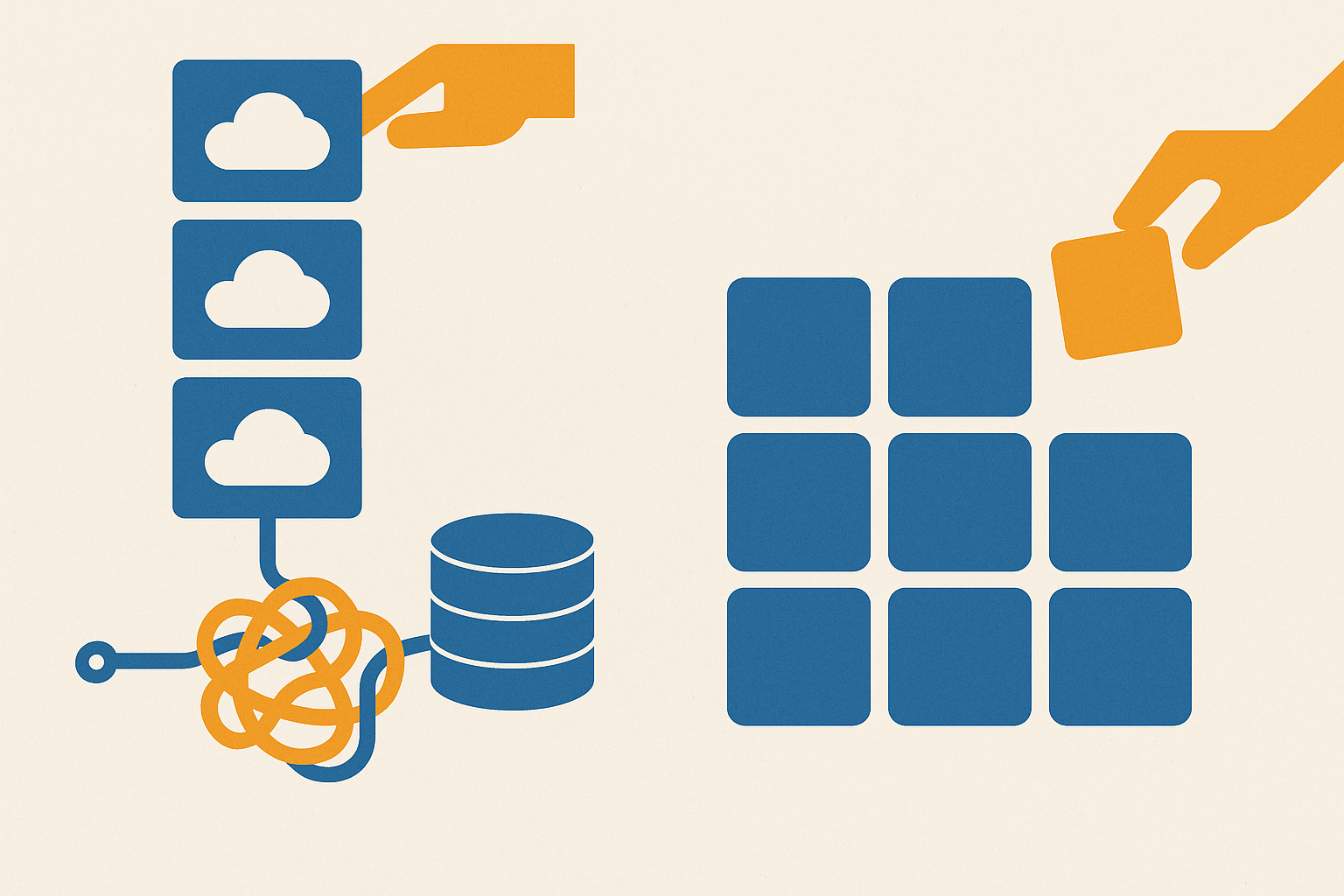
When scalability investments are postponed, patterns often emerge that are not immediately visible as incidents but do undermine operational effectiveness. For clarification, this article uses the editorial terms symptom-driven overcapacity and all-or-nothing thinking; these are not established industry terms. With symptom-driven overcapacity, organizations increase their hosting capacity or cloud resources to compensate for slow loading times, while underlying causes, such as inefficient queries or system bottlenecks, remain unresolved. This leads to rising costs and increasing dependence on temporary solutions, without actually addressing the structural limitations of the Laravel application.
In addition, all-or-nothing thinking can narrow decision-making. Rather than seeking a proportionate and phased approach, the discussion is reduced to a choice between endlessly applying patches or undertaking a complete, risky rebuild. As a result, intermediate solutions, such as modularly isolating and renewing specific parts of the application, remain out of view. The consequence may be that necessary structural improvements are delayed for too long or that an overly large-scale approach is chosen, with associated delays and risks to business continuity.
Postponement thus increases both cost and uncertainty, while the actual barriers to growth may persist. Recognizing these patterns helps assess scalability issues before the application does no more than ‘usually work’.
Factors in making scalability decisions
The considerations below show why a technical choice is also a choice about pace, budget, and risk. They are not a fixed outcome for every application, but identify the tensions leaders can make explicit before resources are allocated.
| Consideration factor | What the choice means | Decision implication |
|---|---|---|
| Speed of delivery versus structural quality | Runtime optimizations and caching can deliver measurable short-term gains at relatively low cost. However, those gains do not remove fundamental architectural scalability constraints and cyclical dependencies. | A short improvement path is appropriate when measurable short-term relief is needed and the constraint is not fundamental. When cyclical dependencies or architectural boundaries continue to determine development, quick gains are no substitute for structural work. This requires two separate expectations: immediate relief on the one hand and a dedicated path for the underlying limitation on the other. |
| Cost of delay versus immediate capital commitment | Proactive modernization can prevent later acute failure costs and delays, but requires direct budget allocation. That budget temporarily competes with commercial functionality whose effect may be visible sooner. | Postponement is not without cost, but neither is immediate modernization free or without trade-offs. The comparison should therefore make both potential future disruption and delay, as well as the current budget commitment, visible. The investment becomes manageable when it is clear which commercial functionality is temporarily not funded, which risk remains as a result, and which form of modernization is intended to reduce that risk. |
Practical framework for scalability decisions
A practical framework for scalability decisions starts by distinguishing factual bottlenecks and carefully substantiating the chosen change path. This prevents investments from being driven by assumptions or the most visible complaints, and ensures that the scale of the intervention is proportionate to the actual cause.
- Start with data-driven diagnostics and objective profiling audits. Use measurement tools such as Application Performance Monitoring (APM), query inspection, and static analysis to establish where delays occur and which parts of the Laravel application require structural attention. This approach replaces assumptions with verifiable insights, enabling management and technical teams to clearly demonstrate the relationship between an identified problem and the required investment. The goal is not to collect as much technical data as possible, but to set priorities based on demonstrable bottlenecks. The outcome of this step may also be that the original problem definition needs to be adjusted before an implementation plan is drawn up.
- Use an incremental, risk-averse modernization path where possible. A complete rebuild of an application carries the risk that undocumented business rules and exceptions must be rediscovered, which can lead to significant delay and unforeseen costs. An incremental approach limits these risks by changing only the part of the application that is actually constrained, while preserving existing business knowledge. Where isolating a component is appropriate, the phased route described earlier can be used; the required transition layers and their management should then be explicitly included in the assessment. Each step is thus aligned with a verified diagnosis, without unnecessary loss of valuable domain knowledge.
Frequently asked questions about scalability decisions
Many organizations struggle with how to modernize their Laravel application without interrupting operations. Below is a frequently asked question that makes the balance between continuity and renewal concrete.
- Can you modernize without bringing everything to a halt?
Modernization does not have to mean that the existing application is completely replaced or that operations temporarily stop. A phased route, as described earlier, makes it possible to renew defined parts of the application while core functionality remains available.
New modules or improvements can be added incrementally, but the transition introduces temporary complexity. Additional synchronization layers and routing mechanisms may be needed to allow old and new components to operate alongside one another. This requires additional management and monitoring during the transition period.
The trade-off is therefore between preserving business continuity and accepting temporary technical intermediate layers. Determine in advance which parts will run in parallel, which synchronization is necessary, and how long this situation must be managed. This keeps the impact on daily operations manageable, while allowing targeted renewal without the risks of a complete switchover.
Concluding synthesis of scalability decisions
The final choice becomes stronger when the modernization path itself can be tested. This does not require the promise that every risk will disappear, but an approach in which progress, reversal, and remaining burden are visible in advance.
- Treat modernization as a series of reversible decisions. A phased transition should include predefined rollback scenarios and measurable intermediate phases, rather than one complete switchover. This gives an organization multiple moments to determine whether the chosen direction still aligns with operational reality. An intermediate phase is not merely a technical milestone: it shows which part of the transition is functioning and which part must still be capable of being reversed. Rollback scenarios do not prevent a change from requiring attention and management, but they do limit financial and operational exposure when a step does not deliver the intended result. The temporary complexity of transition layers thereby becomes an explicit part of planning, assessment, and management. The choice between optimization, restructuring, and rebuilding thus remains connected to what is demonstrably necessary, what can change safely, and which risk the organization is willing to bear temporarily.