

Optimizing a growing Laravel web application is preferable when its functionality is still recognizably divided into domains and modules, and the application runs on a recent Laravel and PHP version. This makes targeted modernization more economically viable than a full rebuild, especially with predictable growth within the existing business model.
Strategic choices in Laravel refactoring
When deciding between optimization and rebuilding a Laravel web application, technical and organizational factors play a crucial role. Making the right choice is important for safeguarding the application's growth and stability.
- Identify whether the application still has clear domain boundaries and modularity for incremental improvements.
- Assess the application's technical foundation and its compatibility with recent Laravel and PHP versions.
- Analyze growth expectations within the current business model to determine whether targeted refactoring is sufficient.
- Consider the impact of technical debt and maintenance burden on strategic roadmap initiatives.
- Weigh the risks of in-place refactoring against the complexity of a full rebuild.
When should you optimize versus rebuild a Laravel web application?
Optimization and rebuilding are not variations of the same task. Optimization focuses on targeted constraints in an existing Laravel web application: components are improved while the current functional foundation is retained. Rebuilding shifts the starting point to a new technical foundation and therefore requires recreating the functionality the organization already relies on. For a growing application, the distinction matters because an application can simultaneously support daily operations and become increasingly difficult to adapt.
Targeted refactoring is especially suitable when the existing functionality is still recognizably divided into domains and modules. If a module can be isolated separately without circular dependencies disproportionately increasing the effort, there is room to modernize step by step. The organization then retains existing functionality while improving a defined part of the application. This is a different starting point from a codebase in which every change affects an opaque network of mutual dependencies.
The distance from the current Laravel and PHP versions also determines the boundary. A recent version, or one that can reasonably be bridged, makes targeted modernization easier to justify economically than an initiative that must cross several major, outdated framework generations at once. The question is not whether an application is “old,” but whether the technical lag fits within a manageable modernization step.
A rebuild becomes more relevant when these two conditions are absent: domains can no longer be treated independently, or the technical foundation is so far behind that a targeted intervention itself becomes an accumulation of major transitions. A working application is therefore not automatically a candidate for preservation, but technical debt is not automatically a reason to build anew either. The decision boundary is whether a defined change can genuinely land independently and whether the existing foundation can be modernized reasonably.
There is also a hard prerequisite: refactoring without an automated test safety net increases the risk that historical edge cases disappear. Legacy methods in particular may contain behavior that is not immediately visible in the code structure. Regression or characterization tests capture that existing behavior before changes are made. Without that protection, optimization changes from a controlled intervention into a risk to operational continuity.
Why decide on Laravel refactoring now?
The pressure to decide on Laravel refactoring does not arise from one visible incident, but from a combination of growing maintenance burden and increasing scalability needs. As usage increases and the application becomes more complex, the risk shifts from isolated outages to structural bottlenecks that undermine development speed and stability. A common technical signal is the absence of an asynchronous queue architecture: during peak load, web server threads can become exhausted, causing chain reactions of timeouts and reduced availability. These types of bottlenecks make scalability an immediate operational issue, not merely a future risk.
Maintenance pressure also grows gradually when technical complexity increases without sufficient automated tests. Developers then avoid changes to existing code, choose duplication more often, and lead times for changes increase. Under deadline pressure, code reviews and refactoring are sidelined, causing technical debt to accumulate and become increasingly less visible. Ultimately, new feature development is blocked by a buildup of ad hoc bug fixes and structural instability.
Postponing a decision on refactoring or rebuilding increases the risk that these patterns deepen to the point where the roadmap is no longer feasible. At the same time, an open-ended, unbounded refactoring initiative without clear business milestones or stop criteria is a pitfall: it undermines trust in the process and makes budget accountability difficult. The need, therefore, is to determine in time which specific bottleneck will be addressed, what result it delivers for the growth phase, and how the scope of the intervention will be bounded. Only then does refactoring gain a business justification alongside visible roadmap initiatives, preventing necessary investments from taking place only once the damage is already visible and costly.
When does the choice for refactoring arise?
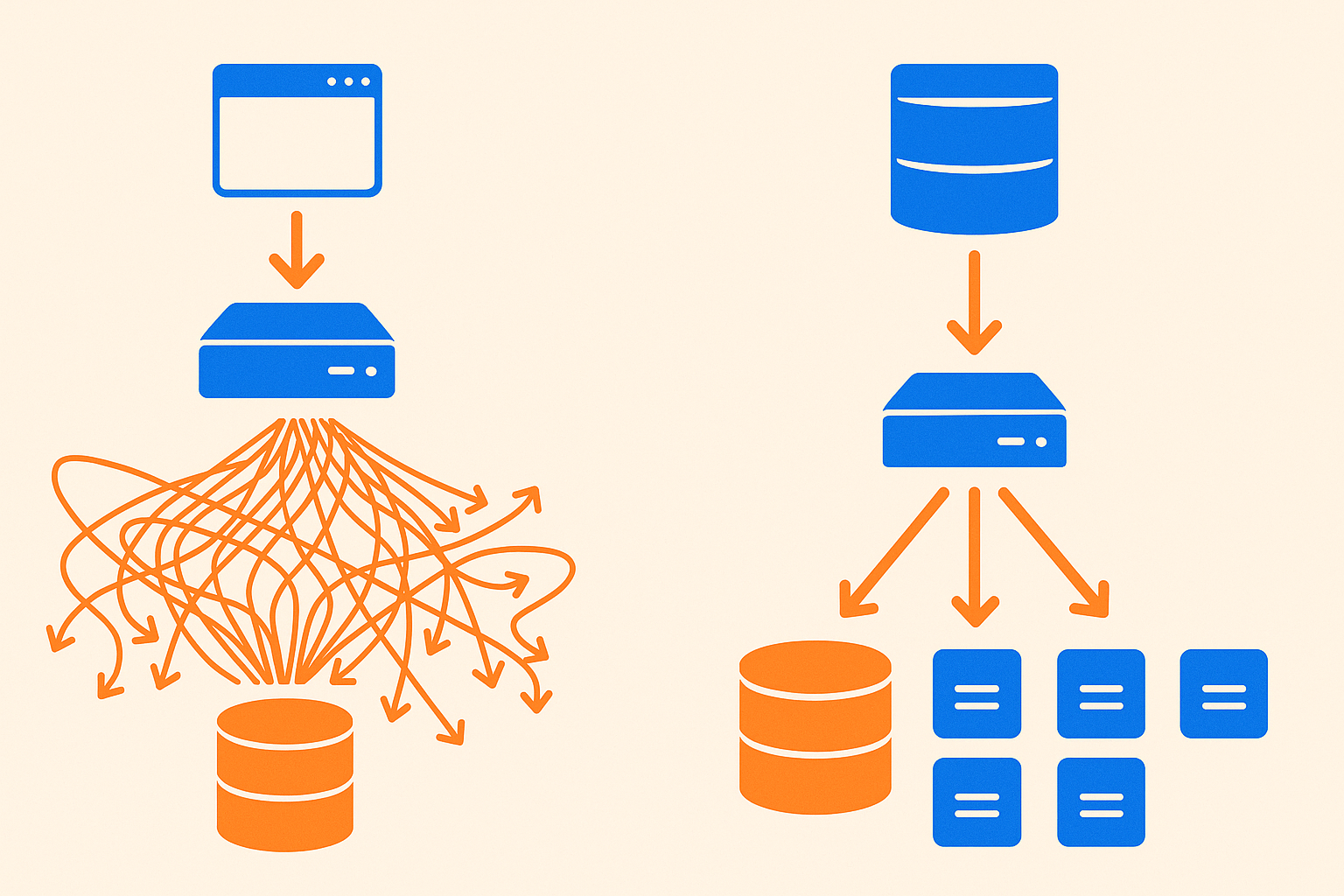
The choice between refactoring and rebuilding often arises when growth places a greater burden on an existing Laravel application than its original design could support. A recognizable scenario is an application in which Eloquent ORM relationships are used without eager loading. This creates cumulative N+1 query problems: a single request can cause hundreds of separate database calls. The load is not limited to database I/O; PHP-FPM workers also remain occupied longer. This pattern shows that the growth challenge may lie in a defined execution approach, rather than necessarily in the application's entire functional foundation.
Whether this scenario justifies targeted refactoring also depends on the type of growth. With incremental and predictable growth within the existing business model, a targeted intervention can align with expected demand over the next 12 to 18 months. This condition does not automatically apply to an abrupt transition to a fundamentally different multi-tenant architecture model. In the latter case, not only the load changes, but also the application's underlying premise, making a limited optimization less obviously sufficient.
A second signal lies in the allocation of sprint capacity. When more than 20–25% of available capacity is consistently spent on unplanned corrective maintenance and bug fixing, this general guideline can help make visible that maintenance is no longer incidental. It is not a universal threshold or formal tipping point, but a reason to investigate which interventions can return capacity to planned development.
These scenarios require distinguishing between a local scalability issue, a predictable growth phase, and a change in the business or architecture model. That distinction determines which assumption must be tested first: the execution of a specific process, the expected load, or the sustainability of the current model.
Which factors influence the choice for refactoring?
The choice between targeted refactoring and a full rebuild of a Laravel application is determined by several concrete technical and organizational factors. Below are the key risks and conditions that influence this decision:
- Limited delay caused by synchronous processes: When I/O-intensive tasks such as sending email, generating PDFs, or synchronizing external APIs are handled directly within the HTTP request, a bottleneck arises. The application's response time then becomes dependent on external systems and network delays. If these delays can be demonstrably linked to specific processes, targeted refactoring — for example, by moving these tasks to asynchronous queue workers — can extend the life of the existing application without immediately requiring a full rebuild.
- Risk of the 'Big Bang Rewrite Trap': A full rebuild alongside an operating organization creates the risk of a continuous catch-up race. While the existing application remains in production and continues to evolve, the new system must keep up with all existing functionality as well as new requirements. This increases the risk of budget overruns and project cancellation. The choice for a rebuild therefore requires a realistic assessment of feasibility and the extent to which functional equivalence can be achieved within acceptable limits.
The technical cause and the delivery approach must therefore be assessed together. A separately slow process may require a different intervention from an initiative in which a second system must be maintained alongside production for an extended period.
How do you apply the refactoring decision?
A practical application does not begin with additional server capacity, but with isolating the cause and bounding the change. The steps below focus the assessment on the existing Laravel structure and prevent symptom treatment from being presented as modernization.
- First map tightly coupled domain logic. So-called fat controllers and god models can combine domain logic, data structures, and behavior in strongly coupled components. A local change to a data structure can then cause unexpected regression errors or instability in other modules. In practice, this means the refactoring scope cannot simply be a list of technical files. First, it must be clear where a change has an effect and which module boundaries actually exist. This makes it possible to select a defined part whose impact is manageable. If this coupling is not made visible, a change that appears small can still cause broad disruption. The refactoring decision therefore shifts from “which code should we clean up?” to “which dependency can be safely decoupled?”
- Investigate query patterns and database indexes before expanding server capacity. Vertical or horizontal scaling without causal analysis can increase operational costs while the structural capacity limit remains. When the constraint lies in database indexes or query patterns, additional infrastructure adds capacity without resolving that underlying cause. This provides a concrete decision step: a scaling issue should only be treated as an infrastructure question after it has been established that the database and query layer are not causing the constraint. This makes targeted refactoring testable. If analysis identifies a structural pattern, a change can be directed at it; if it identifies no relationship, server expansion is not automatically ruled out, but neither is it automatically the explanation for the growth limitation.
Frequently asked questions about Laravel refactoring

Two questions frequently recur when an organization considers targeted Laravel refactoring alongside further modernization. The answer depends less on a preference for one approach than on the temporary complexity introduced by the chosen route.
- “Is refactoring within the existing application not too risky?” In-place refactoring minimizes integration complexity because the change takes place within the existing application. This comes with a clear condition: a rigorous test safety net. Without that protection, it is difficult to determine whether existing behavior is preserved when internal structures change. The risk therefore does not lie solely in working on existing code, but in the extent to which behavior before and after a change can be verified. This route is suitable when limiting new integration complexity carries more weight and the organization can sustain the required test discipline. The choice is therefore not a claim that in-place refactoring is always simpler; it trades a limited integration layer for a higher requirement for verifiability within the current application.
- “Does a Strangler Fig approach offer more certainty than refactoring directly?” In a Strangler Fig modernization, new modules are gradually placed alongside the existing application and traffic is progressively routed to those modules while old components are phased out. This can fully decouple domains, but it temporarily adds complexity around data synchronization. The approach therefore shifts the risk: less dependency between domains on one side, more attention to temporary data exchange on the other. For organizations evaluating this option, the relevant question is which temporary burden is more manageable: a rigorous test safety net in the existing application or synchronization between old and new. Within an iterative, risk-reducing positioning, in-depth Laravel expertise may be relevant for assessing that trade-off, without predicting a fixed outcome or a universal working method.
Key considerations for Laravel refactoring
A decision on Laravel refactoring gains governance value when technical observations are linked to the room still available in the roadmap. The following criteria keep the assessment factual and limit the risk of investing based on assumptions.
- Support the choice with a diagnostic phase. The analysis of query patterns and database indexes from the practical assessment can be supplemented with APM tools such as Laravel Pulse or Blackfire and database EXPLAIN analyses. This shifts the discussion from a general impression that the application is “too slow” or “too complex” to a traceable cause. That cause then determines whether a limited intervention is plausible or whether the technical constraint is broader. The diagnostic phase is also where it should be made explicit which assumption is being tested: a bottleneck in behavior, data access, or the boundary between components. A decision without that foundation may inadvertently choose a rebuild when a bounded change is sufficient, or refactoring when the problem lies outside that scope.
- Assess the roadmap consequences as an operational risk. When engineering capacity is consistently absorbed by ad hoc bug fixing and recovery work in legacy code, strategic initiatives can stall. This applies, for example, to a B2B customer portal, AI applications, or ERP integrations. These consequences clarify why the decision is not determined solely by a technical backlog inventory. The point is to establish which roadmap obstacle will be removed, what capacity is required for it, and when progress will be reassessed. This keeps the investment tied to the growth phase rather than to an abstract desire to clean up code.