

Optimising a growing web application is better when the application runs on a recent framework version, the data model is coherent, and bottlenecks are measurably isolated. A full rebuild is only justified when the core technology is end-of-life, fundamental data model changes cannot be made incrementally, and complete documentation of business rules is available.
Optimising versus Rebuilding Laravel Web Applications
Both business and technical factors play a role when deciding between optimising and rebuilding a Laravel web application. This article examines the conditions under which optimisation or rebuilding is preferable and how these decisions can be framed in business terms.
- Optimisation is suitable when measurable bottlenecks exist in query indexing, caching, or queue workers.
- Rebuilding is required when specific subsystems block further development or pose an operational risk.
- A full rebuild is only economically justified when the technology is end-of-life and documentation is complete.
- Phased modernisation offers continuity and minimises risks compared with a big-bang approach.
When to optimise and when to rebuild?
The choice between optimising or (partially) rebuilding a growing Laravel web application depends on several business and technical conditions. Incremental optimisation is appropriate when the application runs on a recent framework version, the data model is coherent, and bottlenecks are measurably isolated—for example, in query indexing, caching, or queue workers. In this situation, the existing application can continue to serve as the foundation, and investment focuses on solving a specific, demonstrable problem that hinders operations or growth.
It is important to consider optimisation only when objective measurement data is available. If performance complaints are purely anecdotal and there is no telemetry—such as p95 response times or query logs—there is no basis for targeted investment. In that case, it is wiser to first carry out focused measurements before deploying resources. This prevents budget from being spent on assumptions rather than demonstrable bottlenecks.
Targeted partial rebuilding becomes relevant when specific subsystems block further development or create an operational risk, while the rest of the application still meets requirements. A full rebuild is only appropriate when the existing foundation can no longer be improved purposefully. Without clear, measurable justification, it is not responsible to start large-scale redevelopment. This keeps investment proportionate and focused on actually resolving obstacles to growth and continuity.
Why scalability investments often lose to features
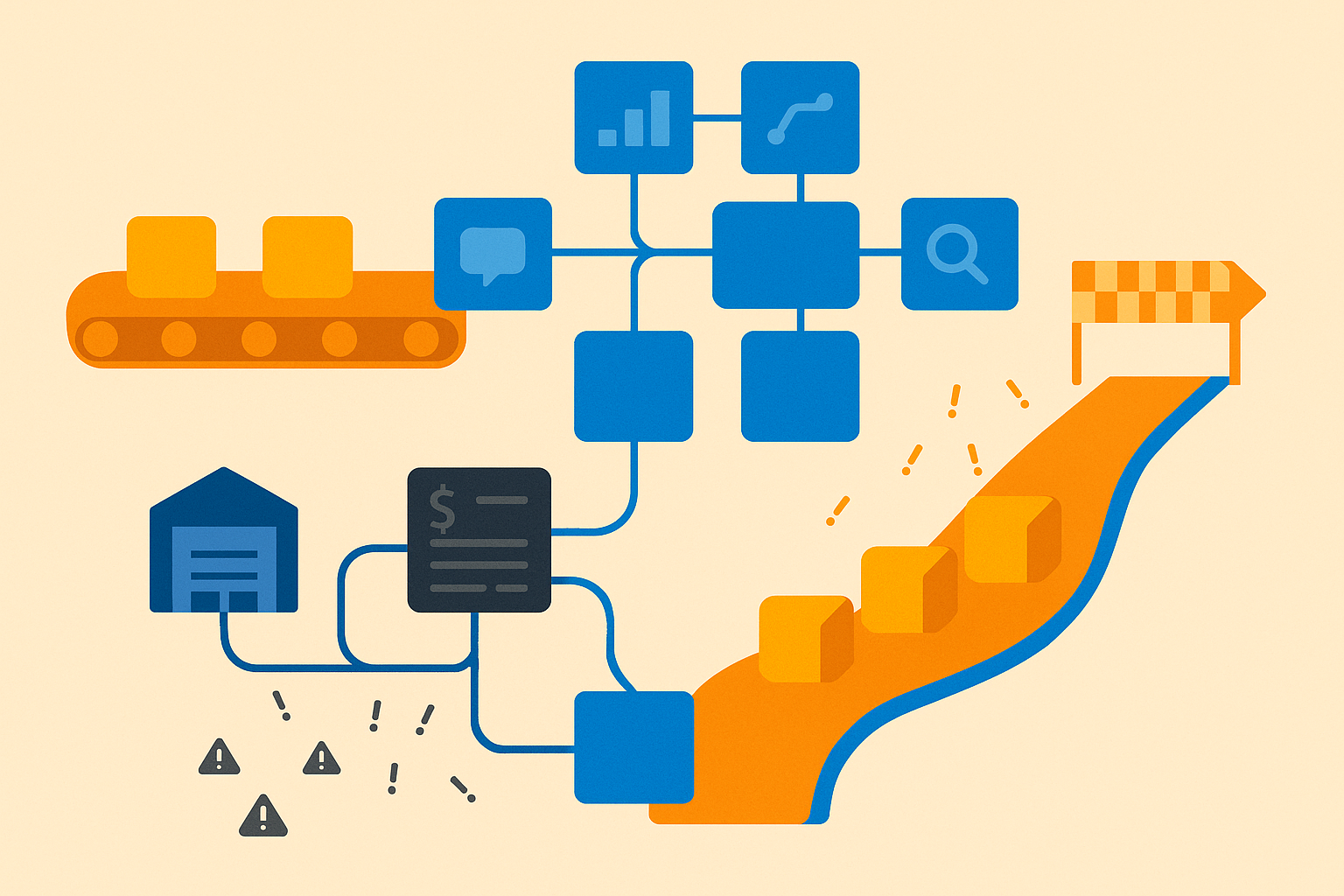
Feature development has a visible story in a budget conversation: a new function can be named, scheduled, and linked to demand from the market or organisation. Modernisation, by contrast, is often seen as work under the hood. That perception becomes even more persistent when the application is still functioning. The discussion then easily shifts into a false contrast: immediately visible expansion versus an investment whose value lies primarily in maintaining reliable progress.
That contrast becomes less stark once the conversation is not about an abstract technical ideal, but about which component blocks further feature development. A subsystem for billing or an ERP integration, for example, can become so critical that new functionality cannot responsibly be built around it. In that situation, targeted partial rebuilding is not an alternative to product development, but a prerequisite for continuing that product development without accepting disproportionate operational risk.
The financial framing then lies not in the promise of a completely new system, but in protecting existing operations during change. A full big-bang rewrite may sound appealing because of the prospect of a clean slate. However, it brings risks of budget overruns, losing hidden domain logic, and a prolonged period in which the organisation faces stagnation. These consequences are often insufficiently visible in a feature roadmap, even though they directly limit capacity for future delivery.
Phased modernisation provides a different budget narrative. Rather than replacing everything at once, a specific component is addressed separately while the rest of the application continues to function. The choice therefore becomes not features or scalability. The question becomes: which targeted fix or renewal prevents a dependent component from limiting the feature roadmap, continuity, or both? For a management team, this is a more concrete comparison than a technical discussion about the state of the codebase. The budget then protects not only an application, but also the ability to continue delivering new functionality with confidence.
The pitfalls of technical debt without a business translation
When technical debt is presented solely in developer terms, such as 'clean architecture' or 'refactoring', a gap emerges between the technical proposal and business decision-making. For budget holders and management, it is not immediately clear what impact these technical choices have on capacity, risk control, or delivery reliability. As a result, modernisation proposals are often set aside, not because the underlying problem is unimportant, but because the business consequences have not been made sufficiently visible.
The risk is that necessary updates are structurally postponed. As long as technical debt is not translated into concrete consequences for development capacity, operational risks, or delivery predictability, the urgency remains unclear. This causes investments in scalability and maintenance to lose out to visible feature development, while the system's structural vulnerability increases.
An effective approach starts by making the business consequences of technical limitations explicit. By demonstrating, for example, how a particular technical debt limits development speed or increases the risk of disruptions, it becomes clear why timely modernisation is necessary. Without this translation, technical debt remains an abstract concept, causing the organisation to unknowingly choose delay and reactive action when future problems arise.
This gap can be reduced by starting with a compact discovery phase, followed by a measurable proof of concept with clear acceptance criteria. This makes it possible to test assumptions and justify large-scale implementation only when the business impact is demonstrable. In this way, the decision-making process becomes more transparent and necessary updates are no longer displaced by more visible but less urgent initiatives.
Criteria for choosing the right modernisation path
The modernisation path becomes easier to compare when you assess delivery behaviour, change risk, and continuity side by side. The criteria below distinguish between a situation in which improving the existing foundation is appropriate and one in which a defined component should be renewed step by step.
| Assessment point | What the data can show | Implication for the path |
|---|---|---|
| Release frequency | High-performing software teams can release multiple times a day. Teams constrained by a stalled architecture may fall back to monthly releases. | A low release frequency is not standalone evidence for rebuilding, but it shows that the organisation should investigate whether the existing setup is hindering change. The conversation then concerns the speed at which valuable changes actually become available. |
| Change failure rate | In the cited DORA statistics, the Change Failure Rate for strong software teams remains below 15%. For teams with stalled architectures, the failure rate exceeds 30% to 40%. | This is a benchmark for delivery reliability and change risk, not a universal standard for every Laravel web application. When an organisation's own pattern points towards many failed changes, a targeted intervention can be better justified by the risk of disruption than by technical preference. |
| Continuity during replacement | In a phased migration, new components do not immediately become leading. They first read data in parallel, then their outcomes are tested against existing business rules, and only then can routing change. | This sequence provides a path when a component must be renewed without stopping business-critical production processes. The organisation therefore retains the ability to validate a step before it takes over regular processing. |
| Scope of the change | The data distinguishes between a problem in the way delivery is performed and a problem that calls for a specific component. The migration method is designed to introduce new components separately. | Partial rebuilding is suitable when the risk and obstacle are concentrated. When measurements show no clear connection between the delivery problem and a defined component, there is insufficient basis to commit to the path. |
Step-by-step plan for phased modernisation
Phased modernisation treats replacement as a series of bounded handovers, not as a single switch-over moment. The process below keeps existing operations as its starting point and reserves broad redevelopment for situations in which incremental change is demonstrably no longer possible.
- 1. Determine whether broad redevelopment is defensible at all. This path only becomes relevant when the existing core technology is end-of-life, fundamental changes to the data model cannot be made incrementally, and complete documentation of business rules is available. These three conditions belong together. End-of-life technology alone does not make broad redevelopment economically defensible when data models can be changed step by step or when business rules are insufficiently documented. Missing documentation, after all, increases uncertainty about what must be retained during replacement.
- 2. Define the component to be renewed. The Strangler Fig pattern focuses on gradually replacing parts of an existing system. The practical consequence is that the organisation does not begin with an abstract intention to modernise everything, but with a separate component whose role and transition can be defined. This keeps the existing application active while a new component can emerge alongside that foundation.
- 3. First run the new component alongside existing processing. The phased approach creates room to introduce a new part without immediately making it responsible for regular production. This prevents the change from being equated with a one-off switch-over. The existing application remains the reference point during the transition, while the new component is integrated step by step.
- 4. Move responsibilities per defined component. Once a component can function in the new path, the next part can be addressed. This iterative approach limits the scope of each change and keeps operations in view. The goal is not to artificially delay replacement, but to divide the transition into controllable parts instead of changing all dependencies at once.
- 5. Reassess the path after every transition. Phased work means the organisation is not irrevocably committed in advance to a full redevelopment. If the existing core technology, data model, and documentation ultimately appear to meet the conditions for broader renewal, that assessment can be made again. Until then, targeted renewal remains a way to implement change without replacing the entire application at once.
Frequently asked questions about scalability investments
The most common objections are rarely about technology alone. They concern whether an investment without an immediately visible feature outweighs the cost, the temporary burden on the organisation, and the uncertainty of change.
- “The application still works; why should this receive budget now?”
The fact that the application works does not exclude the possibility that a defined component limits further growth or reliable delivery. The business rationale is not that technical work is required, but the choice between two outcomes: limited, targeted intervention or continuing to work with a process that makes expansion or change increasingly difficult. Optimisation generally has a low direct cost and minimal operational risk. It can therefore be appropriate when the existing foundation is still usable and the limitation is not a fundamental data model problem. - “Why not rebuild everything straight away?”
A full replacement is not the only route when a core process is under pressure. Targeted partial rebuilding according to the Strangler Fig pattern addresses a separate process more thoroughly without automatically replacing the entire application. Its cost is temporary dual management and an API intermediary layer. These burdens should be explicitly included in the assessment, as should the advantage that a component can be renewed separately while the rest of operations remains available. - “Does optimisation not merely postpone the issue?”
That risk exists when the real obstacle lies in deep limitations of the data model. Incremental optimisation does not resolve such boundaries. The distinction is therefore concrete: optimisation is intended to improve a usable foundation; partial rebuilding is appropriate when a core process must be fundamentally addressed. The investment only becomes meaningful when it is clear in advance which of these two problems is being solved and which limitation deliberately remains. - “How do we make change risk visible in budget discussions?”
DORA metrics provide a benchmark for discussing delivery reliability and risk in changes. The comparison between multiple releases per day with a Change Failure Rate below 15% and monthly releases with a failure rate above 30% to 40% shows the patterns associated with strong and stalled delivery behaviour. These figures do not replace an assessment of your own situation, but they shift the conversation from an opinion about slowness to the reliability with which changes are delivered.
Key considerations for scalability investments
Assessing scalability investments in Laravel web applications requires a business-focused, measurable rationale. The following points together form a realistic decision-making framework:
- Objective measurement data as the basis. Only hard telemetry—such as p95/p99 response times and queue delays from Laravel Pulse, Horizon, or Blackfire—makes bottlenecks demonstrable. This prevents investments from being driven by subjective complaints or assumptions and provides a shared starting point for both management and development.
- Phased modernisation minimises risk. By tackling modernisation step by step, the existing application remains operational and every intervention can be tested against its actual impact on performance and delivery reliability. This increases controllability and enables adjustments without unnecessary disruption to operations.
- Full redevelopment only under strict conditions. A full rebuild is only defensible when measurement data demonstrates structural limitations that cannot be resolved incrementally and alternatives provide insufficient relief. Without this justification, a big-bang approach brings unnecessarily high operational and financial risk.
Even with good measurement data and a phased approach, there remains a risk that investments will be postponed as long as the application still functions. This requires the ongoing translation of technical signals into business impact in order to act in time.