

Optimization is better than a full rebuild when the web application still has functional boundaries that can be delineated through API integrations or routing rules, and there is sufficient test coverage to guarantee functional parity. This makes it possible to improve specific parts without replacing all business logic.
Optimization versus rebuilding web applications
When deciding between optimization and rebuilding a growing web application, several factors matter. The core question is whether functional boundaries are identifiable and whether changes can be sufficiently verified.
- Identify functional boundaries within the application that can be delineated through API integrations or routing rules.
- Ensure sufficient test coverage or automated verification to safeguard functional parity.
- Assess database integrity and avoid dependency on undocumented triggers or procedures.
- Weigh the short-term speed of ad hoc patches against the long-term stability of a phased rebuild.
When is optimization better than a full rebuild?
Optimization is preferable to a full rebuild when the growing web application still provides enough foothold for targeted intervention. This does not mean every performance problem can be solved with a patch. It does mean that an organization does not need to replace all working business logic when individual functional parts are identifiable and controllable. A reporting module, invoicing flow, or customer portal can, for example, form its own functional boundary. If such a boundary can be delineated through API integrations or routing rules, the existing application can remain operational while one component is improved, restructured, or replaced.
The technical question is then whether the behavior of that delineated part can demonstrably remain the same where necessary. Sufficient test coverage provides a basis for this, but automated end-to-end verification can also fulfil that role. Without such verification, a change is mostly an assumption: an updated flow may look correct on screen while exceptions, integrations, or underlying rules produce different outcomes. Optimization is therefore only manageable when the team can hold old and modified functionality to the same expected outcome.
Data rules determine the hard boundary. A phased change remains feasible if database integrity does not depend on a large number of undocumented triggers or stored procedures outside the application layer. If such hidden rules are decisive for simultaneous synchronization, it is no longer clear which mutation produces the correct state. An API layer or routing rule does not solve this lack of insight; at most, it shifts access to the existing complexity.
This is also where the distinction from superficial optimization emerges: a visible improvement that leaves the structural cause untouched. Targeted optimization preserves what works reliably, isolates what is demonstrably bounded, and makes the effect of each change verifiable. This keeps the choice for optimization tied to evidence about behavior and data, rather than merely to a temporarily faster application.
Why consider a phased Laravel rebuild?
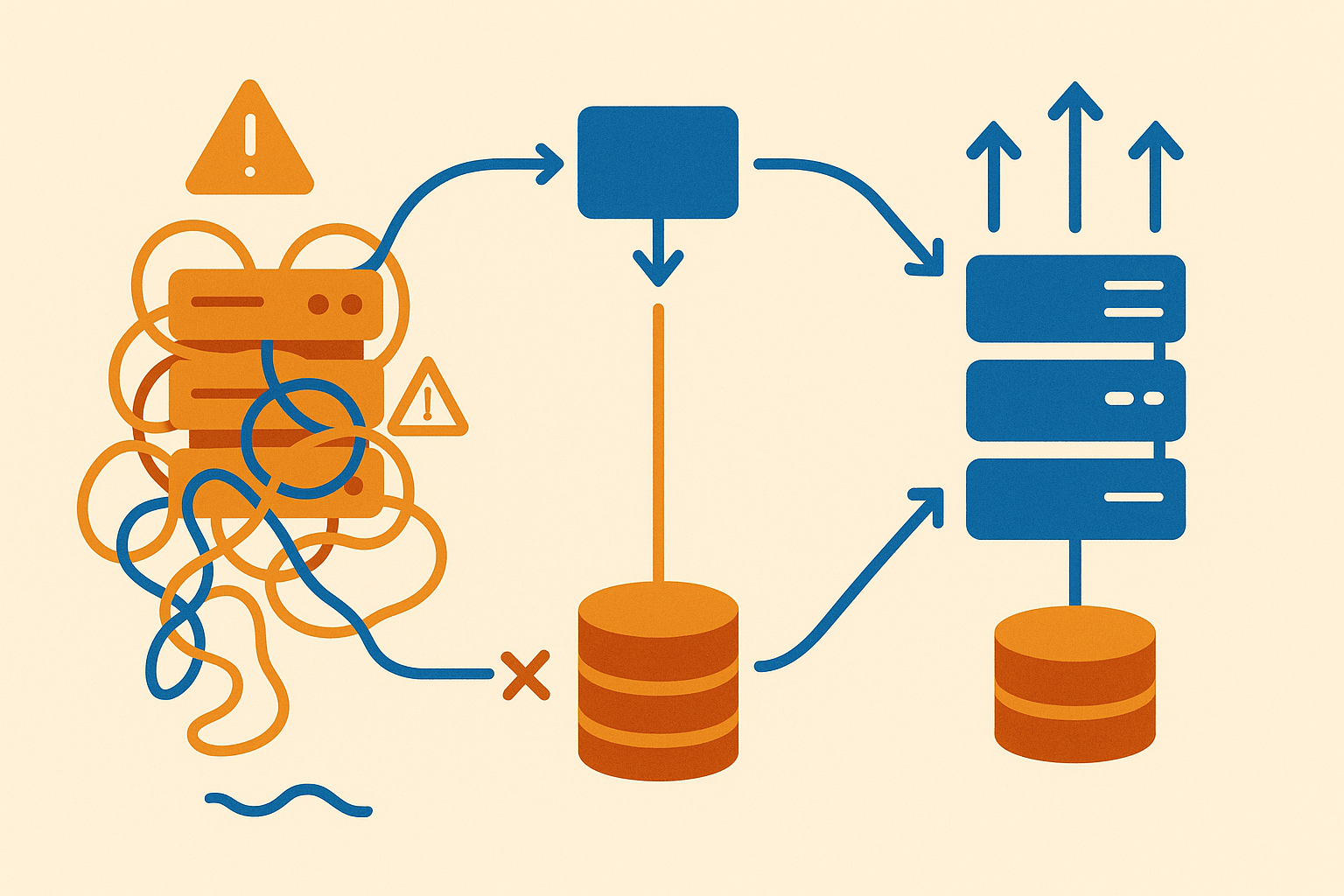
A web application may still function on the surface while the technical room to keep growing safely continues to shrink. When structural investments are postponed because the system still works today, the pressure shifts to the development team. They absorb new operational requirements with temporary solutions and ad hoc patches. These interventions solve immediate problems but also increase complexity and technical debt, making the foundation increasingly fragile.
With increasing usage or transaction volume, these underlying vulnerabilities become visible as unexpected disruptions, such as database lock contention or downtime. Instead of a controlled modernization process, this creates a pattern of reactive work: resources are used to put out acute incidents, causing the budget for planned renewal to disappear. The reason for a phased Laravel rebuild therefore lies not only in outdated technology, but also in breaking a way of working in which temporary measures become the standard.
A phased approach can reduce the risk of such a crisis pattern, provided the transition is designed carefully. It is crucial to establish for each migration phase which environment is the source of truth for a particular data domain. If both the legacy environment and the new Laravel application write to the same tables without clear agreements, inconsistencies and loss of control over the data quickly arise. The transition therefore requires an explicit migration sequence and defined write permissions, so that new components can genuinely take over old responsibilities.
What are the risks of superficial optimization?
Superficial optimization occurs when measures reduce visible slowdown without addressing the structural cause in the database or architecture. Additional cloud servers or aggressive caching can temporarily make an application feel more responsive. However, this says little about the quality of the underlying code, the cohesion between modules, or the durability of data processing. If a structural problem merely becomes less visible, it remains present for a future growth phase, change, or disruption.
The result is hidden complexity. The organization sees an immediate improvement and may conclude that restructuring is unnecessary. Meanwhile, outdated code remains the defining layer for new changes. Each additional adjustment may then affect the same difficult-to-understand parts of the application. Maintenance no longer remains solely a technical matter: the time required to assess changes and rule out regressions increases because the effect of a change becomes less and less localized.
A transition that is not completed after an initial improvement can also become a structural problem in its own right. Old and new components then continue running side by side, with separate deployments, maintenance cycles, and security work. Hosting costs may increase when both environments remain structurally in operation. The temporary transition architecture thus becomes part of regular operations without providing a complete replacement path.
This makes targeted optimization fundamentally different from postponement. Targeted optimization makes a component demonstrably function better within a manageable structure. Superficial optimization adds capacity or temporary acceleration while leaving structural database and architecture problems untouched. The relevant question is therefore not whether caching or extra servers are useful, but whether they solve a delineated problem or merely prevent a deeper dependency from becoming visible.
For a phased Laravel rebuild, it should therefore be clear for every replaced component which old responsibility disappears. This reveals whether the transition is reducing the technical burden instead of adding a permanent extra layer.
Which factors make a phased rebuild credible?
A phased rebuild of a Laravel web application is only credible when both the organization and the technical environment are prepared for the temporary complexity of a transition period. The following factors determine whether a phased approach is genuinely manageable and defensible:
- Organizational willingness to manage two environments temporarily. During the transition, the existing application and new Laravel components will operate side by side. This requires the organization to explicitly accept that additional infrastructure and monitoring are temporarily needed. This temporary overhead helps limit operational disruption; without active management, the coexistence quickly slips out of view.
- A clear trade-off between short-term speed and structural delivery time. Continuing with ad hoc patches delivers new functionality quickly, but increases regression time and technical debt in every subsequent sprint. A phased rebuild requires a deliberate architecture investment at the beginning, with the goal of more stable and predictable delivery time in the longer term. The trade-off must therefore be explicit: less immediate speed now in exchange for greater structural manageability later.
- Room for both product development and technical management. Management teams often steer toward visible, revenue-increasing features, while IT leaders must ensure structural stability, framework upgrades, and security work. A phased rebuild is feasible when these interests are planned as parallel tracks within the project. This gives necessary technical investments a structural place alongside the functional roadmap.
How do you carry out a phased Laravel rebuild?
A phased Laravel rebuild works as a controlled replacement of functions, not as the parallel construction of a second complete application. Execution consists of three interconnected components that determine where traffic goes, which environment manages data, and when a next investment is defensible.
- Redirect traffic by functional component. Place a reverse proxy or routing middleware in front of the existing application. This allows traffic to be intercepted by URL path or API domain and directed to a new Laravel service. Functions that have not been migrated continue to run in the legacy stack. This routing makes the transition visible and bounded: for a specific domain, users reach the new capability without unnecessarily changing other parts of the application. It is therefore controlled replacement per route or domain, not a hidden second access path.
- Define the write path for each data domain. Read-only interfaces and background queues support a transition in which old and new environments coexist. Define for each data domain which application processes mutations and how the other environment consults that data. This keeps the route of a business event traceable, even when data is temporarily exchanged between components. The technical design thus follows the selected migration boundary, rather than having both environments independently attempt to handle the same change.
- Make every phase independently testable. Divide the process into separately funded phases with predefined acceptance criteria. Response times and error-free processing rates are examples of criteria that can determine in advance whether a delineated workflow is ready for the next step. This replaces one-time big-bang approval with a series of explicit decision points. A phase then delivers not only code, but also evidence about the operation of routing, data processing, and the selected transition boundary.
Frequently asked questions about phased rebuilding
Frequently asked questions about phased rebuilding focus on the temporary coexistence of old and new components, and the operational risks that come with it. The most common objections and their underlying mechanisms are explained below:
- “Does phased rebuilding not lead to duplicate complexity?” Temporary coexistence does indeed bring additional complexity. While a big-bang rebuild concentrates all risks in a single moment, a phased approach spreads operational risk across multiple, more manageable steps. It does require temporary management of both legacy and new components, including additional attention to synchronization and monitoring. The choice is therefore a trade-off between concentrated risk and a temporarily increased operational burden.
- “How does authorization continue to work when users switch between old and new?” By implementing a shared authentication layer, such as central single sign-on or token-based verification, sessions and authorizations remain consistent while using both legacy and new Laravel components. This prevents users from having to log in again or access rights from having to be managed separately per environment.
- “How do you prevent an initial phase from getting stuck as an expensive trial?” A phased approach becomes credible by defining clear decision points (stage gates) in advance. Start with a compact architecture audit and a Proof of Concept for one delineated workflow. Each phase receives an explicit go/no-go decision, based on predefined technical and functional criteria. This prevents the process from depending on general confidence and instead makes it depend on demonstrable progress per workflow.
Key considerations for a phased Laravel rebuild
The quality of a phased Laravel rebuild is shown less by the number of new screens than by the extent to which each transition truly replaces an old dependency. Three testable considerations make that distinction visible.
- Domain decoupling must be visible in the code. Heavily intertwined Eloquent models can be extracted into separate domain services with clear data transfer contracts. This makes core functionality modularly rewritten instead of modified through yet another dependency. The contracts define which data is transferred and where responsibilities lie. This reduces the likelihood that a change in a renewed domain unexpectedly causes regressions in related modules. Without this decoupling, a new Laravel component is mainly an extra layer on top of the same interdependencies.
- Operational continuity requires demonstrable experience with controlled exposure. For a core application, it is relevant whether an implementing party can show that it has previously exposed a legacy database through a controlled API layer without production downtime or disruption to core operational processes. This is not a general quality claim, but a concrete indication that the transition route is treated as an operational issue. The distinction lies in the combination of data source, API layer, and ongoing business processes, not merely in building a new interface.
- Data ownership should align with the domain boundary. Clear data transfer contracts show which data a modularly rewritten function receives and transfers. They must align with the previously defined write path, so that a replaced core function does not quietly continue to rely on undefined data responsibilities. It is precisely when a new component can let go of old responsibilities that maintenance pressure and dependencies genuinely decrease.