

Optimization is preferable to a full rebuild when the existing code architecture is already structured into clearly bounded Action classes and the Laravel version is current. This enables targeted refactoring without unpredictable consequences, allowing the investment in the current application to remain worthwhile for longer. A full rebuild is justified when central models have too many responsibilities and dependencies are outdated, leading to release uncertainty and operational risks.
Budget considerations for Laravel rebuilds
When considering optimization versus rebuilding a growing Laravel web application, costs and risks play a crucial role. The decision depends on the current code architecture, the frequency of required changes, and the availability of domain knowledge.
- Identify whether the current code architecture allows refactoring or whether entangled models require a rebuild.
- Assess the change frequency of modules to determine whether a partial rebuild is justified.
- Ensure sufficient domain knowledge and documentation to minimize regression risks during refactoring.
- Consider the impact of release uncertainty on the product roadmap and the associated costs of delays.
- Weigh the short-term benefits of optimization against the long-term risks of increasing release risk.
When optimization is no longer enough for a Laravel web application
A growing Laravel web application does not need to be rebuilt simply because it is getting older or because releases require more attention. The tipping point lies in the relationship between the existing code architecture and the change the organization requires from the application. When domain logic is already contained in clearly bounded Action classes and the Laravel version in use is current, refactoring generally has room to deliver improvement. Responsibilities are then recognizable enough to make targeted changes without each new component affecting the rest of the application unpredictably. In that situation, optimization is a business decision to keep the existing investment useful for longer, provided technical debt is explicitly taken into account.
The situation shifts when central models have accumulated too many responsibilities and dependencies are outdated. Such entangled fat models make it harder to contain a change. An adjustment that appears local can then affect processes that are not immediately visible. If releases consequently revolve mainly around additional manual checks, longer freezes, and caution around rollbacks, this is more than a development problem. The product roadmap becomes less agile, and the value of delayed functionality increases.
A partial rebuild does not replace the entire application, but rather a bounded domain or module for which change has become structurally expensive or uncertain. That part is separated and rebuilt behind a clear boundary, such as an API. This keeps the working system in use while ensuring new development does not repeatedly depend on the same fragile core. The investment question then becomes concrete: which domain slows releases, which dependencies make that domain difficult to adapt, and what business value remains unrealized as long as that situation continues?
For management teams, the line is therefore not whether the app works today, but whether the architecture still supports a predictable pace of controlled change. If it does, optimization may be appropriate. Where reliance on temporary interventions around entangled logic and outdated dependencies is increasing, it is wise to first clearly define the affected domain, the dependencies, and the desired transition boundary.
Why a stable app can still pose a risk
An application can appear stable on a normal workday and still represent a growing business risk. That difference becomes visible when something needs to change. As long as teams can release with confidence and recover quickly from a disruption, daily use rightly says much about the application's usability. But when the same application remains stable only because changes are postponed, require exceptional preparation, or are difficult to roll back, the risk shifts to the next release. The app works, but its changeability is under pressure.
Recovery time makes that pressure concrete. A recovery target should fit the critical processes and the impact of disruption; for some teams, recovery within one hour is a useful internal guideline. When recovering from inconsistent queues or database states takes hours, there is an immediate threat to continuity. Those hours are not merely technical recovery time. They are also a period in which the organization must deal with uncertainty about the status of processes and with a release that can no longer be managed predictably. An application that rarely fails but is difficult to recover from for an extended period after an error therefore deserves the same management attention as an application with visible daily disruptions.
This paradox explains why waiting for a complete outage is not a useful decision point. The room for controlled change is generally greater while the existing system can remain operational. An incremental approach can place new functionality behind an API layer or routing facade. This keeps the existing application in use while a risky component is replaced step by step. Operations do not need to wait for a complete renewal to be finished before reducing part of the risks.
Stability therefore has two sides: the reliability of current operation and the predictability of future change. Alongside incidents, record recovery time, rollback capability, and the effort required for a release. This makes visible where operational headroom is under pressure.
When a Laravel application needs rebuilding
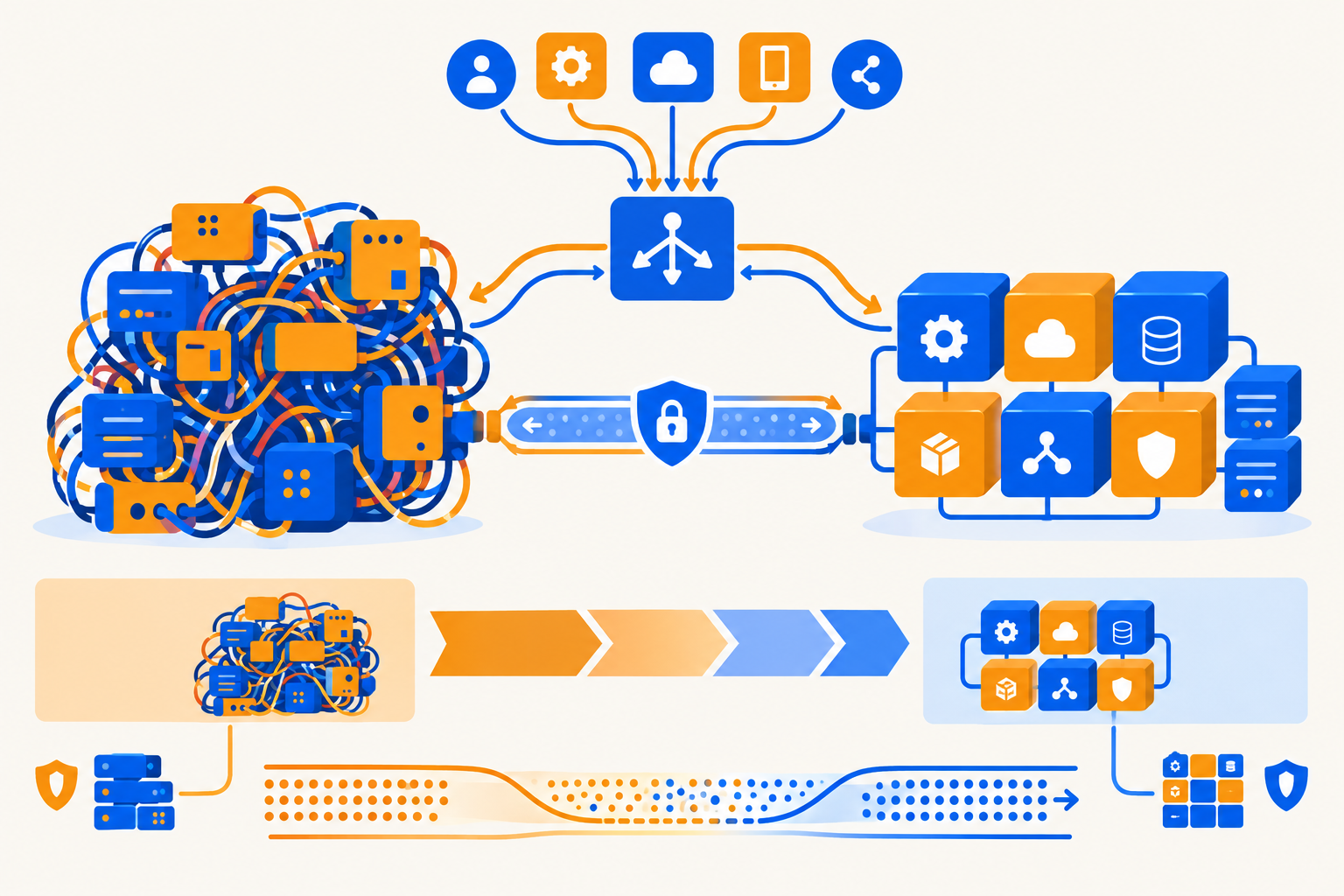
Not every part of a Laravel application requires the same approach when scalability and changeability come under pressure. Modules that need frequent adjustment—for example, because they respond directly to market developments—can become a structural bottleneck when release anxiety arises. In that context, a partial rebuild can be justified: the investment focuses on the part of the system where the organization repeatedly needs speed and flexibility. By isolating and rebuilding precisely these modules, technical debt is addressed at the most critical point, without unnecessary interventions in stable parts of the application.
For static components, where pressure to change is low and the likelihood of release risk remains limited, marginal optimization is generally sufficient. The distinction between dynamic and static parts prevents temporary frustration around one changing domain from leading to a large-scale, disproportionate rebuild of the entire application. This keeps the budget focused on the components where the business need actually recurs.
A phased replacement strategy, such as the Strangler Fig pattern, does introduce temporary operational friction: data synchronization and routing become more complex while old and new coexist. That additional complexity must therefore be explicitly included in planning and acceptance criteria. In return, an all-in-one migration is not necessary to renew the risky part.
Risks and conditions for rebuild decisions
The choice between in-place refactoring and a bounded extraction does not depend solely on technical symptoms. Two conditions determine whether a change remains controllable:
- Domain knowledge and documentation. In-place refactoring assumes the organization sufficiently understands which business rules are embedded in the existing application and where they have an effect. If the original builders are unavailable and the application functions as an undocumented black box, regression risk increases. A change can then damage behavior whose rationale or dependency is unknown. In that situation, a bounded extraction behind an API offers more certainty than modifying logic in the existing core. The API then forms the boundary within which new behavior can be developed without immediately disrupting unknown internal cohesion.
- Phasing with testable acceptance criteria. A partial renewal becomes more manageable when phases are pragmatically defined and have a measurable quality threshold in advance. The principle of reading first, then writing provides a cautious start: first expose and observe information before writing changes back. This allows the operation of the new layer to be assessed without it directly intervening in the existing process. Only when acceptance criteria have been met does a better-substantiated basis emerge for the next step. This phasing shifts the discussion from an abstract promise of rebuilding to concrete conditions under which a part is safe enough to proceed.
Practical application of rebuild logic to Laravel web applications
The most costly response to rising release risk is often the reflex to start a complete greenfield rebuild from scratch. This choice appears straightforward because old and new are sharply separated. In practice, however, it creates a long period in which the running system must continue to be maintained while the replacement is not yet operational. That dual maintenance burden competes directly with the capacity needed to advance the new solution. New requirements do not disappear during a rebuild; they continue to arise in the existing application.
The Big Bang Replacement Trap emerges when management underestimates this double burden. A full rebuild can take several quarters, while the original system must continue to run during that period. This increases budget pressure and the likelihood that the program will be stopped before the intended replacement supports operations. Rising release risk alone is therefore not proof that a comprehensive replacement results in the least uncertainty.
Incremental modernization avoids one major switch-over moment by linking replacement to separate parts. This shifts attention from the general choice between old and new to managing the transition: which part can be separated, which data flows remain temporarily shared, and when is the new part reliable enough for the next step? The existing system remains available during the transition, while renewed components can be put into use separately.
For a Laravel web application, the rebuild question thus becomes a bounded change initiative, rather than a general desire to start over. The financial comparison should therefore include both the cost of dual maintenance and the cost of continued release delays.
Frequently asked questions about optimization and rebuilding
Many organizations struggle with the trade-off between immediate roadmap progress and the structural reliability of future releases. Reliability and maintainability are also recognizable quality characteristics within ISO/IEC 25010; this provides a useful framework for making the technical and operational consequences of the choice explicit. Below, we answer two frequently asked questions about optimization and rebuilding in light of rising release risk.
- Should we rebuild everything immediately when releases keep becoming more stressful?
Not necessarily. Increasing release fragility indicates that the current way of making changes is under pressure, but it does not automatically justify a total rebuild. Short-term optimizations or patches provide visible progress in the near term, but may increase the risk that future releases become more complex and costly. A partial rebuild—where only the most risky or changeable modules are replaced—temporarily requires less feature capacity, but can reduce the cost and uncertainty of future deployments. The trade-off is therefore about the balance between immediate sprint results and the structural reduction of release risks. Both cost and time horizons should be included in decision-making.
Can optimization still be useful if the application runs on a recent Laravel version?
Using a current Laravel version does not mean optimization is unnecessary, nor does it mean a rebuild is inherently required. The core question is whether the chosen intervention supports delivery reliability in the long term. If quick patches are the only way to demonstrate progress, technical debt is pushed into future releases. Targeted refactoring can then reduce the deployment burden without starting a complete replacement. It is commercially defensible to compare immediate sprint gains with recurring release risks and choose the approach that best supports operational continuity.
Key considerations for optimization versus rebuilding
The persuasiveness of an investment proposal lies not in the scale of the proposed renewal, but in demonstrating that the transition can take place under operational conditions. Use the following considerations to assess an incremental approach:
- Ask for evidence of change alongside active production. An approach in which a new architectural layer is placed alongside an active production system shows that modernization does not need to wait until the existing system is taken out of service. This distinction is relevant when a Laravel web application supports processes that must remain available during the change. The assessment then goes beyond whether a supplier can deliver a new application. It concerns whether the proposed transition takes account of a system that continues to deliver business value in the meantime.
- Assess an approach based on the visibility of the transition. With an incremental route, the change becomes visible in separate architectural layers alongside the active system. This makes it possible to connect the investment to a bounded part of the operation rather than to an abstract end state. For decision-making, this provides a more concrete basis: which layer is changing, how long will the existing system remain active, and which operational dependency will remain during that period?
- Link continuity to a financial limit. Avoiding production downtime is not a promise that every situation will proceed without disruption. It does, however, provide direction for an approach that seeks to avoid a total switch-over. For an organization facing increasing release uncertainty, the financial limit lies in how much cost and delay an active production system can still bear while renewal takes place. An initiative in which that limit has not been made explicit may put the continuity of the running process under pressure.