

There are four key strategies for integrating legacy systems with new cloud-based solutions: direct API integration, a decoupling integration layer, event-driven synchronization, and phased replacement. The right approach depends on the available interfaces, the required timeliness, and the maintainability of the existing system.
Strategies for integrating legacy systems with cloud solutions
The four routes differ primarily in the problem they solve:
- Direct API integration uses existing, stable, and documented endpoints.
- An integration layer decouples the cloud solution from the internal structure of the legacy system.
- Event-driven synchronization processes changes without continuously querying the source.
- Phased replacement provides a way forward when continued maintenance of the codebase is no longer sustainable.
Key strategies for legacy-to-cloud integration
Legacy-to-cloud integration is not a choice between retaining everything and replacing everything. The appropriate route follows from the technical characteristics of the existing system and from what the new cloud solution actually requires. Four strategies recur in this issue: direct API integration, a decoupling integration layer, event-driven synchronization, and phased replacement. They are not interchangeable. Each model emphasizes a different boundary: available interfaces, change processing, required timeliness, or the maintainability of the existing code.
Direct API integration is suitable when the legacy system already provides stable and documented REST or SOAP endpoints. The cloud solution can then access data and transactions through those existing interfaces, without first requiring an additional translation layer. However, this simplicity is subject to two conditions. The documentation and behavior of the endpoints must be sufficiently stable to build upon. In addition, the transaction volume must be manageable synchronously without overloading the source server. An endpoint that technically exists is therefore not automatically suitable as an integration boundary: the load on the existing system also determines whether this route remains responsible.
An integration layer becomes relevant once direct access does not reflect the actual structure of the core system. In a closed architecture without public interfaces, an adapter is needed to establish a controlled connection between old and new. Event-driven synchronization addresses a different issue: data timeliness. When information must be available within seconds while heavy synchronous polling queries make the legacy database too vulnerable, integration shifts to signals about changes via CDC or message queues.
Finally, phased replacement is not a disguised full migration, but a route for a codebase that has become technically unmaintainable. This strategy is indicated when the cumulative costs of continual patching exceed those of incremental redevelopment. The core of the decision then lies not in the fact that the system is old, but in the balance between continuing to adapt it and replacing components in a controlled way. Integration temporarily marks the boundary between what still works and what is being rebuilt.
When is an integration layer needed?
An integration layer or middleware is particularly important when the cloud solution must not only read data but also make changes. In many legacy systems, write operations are inseparably linked to existing business rules that determine whether a change is valid. If this validation must take place through the core system, middleware generally provides a controlled route for guiding changes through the correct validation steps. This prevents new systems from attempting to implement changes outside the existing control mechanisms.
The distinction between reading and writing is fundamental here. Making information available to the cloud can sometimes be achieved with limited exposure, but changes require alignment with the applicable business rules. The integration layer keeps that responsibility with the legacy system and limits dependence on uncontrolled access paths.
Risks of insufficient API security
An API layer around a legacy system changes that system's exposure. Data and functions that were previously available within a limited environment become accessible to external cloud users. As a result, the quality of authorization is not merely a detail of the connection. When access is not checked with sufficient granularity for each object, a user may view data for which they have no permission. This risk is known as Broken Object Level Authorization, or BOLA.
BOLA does not arise because an API is inherently insecure, but because the API layer does not sufficiently verify whether the requester belongs to a specific object. In a legacy context, this requires particular attention: a rudimentary layer can technically expose data without properly translating the authorization depth of the underlying process. The connection then appears functional, while access at the object level proves too broad. For external cloud users, this may mean they see information beyond their authorized scope.
Resource Consumption is also relevant. An endpoint can become overloaded when capacity consumption is not sufficiently limited. In a legacy system, this is more than a performance issue for the API itself. If API calls place a heavy load on the underlying environment, the availability of the exposed function comes under pressure. Within the Shared Responsibility Model, this requires clear agreements about the security and load of the integration layer, alongside responsibilities for the cloud environment.
A quick API layer is therefore not a complete solution in itself. In addition to a technical route to data, per-object access control and limits on endpoint use are needed to prevent access from becoming too broad or the existing system from being exhausted.
Applying event-driven synchronization
Event-driven synchronization is suitable for processes in which the cloud solution needs data within seconds, but the legacy database cannot tolerate heavy synchronous polling queries. The tension lies between timeliness and load. Repeatedly searching the source database directly for changes keeps the cloud environment current through continuous querying. That querying can put a vulnerable legacy database under pressure.
CDC or message queues offer a different direction for data exchange in this situation. Synchronization then starts from changes as they occur, rather than from heavy repeated requests from the new environment. This aligns the data flow with the moment new information becomes available. The cloud solution receives information based on events, so it does not depend on a synchronous query to the legacy database for every update.
This approach shifts attention from continually requesting data to carefully processing change signals. This puts less strain on the source while enabling the cloud solution to respond to new information as soon as it becomes available. If near-immediate timeliness is not needed, or polling does not create a noticeable load, event-driven synchronization need not be the preferred route.
Key considerations when choosing an integration strategy
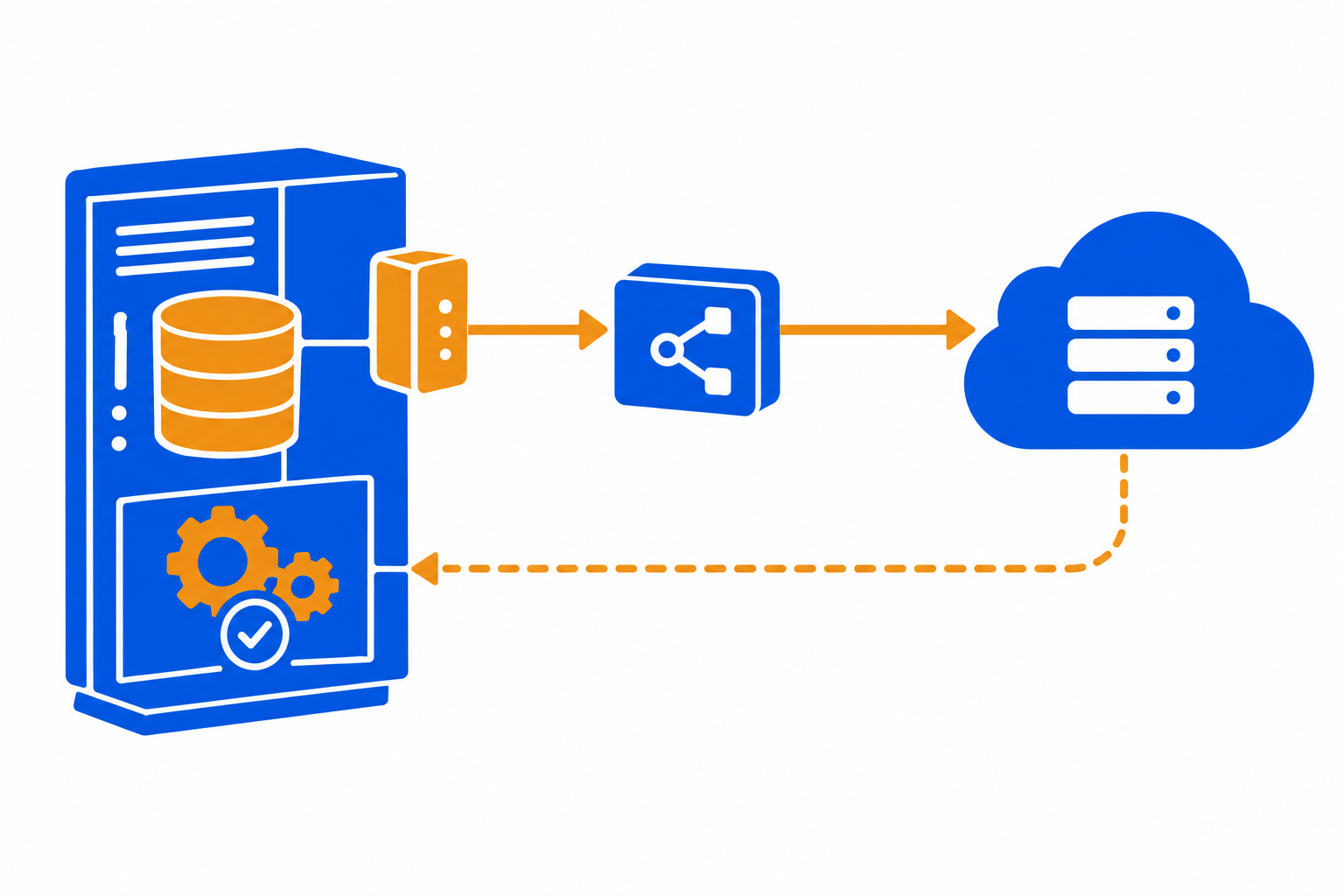
The choice becomes clearer when you do not start with a preferred product, but with the boundary that the existing system can actually handle. A limited practical illustration shows how that boundary can be explored step by step without immediately moving the operation of the core system.
- For a scheduling system from 2012, a side-by-side API layer was used as a constrained integration route. This approach started by reading only from the existing database. Changes subsequently went through the business rules of the old system, so the system did not have to process two different sources of truth for the same change. A migration path was also defined for components made available through the API: they could later be replaced individually without requiring the rest to change at the same time. This case is an illustration, not a fixed recipe for every environment. Its significance lies in the sequence of the decision: first choose a limited access model, then keep changes within the existing rules, and only then determine which components are suitable for replacement. This limits the operational risk of an abrupt intervention in a system on which daily processes depend. The costs of temporary connections and ongoing patchwork also deserve an explicit place in a FinOps assessment. When these burdens accumulate, they may outweigh phased replacement. The final strategy must therefore allow for controlled access, valid changes, and a defined replacement path, without placing production work on an unproven new route.