

To validate that a security-sensitive API integration can continue performing critical operations under disruptions, outages and recovery scenarios before go-live, a formal continuity test plan must be implemented. This plan includes controlled fault injection, use of the Transactional Outbox pattern, idempotent processing, fail-fast circuit breakers, and bounded retries with exponential backoff. These measures help keep the integration operational, reliable and controlled when normal chain processing deviates.
Validation of API Integrations for Continuity
This article addresses the need for a pre-go-live continuity test plan for security-sensitive API integrations. Here, security-sensitive refers to integrations that process, for example, financial transactions, personal data, access decisions or other business-critical data, where an error has consequences beyond temporary unavailability. It focuses on validating the operational resilience of these integrations under different failure scenarios.
- Identify and validate failure paths through controlled fault injection, such as timeouts and rate limits.
- Use the Transactional Outbox pattern to ensure data integrity and prevent duplicate transactions.
- Implement circuit breakers and bounded retries to prevent cascading failures and resource exhaustion.
- Link go-live decisions to objective acceptance criteria and a validated rollback runbook.
Importance of Continuity Validation for API Integrations
An API integration is only operationally assessed when it is clear what happens if a dependent system does not respond, a response arrives too late, or a transaction has been completed but its confirmation is lost. In a security-sensitive process, this is not only about availability. The central question is whether business operations and data state remain controlled when the chain deviates from its normal flow. Continuity validation makes this question testable before users and critical processes become dependent on the integration.
A common risk path arises with a payment or order transaction. The target system may already have recorded the change while the HTTP response to the integration layer times out. If the request is then submitted again without a strict idempotency key, the target system may process the same transaction again. Financial balances and inventory levels can then diverge, requiring manual reconciliation. A successful demonstration does not reveal this, because the response normally returns on time and the first processing visibly succeeds. The actual uncertainty lies precisely in the combination of an executed action and a missing response.
Persistent disruptions also require behaviour other than simply retrying. A Circuit Breaker can switch from Closed to Open following consecutive downstream timeouts or 5xx errors. New requests then fail immediately locally rather than continuing to wait for a system that is unavailable. This prevents server threads and database connections from being exhausted by an external dependency. The continuity of other processes thus becomes a separate assessment point: the failure of one integration must not automatically make internal application routes unavailable.
The required validation depends on the environment. With a legacy on-premises target system that does not support RFC standards or explicit rate limiting, part of the protection rests with the custom integration layer. That layer must then enforce rate limiting and state tracking itself, so that the source system is not overloaded by request volume. Before go-live, evidence is therefore needed that this protection also works under abnormal conditions, not merely that data is exchanged correctly at a quiet moment.
Why a Demo Is Not Enough for Go-Live
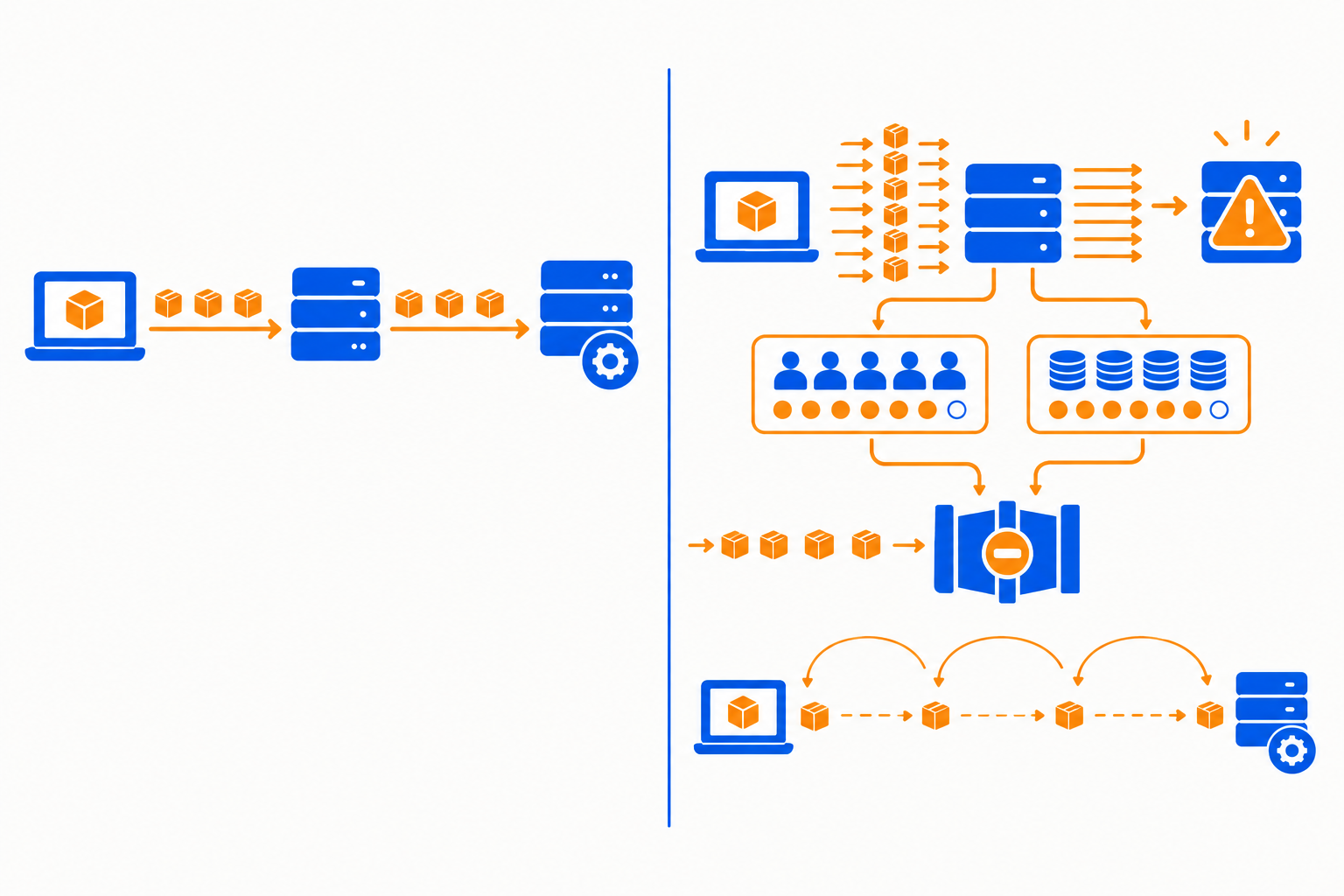
A demo of an API integration typically shows only the ideal scenario: a preselected transaction passes through available endpoints and produces the expected result. This confirms functional operation, but does not address how the integration behaves when external dependencies respond slowly, are temporarily unavailable or impose limits. In a demo, all endpoints are fully available, so it does not reveal what happens with HTTP 429 or 503 errors, or network timeouts. These deviations are precisely what determine the operational resilience of the process.
Production environments create risks that a demo does not expose. For example, if a connected ERP system exhibits slow database locks under peak load, outgoing HTTP calls may block. This not only delays the integration itself but can also—depending on the architecture and resource management—make internal application routes unavailable as workers and connections become exhausted. A functional test that only checks whether an order is forwarded does not detect this cascading effect. The relevant question is whether delayed dependencies remain within manageable limits and whether other processes remain available.
Recovery behaviour is a second blind spot. During a temporary network interruption, active API integrations can cause timeouts. If the integration layer then performs synchronous retries without limits or backoff, there is a risk that hundreds of processes send new requests simultaneously when service is restored. This can overload the external API and prolong the disruption. A demo shows only the success path, not the cumulative request pressure or the effect of mass retries after an outage.
Functional tests and demos are therefore insufficient to prove operational resilience. Without simulated failures, controlled timeouts and recovery tests, it remains unclear whether the integration degrades in a controlled manner, prevents cascading failures and avoids recovery leading to renewed outages. The value of the test lies in understanding behaviour outside the normal path.
When Is Continuity Validation Required?
Continuity validation should be on the agenda as soon as an API integration changes a business process, transfers data between systems or must perform recovery actions after uncertain processing. The risk is then not limited to a temporarily missing screen result. A composite process may, for example, partially succeed in a CRM and then fail in an ERP. Without compensating rollback transactions, entities remain half-completed. This incomplete state leads to silent data pollution: the systems may each appear usable individually, while no longer representing the same reality collectively.
In such situations, it is not enough to test only the successful chain. Validation must establish which local change has been committed, which outgoing message still needs to be sent and when external processing can be considered final. The Transactional Outbox pattern provides a defined mechanism for this: local database changes and outgoing API messages are recorded within a single ACID transaction. Asynchronous workers send the messages only after local data consistency has been secured. This makes the pattern particularly relevant when a local process step and an outgoing notification must not fail independently of each other.
Temporary outages also make validation necessary when many processes use the same external API. Retry attempts can sometimes shorten an interruption for an individual transaction, but simultaneous failures can create a new wave of load. Controlled retries therefore combine exponential backoff with jitter: the waiting time increases and is not identical for all processes. Validation then focuses on whether this distribution remains visibly effective during recovery.
The practical boundary therefore lies in the consequences of a deviation. If an error affects only an isolated query that can be run again, the required validation is more limited. However, if there is a persistent data transaction, a chain between CRM and ERP, or a shared external dependency, go-live requires testing of partial success, delayed delivery and controlled recovery. Normal processing says too little about the operational outcome in these situations.
Key Factors for Continuity Validation
The acceptance criteria follow from how the integration processes data, how long it may depend on connected systems and how it handles exceptional messages. The factors below make the choices explicit, so that a go-live decision does not rest solely on a functioning normal path.
| Factor | What validation must establish | Decision implication |
|---|---|---|
| Consistency versus chain availability | With real-time synchronous two-way validation, it is immediately clear whether data matches. At the same time, the overall availability of the chain falls to the product of all connected systems. | Assess for each process whether immediate confirmation is required or whether a different approach better fits the acceptable dependency on external systems. The test must demonstrate what behaviour occurs when one link is unavailable. |
| Invalid messages in processing | A syntactically valid but semantically invalid payload can repeatedly cause a worker pool to fail. Without routing to a Dead Letter Queue, thousands of subsequent valid messages can remain blocked for hours. | Make the handling of an individual erroneous message an independent acceptance criterion. The evidence must show that the regular message flow continues while the exceptional message is isolated. |
| Phased rollout versus rapid market launch | Validation per supplier using anonymised data and passive shadow operation lengthens the process. In contrast, a big-bang launch introduces risks that have not been made manageable in advance. | Choose the rollout model based on the consequences of an error. Each phase produces concrete evidence of processing under realistic data before the next group joins. |
A Structured Approach to Continuity Validation
A usable validation approach divides testing around distinct failure and recovery behaviours. This makes clear for each component what evidence is missing for go-live and which deviation may affect normal processing.
- Test repeated transactions as a single processing result. Build on the timeout scenario described earlier by sending a mutating request and deliberately causing the network response to be absent. Then submit the same request again with the same Idempotency-Key. Record as acceptance evidence that no second transaction has been created and that the previous processing result or associated status is returned. This keeps the test focused on the distinction between a transport error and a new business action.
- Isolate permanently failing messages. Submit a message that cannot be resolved by retrying and verify that it goes to a Dead Letter Queue. The recorded error context, payload and correlation IDs form the basis for investigation and reprocessing. At the same time, the regular message flow must continue. This test separates two questions that are often conflated: can an employee or operations team reconstruct the erroneous message, and do subsequent valid messages remain available for processing?
- Test recovery under recurring request pressure. Simulate failing API calls followed by recovery of the external interface. In the test runs, check the waiting times, distribution and maximum number of retry attempts around the recovery moment. This demonstrates whether the configured backoff and jitter distribute accumulated request pressure rather than merely proving that an individual request eventually succeeds.
Frequently Asked Questions About Continuity Validation
Many organisations have focused questions about how continuity validation for API integrations is performed and which evidence is actually relevant to decision-making. Below are answers to common questions and objections:
- “Do retries not create an additional risk of overload?” Automatically retrying failed requests can increase availability during short-lived disruptions, but without limits or a backoff strategy, it risks placing further load on an external service. A valid test plan therefore shows how the integration handles repeated requests during an outage, including the balance between rapid recovery attempts and preventing HTTP 429 blocks or cascading failures. Assess the measured distribution and limitation of retries, not only the eventual success of a request.
- “Is a technical test run sufficient evidence for go-live?” A single technical test generally only proves that an error can be simulated. Operational decision-making requires additional evidence: a validated runbook with tested rollback procedures, documentation of manual reprocessing of Dead Letter Queues and recorded recovery times in a representative test environment. This provides insight into both the recovery process and its practical feasibility, allowing technical and operational stakeholders to assess whether continuity is truly safeguarded.
- “Why test in advance with your own data and per use case?” Defining in advance which scenarios and exceptions are relevant for each use case, and testing them on your own data, makes validation concrete and verifiable. A Proof of Concept using realistic data reveals whether the process meets the organisation’s requirements. If certain acceptance criteria prove unachievable, it remains possible to make an informed decision based on these findings to adjust or stop the initiative. This makes validation a defined part of decision-making rather than merely a technical formality.
Key Considerations for Go-Live Approval
Go-live approval becomes defensible when technical operation, recovery evidence and ownership boundaries are available as a single decision package. Two elements clarify what the organisation actually accepts and who acts when the chain deviates.
- A tested Continuity Test Matrix. Directly align specific failure scenarios, including 504 Gateway Timeouts, DNS errors, network jitter and rate limits, with successful test runs and measurable recovery criteria using representative data. This matrix prevents “tested” from becoming a general status. For each scenario, it shows which disruption was simulated, which recovery behaviour was observed and whether the result meets the predetermined threshold. This gives the approver a verifiable connection between the risk faced by the process and the evidence provided for it.
- A formal RACI for the entire chain. Define where the integration and buffering responsibility of the Laravel layer ends, and where data ownership and external API SLAs begin. This prevents an error from remaining unresolved between parties after go-live because each team assumes another team manages the data, queue or external availability. The RACI must therefore include not only names, but also clearly define the boundary between responsibilities during disruption and recovery. This is not a replacement for contractual or compliance obligations, but a practical verification tool for periodic reviews of test runs, runbooks and available audit reports. Without that boundary, a technically successful integration can still lead to delays in daily operations, recovery costs and uncertainty over who will get a stalled process moving again.