
Artificial intelligence can improve diagnostics in hospitals by integrating AI outputs into existing systems such as PACS or EHRs, and by ensuring high data quality and a robust governance framework. This requires a structured approach following the six phases of the AI Quality Guideline, including local validation and continuous monitoring.
AI diagnostics in hospitals: Preparation and implementation
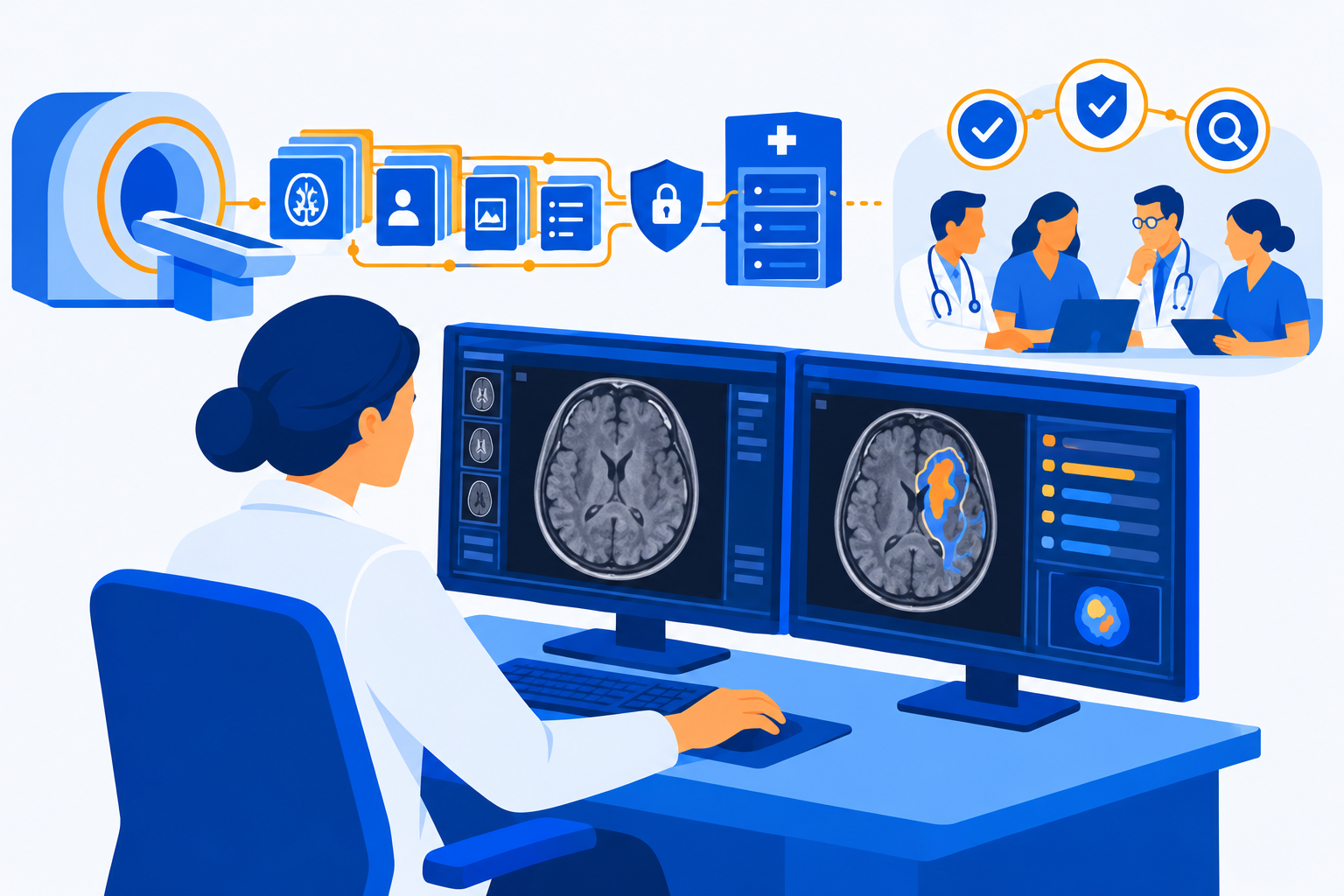
For AI diagnostics in hospitals, technology, workflow and oversight must align from the outset. The main points of attention are integration into existing systems, data quality and continuous monitoring of effectiveness and safety.
- Ensure seamless integration of AI outputs into existing PACS or EHR systems to promote adoption.
- Assess data quality and ensure reliable, structured data to guarantee reproducible AI results.
- Implement a formal governance framework to separate retrospective audits from prospective pilots and provide oversight.
- Use the six phases of the AI Quality Guideline as a structure for preparing and introducing AI diagnostics.
- Prevent clinical risks by thoroughly validating models and monitoring them for performance and deviations.
Prerequisites for AI diagnostics in hospitals
The points of attention identified during preparation only become useful once they have been translated into the daily working environment. AI outputs must therefore be available in systems healthcare professionals already use, such as PACS or EHRs. Standalone applications that operate outside these systems disrupt workflows and raise the threshold for sustained use.
The data flow also requires a fixed setup. Reliable, structured and representative data are needed to assess and reproduce outcomes. Record who is responsible for assessing and following up on AI results.
The governance framework then distinguishes between retrospective data audits and prospective pilots. This separation, as applied within the AI Quality Guideline, prevents findings from historical data from being translated too quickly into routine use. It creates an auditable path from assessment to practical application.
Direct requirements for AI diagnostics
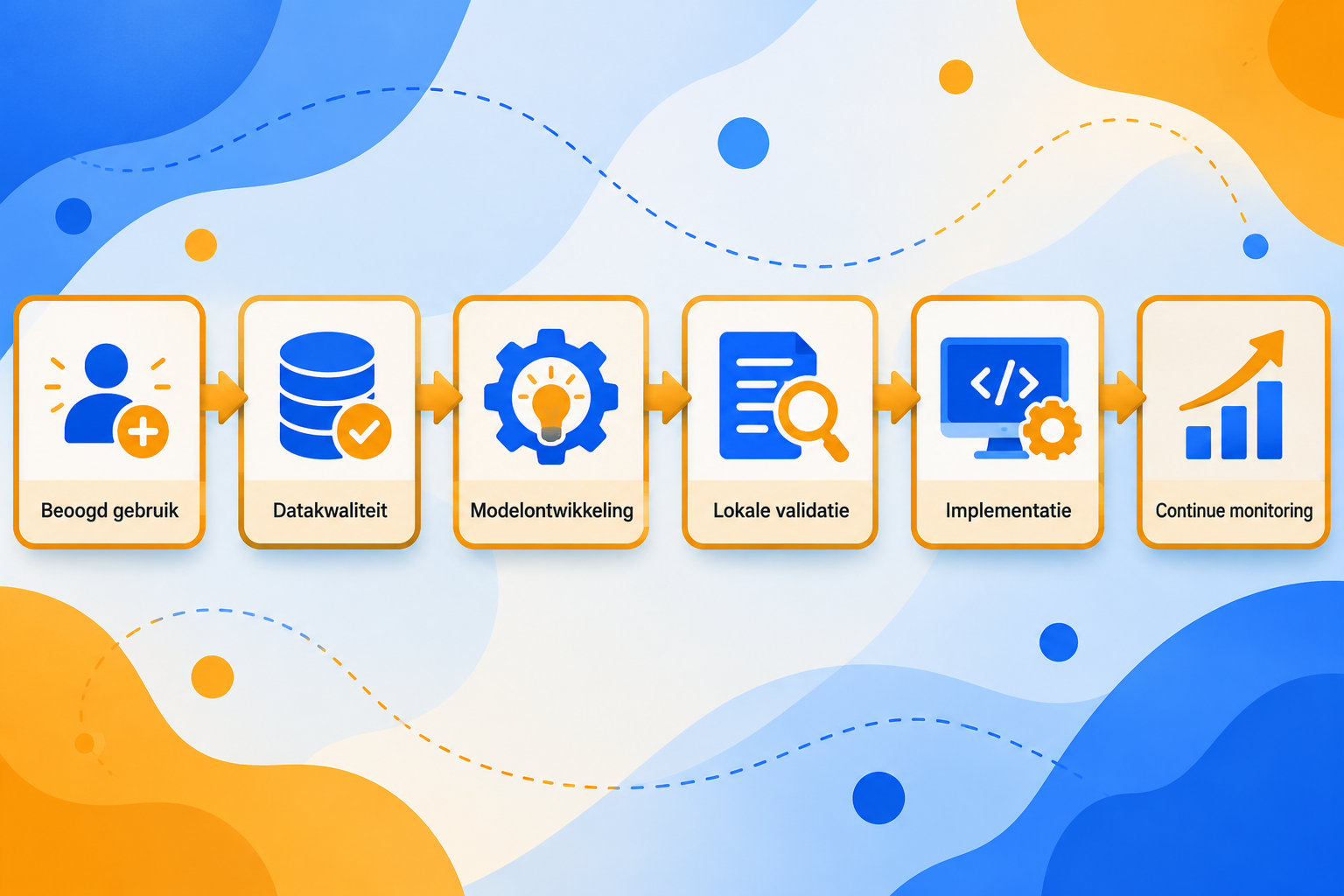
AI can support diagnostics in hospitals within a carefully defined process. However, the usefulness of its outputs depends on local data and on how its use is controlled. Data quality is not a one-time input check. A model may become less reliable when local image acquisition parameters or scanner specifications differ from the cohorts on which it was originally trained retrospectively. This shift in data distribution, also referred to as covariate drift, shows why a result from an earlier dataset is not automatically predictive of the local situation.
The intended use must therefore be explicitly linked to local circumstances. The AI Quality Guideline in Healthcare provides six interconnected phases for this purpose: intended use, data quality, model development, local validation, controlled implementation and continuous monitoring. Each phase answers a distinct question. Intended use defines what the application is used for. Data quality shows whether the available information is suitable for that purpose. Local validation then examines the application in its own context, before controlled implementation and monitoring are considered.
Integration and oversight are therefore not separate from the data question. An AI output displayed in an existing working environment is meaningful only when users can assess the conditions under which that output was generated and when deviations in performance become visible. Continuous monitoring forms the link between controlled deployment and insight into subsequent operation.
This sequence helps a hospital align technical preparation, local evaluation and operational oversight.
Risks of insufficient preparation for AI diagnostics
Insufficient preparation for AI diagnostics shifts uncertainty to the phase in which the application may already influence clinical decisions. The risk lies not only in a technical deviation, but in the consequences of an inadequately validated model within a care process. False positives may lead to overtreatment. False negatives may cause diagnoses to be missed. Both situations affect patient safety and may result in formal enforcement proceedings by regulators.
These risks require an evaluation that goes beyond whether a model produces outputs under test conditions. For early clinical evaluations of AI-driven decision support, the DECIDE-AI framework provides a set of 17 domain-specific reporting criteria. It addresses, among other things, human factors, patient safety and proof-of-concept validation. This shifts the assessment from an isolated technical demonstration to the circumstances in which people work with the application.
Human factors matter because an AI output does not stand alone. The application appears within a process in which users interpret signals, allocate time and carry responsibilities. Patient safety therefore requires attention not only to the model's output, but also to how the application is tested before it is deployed more widely. In this context, a proof of concept is not a shortened route to routine use, but a defined opportunity to make assumptions about use and safety visible.
Oversight becomes concrete when a hospital can demonstrate how the risk of false positives and false negatives has been addressed in preparation. An early evaluation with explicit reporting criteria makes it possible to assess which aspects have been examined and which uncertainties remain. Without this substantiation, it remains unclear whether the application is suitable for the intended clinical situation. This increases not only the risk of incorrect outputs, but also organisational vulnerability when its use is questioned.
Preparation must therefore not disregard uncertainty, but define, investigate and document it before the application becomes part of care delivery.
Checklist for AI diagnostics readiness
Use this checklist to assess whether your hospital is operationally and technically ready for AI diagnostics. The emphasis is on integration into existing systems, data quality and oversight structures.
- Workflow integration: Check whether AI inferences are directly available within the primary viewer or EHR dashboard. Avoid situations in which clinicians must switch between applications or require additional logins. This increases usability and makes it possible to assess AI outputs within existing workflows. Also ensure that logging and transparent presentation of uncertainty margins are in place, so that every recommendation can be verified directly and aligns with oversight frameworks and MDR requirements. MDR here refers to the European Medical Devices Regulation; which requirements apply depends on the AI application and its intended use. Record which information is logged, who has access and how verification takes place.
- Detection thresholds and stop criteria: Establish clear detection thresholds and pause criteria in advance. Higher sensitivity can reduce the number of missed pathologies, but often leads to more false positives, which can cause alert fatigue and resistance among specialists. Therefore define the circumstances under which the system is paused or stopped due to insufficient performance. Link these criteria to recorded outcomes and visible uncertainty information, so the system does not continue operating when signals of inadequate performance are present.
Key considerations for implementing AI diagnostics
The checklist makes operational readiness visible. In addition, three considerations are important for a responsible decision:
- Performance validation with multicentre publications. Base confidence in an AI application on published multicentre validations in peer-reviewed medical literature, carried out according to recognised standards such as TRIPOD-AI or STARD-AI. This makes the substantiation of performance claims transparent and assessable, and prevents decisions from relying solely on internal or one-off results.
- Robust governance framework. Define who is responsible for the assessment, deployment and oversight of AI diagnostics. Use validation documentation as a basis for formalising responsibilities, review points and conditions under which further use is acceptable.
- Continuous monitoring and retraining. Ensure there is a plan to continue monitoring the performance of the AI model after deployment and to make adjustments where necessary. Use the reported validation results as a reference point for monitoring, so deviations are identified and addressed in time.
Together, these considerations clarify which substantiation is needed to assess local applicability, responsibilities and performance in a focused way after deployment as well.