

A startup can launch an AI product quickly when its data input meets predefined validation criteria, such as schema validation and a tiered review workflow. Perfect data quality is not required; however, anomalous or uncertain input must remain visibly outside the automated route.
Data readiness for AI launches at startups
For an AI launch, data readiness is about whether data can flow through the product in a controlled way. To achieve this, startups need clear validation criteria and a manageable processing workflow.
- Use schema validation to ensure consistent data structures and identify unexpected input.
- Implement a 'read first, then write' principle to validate data changes against authoritative sources.
- Limit autonomy to controllable cases to minimise operational risks.
- Use a tiered review workflow to enable human intervention for questionable data.
- Observe and monitor where validation falls short so the workflow can be adjusted purposefully.
Why data readiness matters for AI product launches
An AI product launch is not determined solely by the choice of model or the speed at which a Laravel MVP is built. The data flow also determines whether the application responds predictably under real business conditions. Data readiness does not mean every source record must be perfect, complete, or uniform in advance. However, the application must recognise which input falls within the agreed scope and which input deviates, is missing, or requires further review.
This distinction is operationally relevant. An AI application does not receive an abstract dataset, but fields that may trigger a subsequent action: a response, classification, proposal, or change. When required information is missing or a field has an unexpected format, a model may try to fill in the missing pattern itself. A data problem then becomes a product outcome that may seem plausible but is not grounded in the supplied data. For a startup, this is an unfavourable starting point: the first user experience, internal control, and further product decisions then rely on insufficiently defined input.
The practical boundary lies at the application's entry point. Deterministic schema validation can enforce consistent data structures there. JSON Schemas or form requests can verify in advance whether expected fields are present and follow the agreed format. In a Laravel-based MVP, this control makes the difference between data that may proceed in a controlled manner to an AI step and data that is explicitly rejected or handled separately. The model does not then have to fill gaps in the input itself.
Data readiness is therefore not a reason to postpone an initial release, but a way to define the release boundary clearly. The startup can learn from valid, recognisable input without already having to support every exceptional variant. Deviating input becomes visible early, making it clear whether an outcome results from product logic or from data that did not meet the processing conditions.
Risks of missed data checks
A missed data check often has consequences only after an AI product has produced an outcome. This makes the error difficult to trace: was the analysis incorrect, was the source already outdated, or was a proposal treated as fact? For a startup that wants to launch quickly, delays arise precisely when this distinction has to be investigated afterwards. Users see a result while the team still has to determine whether the data supporting that result was actually correct.
The risk increases as soon as an AI application not only reads but also proposes changes that end up in business data. If a proposed change is stored directly, the application may diverge from the source regarded as the truth within the process and bypass existing business rules. An error is then no longer visible only in the AI outcome, but may recur in subsequent work, reporting, or data on which employees continue to build.
That is why the 'read first, then write' principle forms a clear control boundary. The AI step can consult data and propose a change, but the proposed change is checked against the authoritative source system and existing domain rules before it is stored. The source is therefore not only the origin of data, but also the reference point for determining whether a proposed action is correct.
For the first release, this means the AI function can be useful without automatically applying every proposed change. The action with the greatest operational impact remains behind a control. This keeps an erroneous proposal visible as a proposal rather than making it a fact in the business data.
Essential data checks for AI launches
Schema changes are a concrete risk in integrations with source systems. A field name may change, a date may arrive in another format, or a previously expected component may disappear. When the integration accepts such changes without checking them, the deviation enters the application as seemingly normal input.
This pattern is known as Schema Drift Blindness. The integration with a dynamic source system remains technically operational, while the meaning and structure of the received data can shift unnoticed. For an AI product, it is therefore not enough to check whether data is coming in; the data must still meet the agreed contract. A value in a field is not automatically usable if the field itself has changed in name, structure, or format.
Automated contract validation makes that boundary explicit. A deviating field name or date format is then not silently passed through as incorrectly interpreted data, but generates a visible signal that the input falls outside the product agreement. The first release can therefore focus on input variants that are genuinely recognised, without appearing to cover uncontrolled source variants.
The relevant question is therefore not whether all systems contain error-free data, but whether the AI function processes only data whose structure still corresponds to what the application expects. Deviations can then be handled separately without blocking the entire MVP.
Data readiness checklist for AI launches
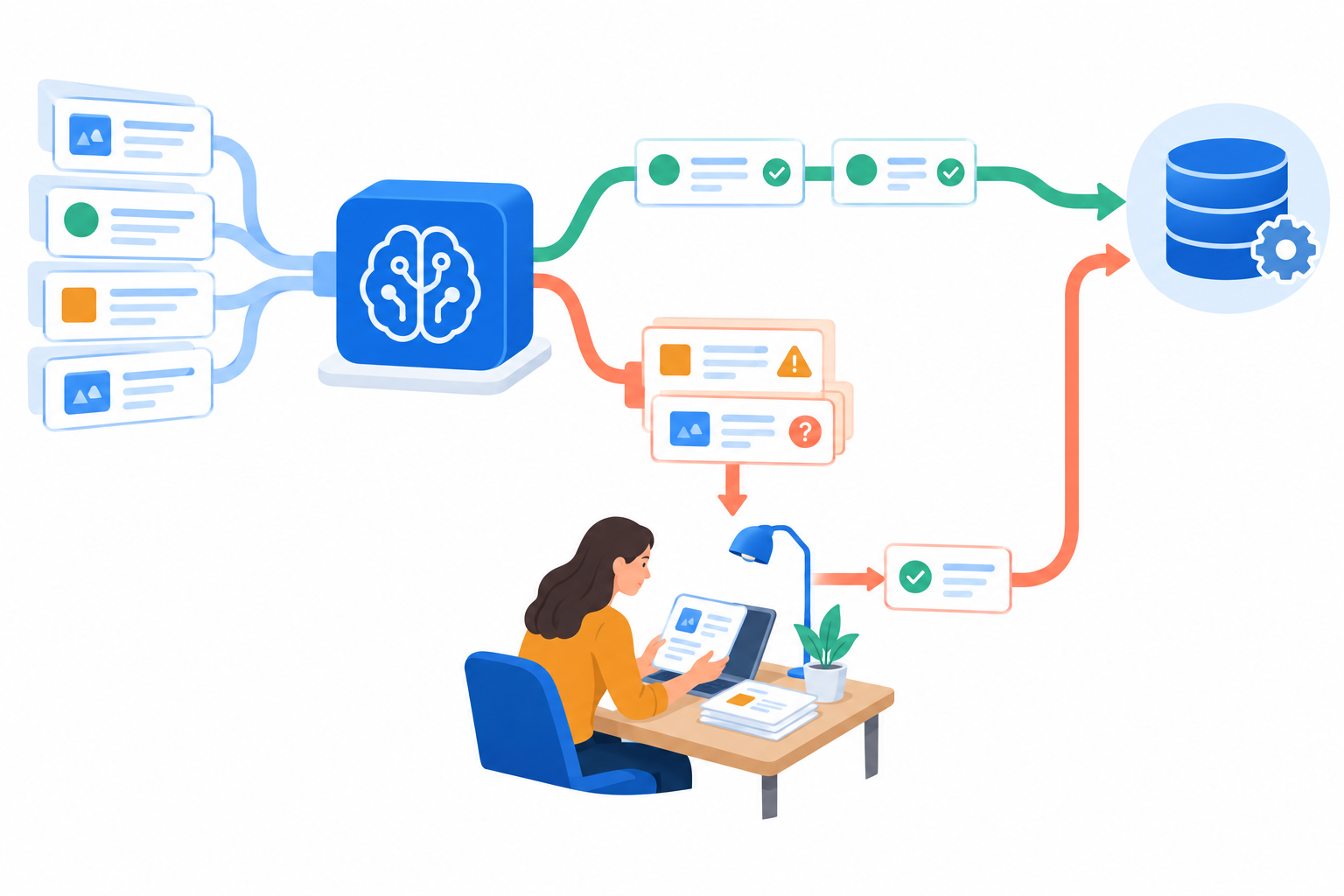
This checklist focuses on the level of autonomy the first release can actually handle. The check has passed when the team knows not only what the AI processes, but also which outcomes may proceed without human intervention and which may not.
- Determine whether human review remains part of the first release. Define which cases the AI handles as proposals and when an employee reviews the outcome before it takes effect in the business process. A tiered review workflow keeps questionable input or outcomes outside the automated route. This makes the data threshold for an MVP more realistic: exceptions do not need to be handled autonomously straight away. Then use the reviews to see which cases recur frequently and are predictable enough to be reconsidered for automation later. The benefit is not that every outcome is correct, but that the application has a controlled route for situations where the data does not allow safe autonomous handling.
Common mistakes in data checks
When launching an AI product, two mistakes in particular make subsequent control unnecessarily difficult:
- Lack of traceability for AI outcomes. If an AI recommendation or extracted field cannot be directly linked to the specific source document or source record, the business user cannot verify what the result is based on. This makes it difficult to quickly verify, when in doubt, whether an outcome is supported by the correct source. By making traceability standard—allowing the user to open the underlying source with one click—control becomes part of the work process rather than an investigation afterwards. This does not prevent all input errors, but it does make errors immediately investigable. For an initial AI product, trust arises because outcomes remain verifiable, not because the system always appears convincing.
- Silently accepting deviating input. When changed field names, missing values, or unexpected formats flow through without validation, it is no longer clear whether the AI is working with the intended data. Schema validation and visible handling of deviations prevent a technically functioning integration from being mistaken for reliable input.
Applying data checks in practice
Start with an explicit operating boundary, not with the promise that the AI can handle all kinds of input. Define in advance what result the application must deliver, how that result is assessed, and what error tolerance is acceptable within the initial scope. This benchmark gives the team a testable basis for determining whether the available data is sufficient for the intended function.
Document types or input variants outside the initial scope do not need to be treated as incidental edge cases that the AI can 'probably' process as well. They should explicitly fall outside the product boundary. This means an MVP does not have to interpret an unlimited number of data formats in practice while, on paper, it has only one function. Stakeholders then know which data falls within the assessment and which does not.
Only then does it become clear which expansion is useful. Rather than waiting until every source file appears suitable, a startup can test whether a defined set of input variants meets the benchmark. Deviations are not hidden in the average result, but classified as out of scope. A new variant can be added to the automated route only after it has been assessed separately against the same boundary.
For a Laravel-based MVP, this provides product clarity. The application does not need to pretend that it understands all data, but can distinguish between input accepted for the agreed function and input that falls outside the first version.
Frequently asked questions about data checks
The most common question is not about technology, but about the boundary between a fast MVP and irresponsible automated processing. That boundary lies in the way uncertain data moves through the process.
- Does a startup need to wait until all data is clean before it can launch an AI product?
Not necessarily. The relevant question is whether the first release can accommodate cases with uncertain or imperfect data without processing them fully autonomously. The AI can process what fits within the chosen route, while doubtful cases remain available for human review.
Data readiness therefore does not equal complete autonomy. An initial product can be useful when it clearly distinguishes between outcomes that may proceed and outcomes that must be reviewed first. The human step then forms an explicit boundary on automation. When the team sees which cases regularly end up in review, it can decide whether expanding the automated route is justified. As long as that certainty is lacking, human review limits the impact of imperfect data.
Key considerations for data readiness
Data readiness in an AI launch is about an explicit boundary for responsible automation. Not every part of a process is suitable for full autonomy, and the consequences of errors vary by case. For a manageable first release, these considerations are decisive:
- Limit autonomy to controllable cases. Allow outcomes to proceed automatically only when the input, rules, and expected follow-up action fall within the agreed boundary.
- Make the review route explicit. Define in advance which situations require human intervention so uncertain cases do not still affect a business process unnoticed.
- Observe where validation falls short. Use the first release to identify where data deviations or schema changes occur. This provides a focused basis for adjusting the workflow and only then considering further automation.
This applies automation where the input demonstrably falls within the product boundary and catches deviations in time. Full autonomy becomes appropriate only when the data proves stable and controllable in practice.
Next steps for data readiness
For a responsible AI launch, it is necessary to explicitly determine which data may be processed directly through automation and where human review must remain required. By defining this boundary in advance, you prevent unclear or inconsistent data from unintentionally flowing into business processes. A phased approach, in which a Proof of Concept using your own data reveals the actual variation and exceptions, helps limit operational risks before further integration or scaling takes place. This keeps the first release manageable and minimises the risk of uncontrolled errors in business data, even if full automation is the long-term goal.