

A shared data model for CRM and ERP systems requires a formal specification of shared business entities, field definitions, validation rules, and ownership. This prevents customer, order, or product data from being considered complete in one system while being unusable or conflicting in the other. Using a Canonical Data Model and an integration matrix helps document consistent data exchange and data quality, while phased
Implementing a shared CRM-ERP data model
A shared data model between CRM and ERP systems ensures consistent data exchange and prevents conflicts. The model establishes which data is shared and under which conditions, using a Canonical Data Model and an integration matrix.
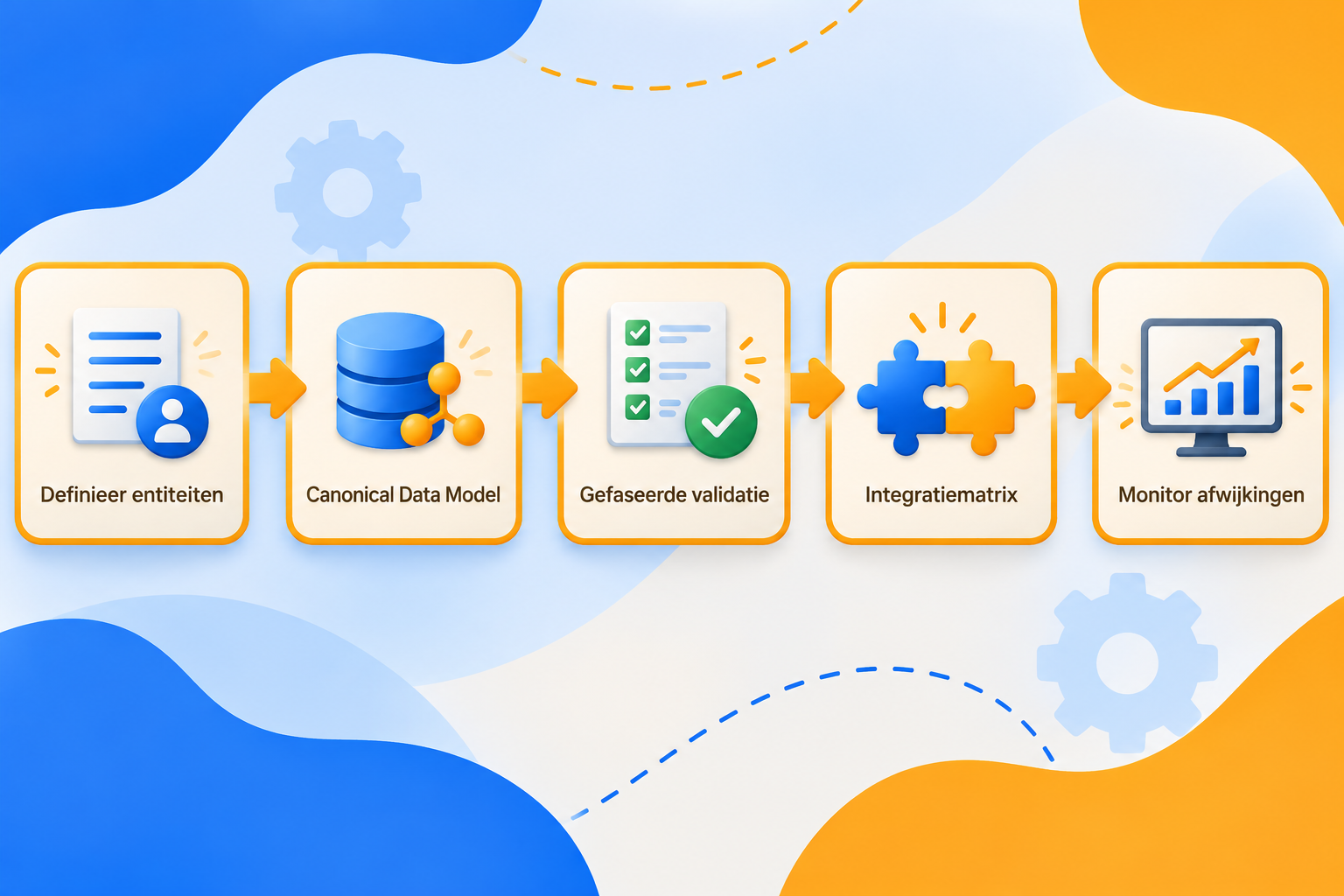
- Define shared business entities and field definitions to ensure consistency between systems.
- Use a Canonical Data Model to create a common language between CRM and ERP.
- Apply phased validation to validate data correctly at different process stages.
- Implement an integration matrix to document agreements on data exchange.
- Monitor deviations and validation errors to manage data quality and prevent operational disruptions.
Key elements of a shared CRM-ERP data model
A shared data model is not an additional document alongside CRM and ERP, but an explicit agreement on which business data both environments share and under which conditions that data is usable. The model starts with the entities that recur in both processes, such as a customer or debtor, and then makes clear which data has a fixed meaning. The usability of connected data depends not only on the presence of a field, but also on its completeness, consistency, and accuracy. This creates a distinction between data that may be available early in a commercial process and data that is only needed later for a subsequent process.
A Canonical Data Model can serve as the common language between CRM and ERP. It prevents each integration from being designed solely from the terminology of one system. An integration matrix makes that language operational: it sets out the agreements for each data element side by side, making it clear where the data comes from, where it goes, and at what point it plays a role. The matrix is therefore primarily a control mechanism for the boundary between systems; the data model describes the shared meaning behind it.
The Data Dictionary then gives those agreements a fixed form. For each attribute, it should specify the semantics, format, requirement, and system of record. This prevents two fields with similar names from silently meaning different things, or both systems from treating the same data as authoritative. The system of record also clarifies which system may determine a change. Without this documentation, an integration can exchange data technically while the business meaning still diverges at each process step.
Validation also requires a time dimension. A static rule that immediately makes all data mandatory does not fit the data lifecycle. An early lead may legitimately not yet contain all the characteristics a debtor needs once an order status is reached. Phased validation keeps these stages separate: the CRM process is not blocked prematurely, while stricter ERP requirements are applied when the process calls for them. The agreement is therefore not only about which fields are required, but also about when.
Finally, a data model remains manageable only when deviations become visible in daily operations. Monitoring rejected data exchanges and validation errors gives functional administrators insight into records that cannot be processed according to the agreed definition. They do not first have to wait for a code change to see which data is missing or deviates. This makes the combination of the data model, integration matrix, and Data Dictionary a manageable foundation for data quality rather than a one-time design exercise.
Direct approach to a shared data model
A shared data model for CRM and ERP is the formal specification of business entities, field definitions, validation rules, and ownership that determines which data has the same meaning and usability in both systems. This model provides the basis for preventing customer, order, or product data from being considered complete in one system while being unusable or even conflicting in the other. This alignment is especially critical in order and invoicing processes: missing mandatory fields, differing values, or outdated information directly lead to manual corrections, process delays, or incorrect transactions.
The international ISO/IEC 25012 standard provides an objective framework for data quality. This standard distinguishes, among other things, completeness (are all mandatory fields populated?), consistency (do values match across systems?), and accuracy (does the data reflect the actual situation?). By making these dimensions explicit in the shared data model, it becomes possible to establish the required data quality for each process transition. This does not automatically prevent data quality problems, but it does make them visible and manageable before they disrupt operational processes.
When CRM and ERP use the same definitions and quality criteria, data can be transferred predictably between commercial and administrative processes. Data quality then becomes not a separate data-cleansing project, but a structural part of how business processes accept, supplement, and use records.
Risks of missing data definitions
When CRM and ERP systems exchange data without clear data definitions, uncertainty arises about the meaning and origin of every change. This makes it difficult to determine whether a repeated request represents a new business action or merely a repetition of an earlier change. In practice, a change request may arrive at the receiving system multiple times, for example because of network issues or an unclear processing confirmation. Without a mechanism that recognizes and handles these repetitions correctly, duplicate records or unwanted status changes may occur. This leads to inconsistencies that only become visible when subsequent processes, such as order processing or invoicing, rely on an incorrect status.
The principle of idempotency is essential here: a data-changing endpoint must be designed so that a repeated request does not result in additional changes, duplicates, or status corruption. This means the receiving application can recognize a repetition as such and keep the result aligned with the original intent. REST API Design Rules and interface standards therefore require data-changing endpoints to be idempotent, so technical exchange does not depend on a request arriving exactly once. This prevents the integration itself from introducing new inconsistencies, even when the data definitions are correct on paper.
The absence of these agreements and technical safeguards increases the risk that correct data will still lead to duplicate registrations or unintended status changes. The reliability of the integration is therefore determined not only by the first successful processing, but specifically by how repeated requests are handled. If the administrative state changes on repetition, there is room for data corruption, even when the content of the request is valid in itself.
Applying a shared data model in practice
A practical implementation starts small enough to test the data agreements in practice, but complete enough to represent the chain between CRM and ERP. The approach below links the shared model to predictable behavior when data is resubmitted, cannot be processed, or risks returning in a loop.
- Make the Canonical Data Model testable in an integration matrix. First document the shared entities and attributes as a single common representation, and use the integration matrix to connect that representation to the relevant data fields for each transfer. This makes visible which translations an integration performs and where the risk of differing interpretations lies. Then include an Idempotent Receiver as an explicit processing agreement for changes. This ensures that a repeated message does not automatically become an additional business action. For messages that cannot be processed, a Dead Letter Channel provides a separate location outside the normal data flow. This prevents unresolved processing from disappearing unnoticed or continuing to circulate through the same chain. A Proof of Concept can test these agreements on a defined set of representative data and transactions: not as a full rollout, but as evidence that the common representation, matching, and handling of exceptional messages are usable under realistic conditions. The outcome is not only a technical demonstration. It shows whether the selected patterns actually provide predictability against data loss and recursive loops before the approach is applied more broadly.
Frequently asked questions about shared data models
Most questions are not about the existence of an integration, but about the agreements that determine what value a shared data element has at a particular moment. A Data Dictionary and integration matrix provide a verifiable answer, without confusing ownership with the system in which a user sees a record most often.
- Why is a Data Dictionary needed, and which system owns customer data?
A Data Dictionary explicitly establishes for each attribute what a value means, which format is expected, whether the field is mandatory, and which system is the System of Record. This is broader than a list of field names. For example, two systems may both contain a customer data element, while one system determines that data and the other only uses it. By documenting the semantics and system of record for each attribute, there is no general statement such as “the CRM owns the customer” or “the ERP owns the customer,” but a more precise agreement for each data element. The owner of an attribute is then the system whose value is authoritative when differences arise.
The integration matrix then makes visible how that agreement is applied in the exchange. It connects the documented meaning with the format, requirement, and relevant data transfer. This allows an administrator to verify whether a value coming from the CRM has the same meaning as the value expected by the ERP, and whether the value should already be present at that process stage. A field that is not yet mandatory for an early commercial record therefore does not have to be treated automatically as incorrect; the requirement can align with the point at which the data is needed.
Data consistency therefore does not arise because all customer fields are managed identically in both systems. It arises when it is transparent for every shared attribute what it means, in which form it is exchanged, when it is needed, and which record is authoritative. When a difference occurs, there is then a predefined basis for determining which value should prevail. Without that explicit system of record, two technically valid values can continue to exist side by side while employees cannot determine which value a subsequent process should use.
Essential considerations for a shared data model
The transition from design to use requires evidence that the agreements also hold up for the data the organization actually processes. A Proof of Concept reduces that uncertainty by testing matching rules and data quality on representative customer and transaction data before a broader rollout becomes dependent on the selected rules.
- Use a Proof of Concept as a measurement point for exceptions, not only for the normal route. A representative trial reveals how matching rules perform on customer and transaction data that actually occurs in the CRM-ERP chain. This makes the assessment quantitative: the organization can determine what outcomes the rules produce rather than relying solely on a logical design. This is especially relevant when a record does not unambiguously match an existing registration. The trial then shows which cases are recognized by the selected rules and which cases require further investigation.
Exception monitoring should be included in this assessment. Not every rejected or exceptional processing result is an error in the data model; some cases show that data is missing, does not fit the agreed rules, or cannot be matched automatically. When these exceptions are made visible to functional management, a workable boundary emerges between automated processing and review. The question shifts from “is the integration ready?” to “which deviations occur, how are they recognized, and which data agreement underlies them?”
The limitation of a Proof of Concept remains that it proves only what has been tested within the selected representative set. New variations in customer or transaction data may produce different results. Its value is therefore not a general approval, but a substantiated starting point for phased application and targeted monitoring. A model that processes only normal records while leaving deviations invisible can still lead to remedial work in order or invoicing processes and thus to operational delays or financial corrections.
Next steps for a successful data model
For a workable shared data model between CRM and ERP, it is advisable to start with an integration matrix and a Data Dictionary. For each attribute, document its meaning, format, requirement, and system of record. Then begin with a Proof of Concept using a limited, representative dataset. Set up validation in phases: a lead does not have to meet the same requirements at an early stage as a debtor in order processing. This reveals where additional agreements or exceptions are needed without unnecessarily blocking the process with overly strict validation. Use the results to determine which fields are mandatory in each process phase and where deviations require further investigation. This prevents missing or incomplete data from entering the operational chain unnoticed.