
No. Process heavy AI tasks asynchronously only when the end result is not needed within the same user interaction; tasks requiring immediate feedback should remain synchronous. Keep costs and response times manageable by measuring queue delay, active duration, errors, retries and token spending for each task route, and first test an intended production route on your own data against a predefined quality threshold.
In brief: queued AI tasks
The choice between direct and background processing is not about technical weight alone, but about the desired user experience, operational load and cost of a specific product function.
- Assess where delays and costs arise for each task: before processing, during execution or through repeated attempts.
- Choose a direct, deferred or combined route based on when the user actually needs a result.
- Use a trial on your own business data with a predefined acceptance threshold before reserving further capacity for integration.
- Have uncertain AI results reviewed first when they could change a core system; background processing does not automatically make a result usable.
- Link observability and token spending to individual tasks, users or functions so expansion is based on a measurable task route rather than a general AI cost figure.
Do not automatically put every heavy AI task in a queue
An AI task is not automatically a candidate for asynchronous processing because it appears technically heavy. Assess each product function by looking at how long passes before a worker picks up the task, how long the task then runs actively, how many retries occur and what token spending is associated with it. Without that breakdown, it remains unclear whether a function burdens the direct interaction because of queue delay, long execution or repeated work.
This distinction is also financially relevant. Two functions may appear to require similar AI capacity, while one mainly grows because tasks accumulate in the queue and the other because retries consume tokens again. A general AI cost figure hides that difference. As a result, it is difficult to justify where a limited development budget will have the greatest impact: in the task itself, in the processing around it or in the route the task follows.
Operational telemetry on worker processes can make this visible for each specific function. With OpenTelemetry's GenAI conventions, you can link queue delay, active task duration, retry rates and token spending to individual functions. This creates an operational view of the task route rather than a general judgement that AI is too expensive or too heavy.
The practical question is therefore which function you can track and compare separately. For that function, define which signals you will examine and measure them during actual processing. This allows you to determine whether the chosen route fits both the intended user experience and the costs caused by that specific functionality. It prevents a broad technical assumption from leading to spending that cannot later be attributed to any product function.
A prototype does not yet prove the production route is right
An AI demo that technically produces an answer is not yet a basis for allocating budget to the production route. The relevant question is whether the intended application performs sufficiently on your own business data according to a previously agreed benchmark. Only then does the conversation move beyond the impression created by a demonstration to the conditions under which further integration can be justified.
A Proof of Concept connects that assessment to the actual application. Therefore, use data that fits the process for which you want to deploy the AI application and determine in advance what result counts. A generic demonstration can show that a model can produce an outcome in principle, but it does not replace validation against your own organisation's data and quality expectations. This distinction prevents a convincing first result from being treated as though quality for the next development phase has already been established.
Define the acceptance threshold concretely before the assessment. For an extraction task, for example, you could choose an error-free extraction rate as the threshold; the appropriate value follows from the application and the risk of errors. The precise threshold should be clear enough to show a non-technical decision-maker when the result does or does not meet requirements. It also clarifies what the trial outcome means: meeting the threshold supports a conversation about the next phase; failing to meet it shows that further investment cannot be justified on the basis of the demo alone.
This is how the startup reserves further capacity based on a defined test using its own business data. The Proof of Concept does not show that the full AI production setup is already suitable for growth, but it does make visible what uncertainty remains before you commit budget to further integration.
When does a background task require human review?
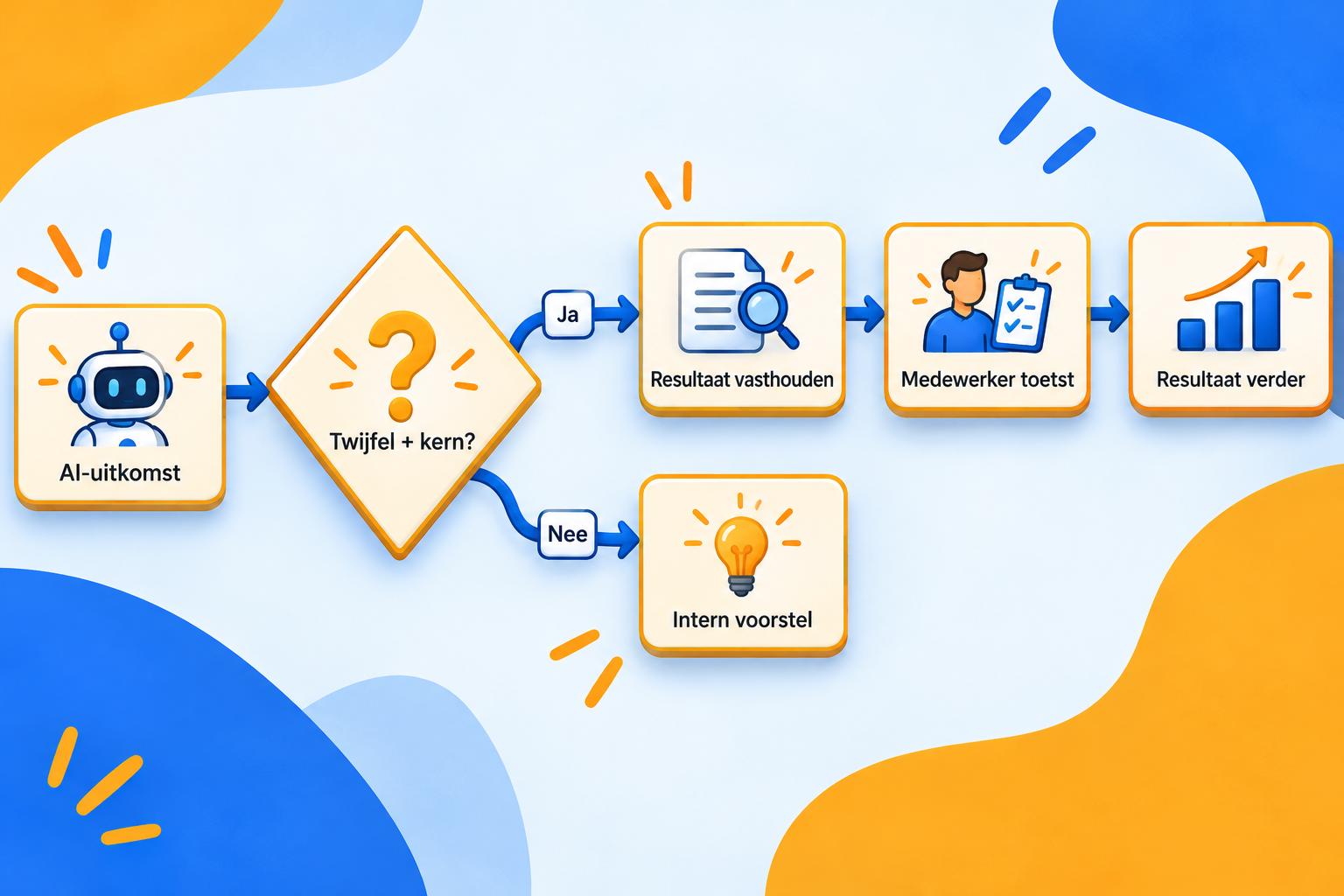
A background task must not independently pass through an uncertain model outcome once that outcome would alter or feed a core system. In that case, Human-in-the-loop is not an extra screen afterward but a separate step in the processing route: background processing completes the AI task, while the outcome remains outside the core system until an employee has reviewed it.
This distinction prevents a mistaken assumption when moving heavy work out of the direct request. A queue keeps the user interaction free of lengthy processing, but says nothing about whether the result is operationally usable. A model outcome can become available as a proposal or intermediate result without having immediate consequences. Once that same outcome would trigger a next step in a core system, the route must explicitly specify that uncertain cases are held back.
Therefore, configure background processing so that it not only produces a result but can also retain a review status. An employee then assesses whether the outcome can be used for the intended process. Only after that review can the result proceed. This keeps the task processed asynchronously without an completed model call automatically becoming an action within the business process.
This control path is not needed for every AI task. It belongs to outcomes where uncertainty and the destination in a core system come together. For a result that serves only as a draft or internal proposal, the same intermediate step does not automatically apply. For an uncertain result that would otherwise be passed through unseen, however, the route requires a named reviewer and a place where the result remains pending.
This choice also has a financial dimension. Background processing reduces the load on the direct request, but human review adds work to the production route. Include that step in the same scope and measurement per task or user: alongside AI processing, it should also be visible when results are held, reviewed and released. This makes review part of the route that must be managed after the initial build phase.
Why response time alone does not explain costs
Use one operational overview for each task or tenant. This lets you assess delay, execution load, error behaviour and token spending alongside one another, rather than treating a fast response as the complete picture.
| Measurement point | What it shows | Meaning for the task route |
|---|---|---|
| Queue delay | The time work waits before processing starts. | Shows whether deferred work accumulates before a worker starts it. This is different information from the active duration of the task. |
| Active task duration | How long the worker actually works on the task. | Makes visible which tasks require capacity during execution. Compare this by task, not only as a total for the entire application. |
| Error rates | How often processing does not complete successfully. | Provides context for a task that initially appears fast but whose execution regularly fails. |
| Retries | How often work is performed again. | Shows where a task may require capacity and model usage repeatedly. A completed response does not automatically reveal how many attempts preceded it. |
| Token costs per tenant or task | The spending attributable to a specific user or product function. | Connects AI spending to the unit you can assess: a task or tenant, not merely an undifferentiated total amount. |
| Combined dashboard | Wait times, processing times, error rates and token costs in one comparable view. | OpenTelemetry GenAI semantics support this visibility per tenant or task.[1] This lets you see which signals relate to a specific product function. |
Three processing routes for one task list
The same task list does not have to follow one technical route. Classify every task by the need for an immediate end result, expected execution duration, fluctuations in load, error tolerance and cost per task. The matrix below provides three useful routes without prescribing a fixed migration sequence.
| Route | When this route fits | What the user or product receives | What you track |
|---|---|---|---|
| Synchronous | The result needs to be available within the same user interaction or request. Immediate feedback is the guiding requirement here. | The task completes before the interaction or request ends. Do not use this route merely because a task appears technically simple, but because the immediate result is part of the product experience. | Assess the task separately for the active processing and usage it causes. A direct route requires visibility into the consequences for that interaction. |
| Asynchronous | The task does not need to complete within that same request. Variable processing or peak load can then be handled outside the direct interaction. | The product confirms that processing has been accepted and returns the result later. HTTP 202 Accepted is appropriate for a request that has been accepted while processing is not yet complete.[2] | Track queue delay, active duration, retries and token spending for the specific functionality in particular. These signals make the behaviour of the background route visible. |
| Hybrid | The user needs an immediate acknowledgement or initial response, but not full completion. This fits when a task has both a visible beginning and later processing. | The direct route provides the acknowledgement or first step. The background route handles completion. This makes explicit which part is visible immediately and which part follows later. | Measure the two parts separately. Otherwise, a fast initial response can make a task appear fully fast, while the deferred part actually causes wait time, retries or token usage. |
Where does the choice between direct and background processing still get stuck?
These questions help test the task classification without turning it into a fixed technical blueprint.
- Should every heavy AI task be processed asynchronously?
No. The need for an immediate result remains decisive. Also look at the measured task route: queue time, active duration, retries and token spending show where the load actually arises. A task that the user needs immediately does not automatically belong outside the direct interaction simply because it requires substantial processing. - What does HTTP 202 Accepted mean?
This status indicates that a request has been accepted while processing is not yet complete.[2] It is therefore appropriate for a background flow where receipt is confirmed immediately but the end result follows later. The status does not mean every background task must use this response. - Why are costs per task or user more useful than just a total amount?
They connect consumption to the product function or user you want to assess, instead of tracking spending only as a total. This makes it easier to discuss expanding or limiting a specific function.[3] - Why is measuring latency alone not enough?
Latency does not automatically show how long work spent in the queue, how long the worker was active, how many retries were needed or how many tokens the task consumed. OpenTelemetry GenAI conventions can make those signals visible for each function.[1] This prevents a short visible response from being read as evidence that the entire process requires little load or cost.
The first investment is a measurable task route, not a complete rebuild
Start with one defined task route that you can link to a product function and a measurable unit, such as a task or user. This makes AI spending discussable where it arises. You do not need to move all processing to the background first to understand what growth does to your budget.
The route must show more than a visible response time. Bring together queue delay, active task duration, error rates, retries and token consumption for the relevant functionality. OpenTelemetry GenAI conventions provide visibility into this data for worker processes.[1] This allows you to distinguish whether pressure arises before processing, during execution, through errors or through repeated model usage.
This breakdown provides a better basis for phased investment. Choose a use case that is clear enough to measure, link a task route to it and determine which signals must be available before you expand. This creates a substantiated sequence for further development based on the function you actually manage.
Also track costs per task or user so consumption remains connected to a concrete unit.[3] This shows which function requires additional processing and where spending may increase as you grow. The technical choice thus also becomes an operational choice: which processing may wait, which outcome requires immediate feedback and which task deserves a separate route first?
Expand only when the first route can answer those questions. Otherwise, background processing grows along with the business without it being clear which task is responsible for the cost or wait time.
Make the first task route and benchmark concrete
Schedule a free half-hour conversation with Shazzoo BV about your process, without a presentation. Define the use case and benchmark in advance. Then, if the scope calls for it, choose a Proof of Concept using your own data, followed by hardening, integration and a phased rollout.
Visit us at Daalakkersweg 10 in Eindhoven.
Use a data readiness decision tree to further define the first trial.