
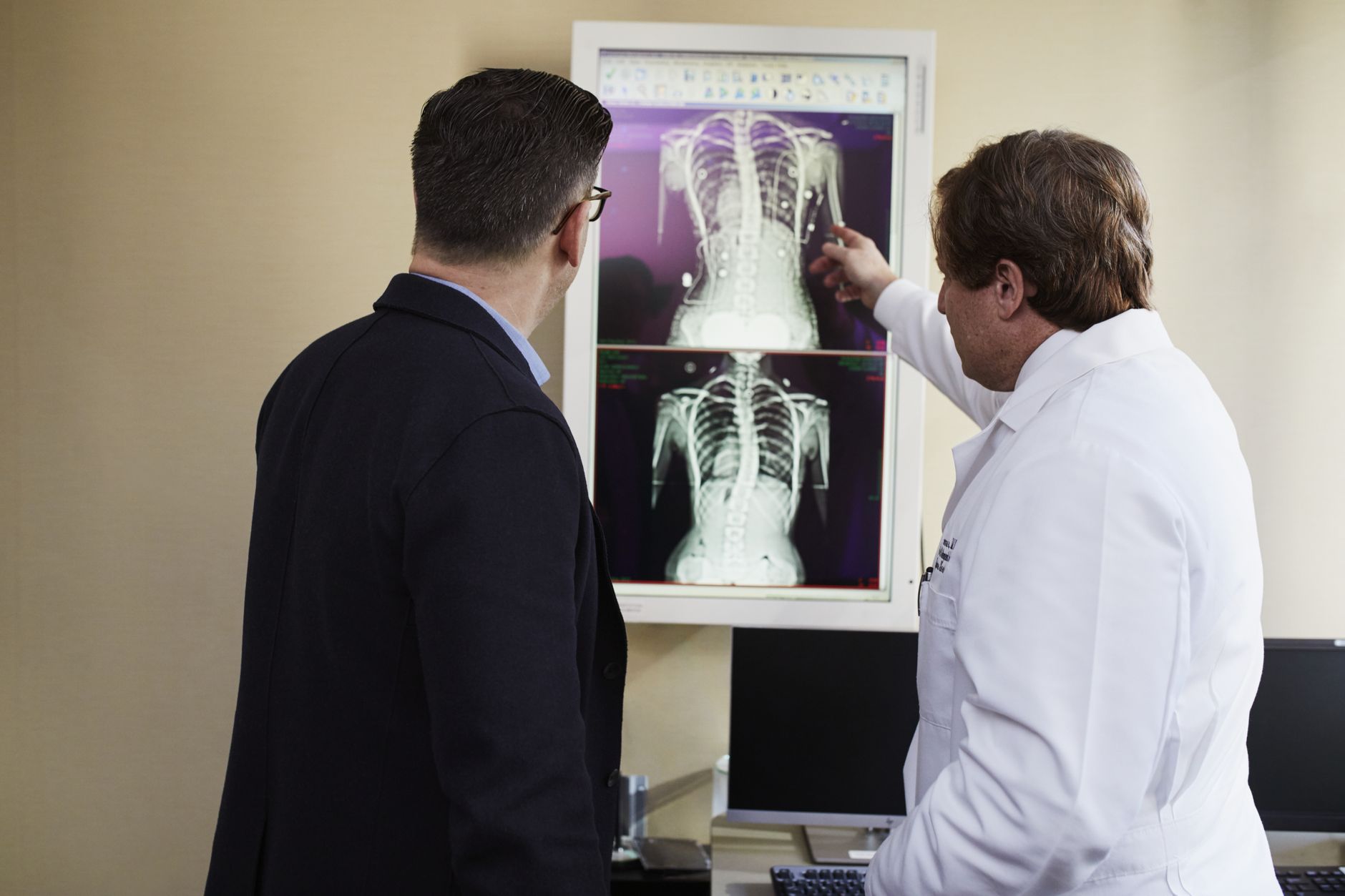
For reliable exchange, you need to record for each AI result what type of outcome it is, where the user reviews it, and which provenance and validation details remain visible. Use FHIR for discrete, indexable scores or classifications, linked to the algorithm and status; use DICOM for imaging findings that must remain linked to measurements, segmentations and the source image; use CDS Hooks only to request a response during an active EHR action, not as a storage format for the result.
In brief: AI results in the EHR
The selected standard follows the evidence the user must be able to review. A technically delivered result only becomes reliably usable when its meaning, review context and provenance are preserved.
- Record an individual score or classification so that it can be retrieved as a structured record outcome, without confusing model output with a clinically validated value.
- For radiology AI, preserve the link between the finding and the underlying image, including location, measurements and delineated areas.
- Treat a workflow call and durable result storage as separate functions: a response during a workflow step does not determine how the result is subsequently stored.
- Alongside every AI outcome, make visible which system delivered it and what validation status it has, so that a preliminary score is not read as definitive record truth.
- Before integration, determine where the result will be reviewed and what context must be available there; that choice determines the appropriate representation.
Which standard suits your AI result in the EHR?
The choice follows from what the user must be able to review: an individual structured outcome, the relationship with a source image, or a response during an active EHR action. FHIR, DICOM and CDS Hooks serve different functions in this regard. A workflow call does not replace result storage, and a record entry does not replace image context.
In this article, preliminary means that the outcome has been delivered as model output but has not yet been reviewed or accepted as a record value within the local care workflow. Validated here means that the responsible organisation or workflow has assigned that review or acceptance to the outcome. This status must therefore be traceable; by itself, it says nothing about the model's performance or any product certification.
| Type of AI result | Suitable representation | What remains visible |
|---|---|---|
| Discrete score or classification | FHIR Observation or RiskAssessment | The individual outcome can be recorded and indexed as a structured resource in the EHR. The algorithm can be linked as a Device; Provenance can record the validation status.[1] |
| Image-linked finding | DICOM | The finding remains connected to the image context, including measurements, segmentations and the location in the radiological image. DICOM AI Results profiles focus on this image-linked exchange.[2] |
| Outcome needed during an active action | CDS Hooks | This describes a synchronous RESTful call from the EHR workflow to a clinical decision support service. It is therefore a pattern for requesting a response, not in itself a storage format for the result.[3] |
A preliminary AI score can be read as definitive in the EHR
A preliminary AI score only becomes risky when it is presented in the EHR in the same way as a completed record value. If an inference service sends that score as a final FHIR Observation without provenance data, the record may process it as a regular measurement validated by a clinician. The technical delivery has then succeeded, but the meaning of the value has shifted: users can no longer see that it is model output that has not yet been confirmed as clinical record information.
In this situation, the final label says only something about the supplied status, not about who reviewed the outcome or which step is still missing. Without provenance metadata, the record cannot be used to reconstruct which AI system delivered the score and why it appears there as a completed result. As a result, a clinician may read the score as a validated measurement; in a decision scenario, this may unintentionally influence the assessment or follow-up action.
The audit trail must therefore be available in the EHR together with the score. It records the relationship between the outcome, the AI system and the status with which the outcome was delivered. FHIR provides options for this through Provenance and the link to a Device. This keeps a score interpretable as a model outcome, rather than merely as a number with a definitive status. This distinction also remains relevant when a model's performance changes in practice due to model drift: a final status must not conceal which outcome was delivered and on which review that status is based.
Why imaging AI does not fit as a standalone textual result
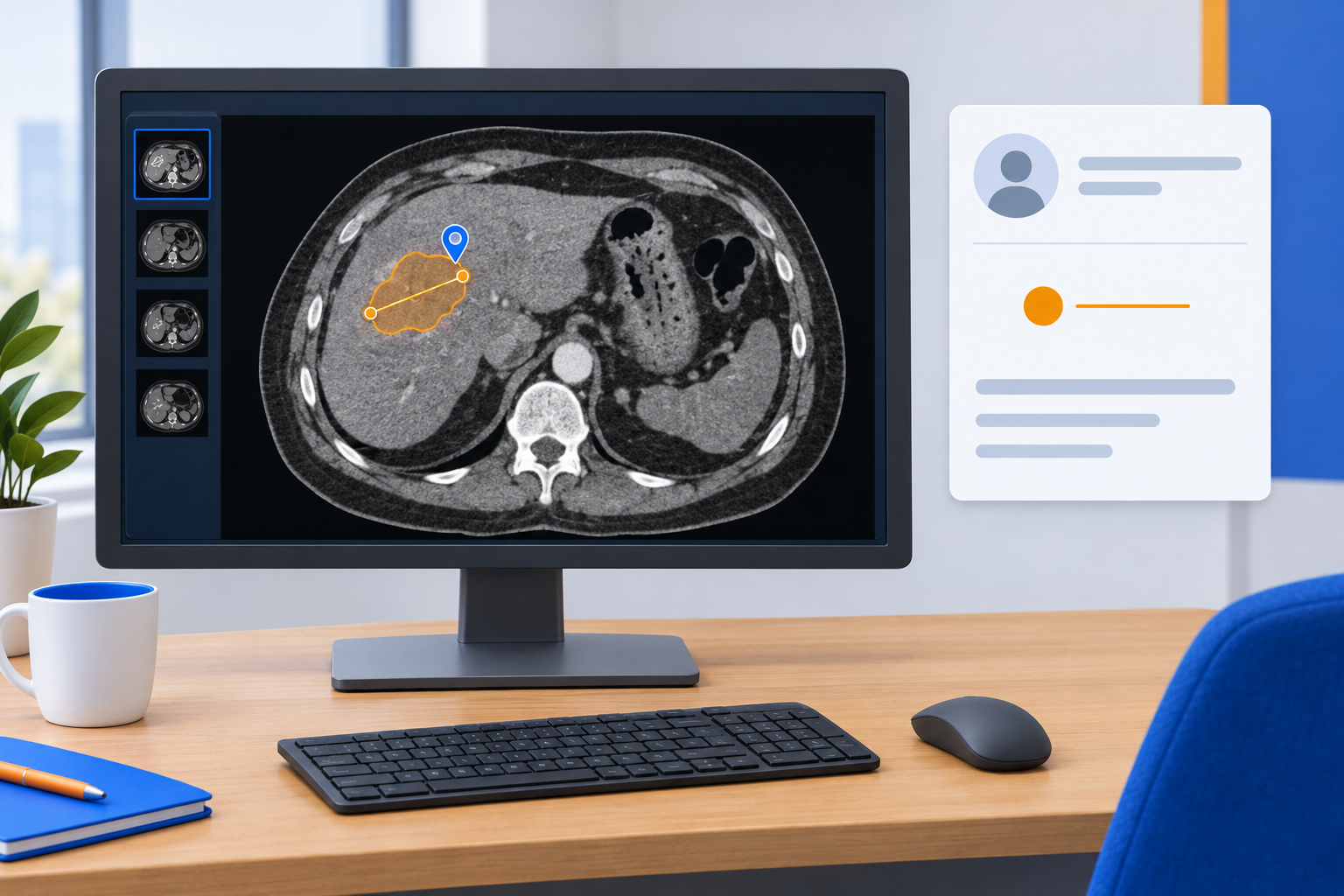
A textual result can state that an algorithm has found something, but not where that finding is located in the image data. In imaging AI, that location is often part of the result itself: a marker at pixel coordinates, a measurement point or a delineated area. If only a record entry is passed on, the direct relationship between the outcome and the image on which it is based disappears.
For the radiologist, that relationship is precisely the review material. DICOM Structured Reporting, including the TID 1500 Measurement Report, carries measurements and findings linked to the image. DICOM SEG is intended for segmentations. This allows markers and segmentations to be reviewed in the PACS alongside the source image, rather than solely through a summary in an EHR result list.
A derived display in the EHR can therefore indicate that an image-linked AI result exists, but it does not replace review of the underlying marker, measurement or segmentation. For a detection that must remain spatially linked to a radiological image, the exchange must preserve that link.
Keeping an imaging finding reviewable in the radiology workflow
Reviewability here does not arise from an additional summary, but from the finding returning to the radiology workflow in a standard DICOM form. The IHE AIR profile provides a structure for this that preserves the distinction between a displayed conclusion and a finding that can be reassessed with its measurement context.
- Record the imaging finding as DICOM Comprehensive 3D SR. The IHE AIR profile uses this DICOM SOP Class to record AI results in imaging.[2][4]
- Use Root Template TID 1500 for quantitative and qualitative imaging findings. This template provides the structured form in which these types of findings are recorded.[2][4]
- Keep the record within the radiology workflow. The value of this structure lies in being able to reassess the imaging finding with its measurement context, not merely in passing on a summary result.[4]
Is FHIR enough when an AI result needs to appear in the EHR?
Is FHIR enough for every AI result? No. For discrete AI outcomes, such as risk scores and biochemical classifications, FHIR can use Observation or RiskAssessment. Device and Provenance can link the algorithm and validation status, respectively, to the outcome.[1] This makes FHIR suitable for an indexable record outcome, but not automatically for image-specific context.
Why does DICOM remain necessary for radiology AI? Because the user may need to assess a marker against the source image. The AI Results profiles describe the exchange of DICOM-based imaging results, including measurements, segmentations and position in the radiological image, within radiology workflows.[2]
What does CDS Hooks add? CDS Hooks describes a RESTful and synchronous call from an EHR workflow to a clinical decision support service.[3] It therefore governs when the EHR requests a response during an active workflow step, not how that response is subsequently stored durably as record data, an image object or a segmentation.
The concepts therefore complement one another: FHIR supports the discrete record outcome, DICOM preserves image context and CDS Hooks supports the workflow call. None of the three automatically replaces the function of another.
The standard follows the evidence the user needs to review
Therefore, do not start with the question of which standard an AI system supports, but with the review the receiving user must perform. If a score needs to be findable and interpretable in the record, a FHIR representation is appropriate; Observation or RiskAssessment carries the outcome, while Device and Provenance can provide context about the algorithm and validation status.[1]
If, by contrast, that user needs to review a spatial imaging finding, the relationship with the source image must be preserved in DICOM Structured Reporting or segmentation. If a response is needed only during a workflow step, the request belongs in the workflow through CDS Hooks and the durable representation follows from the type of result.
The practical boundary lies in the meaning a final status acquires in the record. If provenance and validation status are not visible, model output can be read as record truth. Therefore, before integration, establish which outcome is received, where it is reviewed and which provenance information must remain visible alongside the outcome. This keeps the AI system's uncertainty recognisable in the day-to-day workflow, rather than allowing it to disappear behind a technical final status.
First establish the result type and review location
At Shazzoo, we invite teams to a half-hour conversation about the process, use case and evaluation criteria for the intended integration. Together, we map which result type is needed at which review location, without defining the technical outcome in advance. The next step deliberately remains small: defining one specific integration question.