
Protect sensitive data with server-side authorization for every action and access point: define separate permissions for viewing, editing, and exporting, group them into roles, and check ownership, tenant, or department for each record whenever users with the same role should not be able to see the same data. Apply consistent checks to web, API, and other routes, and reassess permissions when responsibilities change.
In brief: protecting sensitive data in Laravel
The data boundary determines how far your authorization needs to go. Roles govern general tasks; where access differs by record, the application must also check that context.
- Choose access based on whether users with the same task may actually consult the same records; with tenant, department, or ownership boundaries, the assessment must take place for each requested record.
- Separate concrete actions from job titles, so viewing, editing, and export permissions can be assigned precisely without creating a new role for every exception.
- Do not rely on hidden interface elements: an authenticated user can call a backend route or API directly if the server does not reject the action itself.
- Apply the same authorization rule to every path to a sensitive action, including web requests, API endpoints, console commands, and bulk actions.
- Balance the simplicity and cacheability of consistent role checks against the additional code and record evaluations needed for fine-grained data boundaries.
- Keep assigned permissions up to date after job changes or temporary expansions of responsibilities, so unused privileges do not continue to grant access.
Which access permissions protect sensitive data in Laravel?
Start with the data boundary, not the job title. For uniform access, RBAC can define the boundary. If the allowed set differs by tenant, department, or owner, the requested record must be evaluated in addition to the role.
| Situation | Appropriate model | Design question |
|---|---|---|
| Single-tenant application with homogeneous task allocation and uniform data access | RBAC through route middleware or Gates | May every user with this role see the same records? If the answer is yes for all relevant records, access does not need to differ per record. |
| Multiple tenants | Contextual record-level authorization with Policies and Query Scopes | Does this record belong to the user's tenant? The same role then does not grant access to records from other tenants. |
| Strict boundaries between departments or record owners | Contextual record-level authorization with Policies and Query Scopes | Does this record fall within the user's department or ownership boundary? As a result, two users with the same role may legitimately be allowed to open different records. |
A Query Scope limits the list a user can request, while a Policy assesses whether that user may open or edit an individual record. A simple scope could look like this:
public function scopeVisibleTo($query, $user)
{
    return $query->where('tenant_id', $user->tenant_id);
}

$invoices = Invoice::visibleTo($request->user())->get();
The scope prevents records from other tenants from appearing in this list. A Policy is still needed for a detail route or edit, so that a directly requested record is also checked against the same boundary.
Hidden buttons do not protect sensitive records
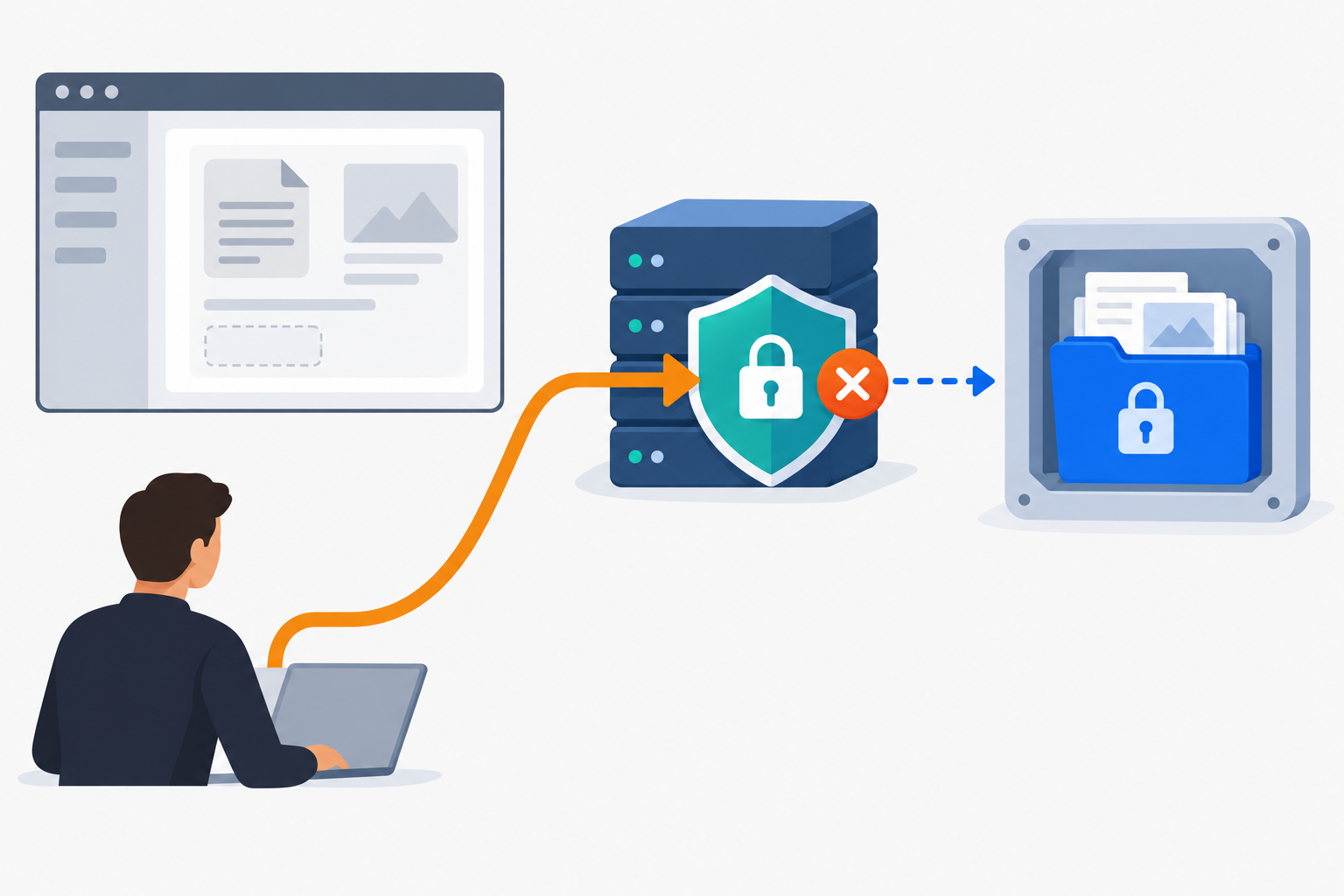
A hidden edit or export button does not change the accessibility of the underlying backend route. If that route does not perform a server-side check, an authenticated user can bypass the interface and send an API request themselves. The button remains out of sight, but the sensitive record can still be viewed, edited, or exported through the same endpoint. The restriction must therefore be enforced when the backend receives the specific request.
A similar risk arises when permissions were once properly granted but no longer match the current role. After a job change or temporary expansion of responsibilities, old privileges can remain active if they are not periodically reviewed or automatically revoked. In the event of an account takeover, that collection of unused permissions partly determines how many sensitive records an attacker can access. Access permissions must therefore change along with responsibilities, not only when an account is created.
Why extra roles and separate access points break the model
These mistakes affect different parts of the design. Too many roles make permissions difficult to maintain; inconsistent checks by access point mean the same action can have different outcomes depending on the route taken.
- A separate role for every exception. When every small exception creates a new role, the role matrix grows into a collection of overlapping combinations. It then becomes difficult to see which permissions each role actually includes and why it was added in the first place. Extensive if-else constructs subsequently appear in the code to handle exceptions after all. This increases the chance that a change to a role unintentionally grants more access or editing capabilities than intended.
- Authorization differs by entry point. A web controller may check a sensitive action, while an API endpoint, console command, or bulk action only establishes that someone is authenticated. The check is then not tied to the action itself, but to the route through which that action is reached. Particularly with bulk actions, this can mean that a permission that appears limited through the web interface is still available more broadly through a parallel path. Such differences can easily go unnoticed when authorization responsibilities are spread across multiple layers.
Divide permissions by action and place rules at the appropriate Laravel layer
Do not turn a job title into an authorization rule. First define the concrete actions, then group them into roles, and place each check at the Laravel layer that matches the scope of the rule.
- Define atomic permissions. Use names for visible actions, such as
invoices.viewandcontracts.delete. This way, a permission describes what someone may do, while a role is only a collection of such permissions. A job title can change without requiring the authorization logic to change.[1] - Group actions into roles. Give a role the set of permissions that belongs to a task. This keeps changes in responsibilities limited to the composition of permissions, rather than making controllers directly dependent on job title names.[1]
- Use Gates for global rules. A Gate is a non-model-bound authorization check that Laravel executes through a PHP closure. This suits a rule that is not about one specific Eloquent model.[2]
- Use Policies for model-bound rules. A Policy is an assigned PHP class that brings together rules for a specific Eloquent model. This gives CRUD actions and domain actions around the same model one recognizable location.[2]
When do roles become too coarse for sensitive records?
Are roles enough to protect sensitive data?
Roles are suitable for general tasks where the permitted data is the same for all users with that role. Such a model remains manageable and can be cached in sessions or Redis.[3]
When is record-level authorization needed?
This additional layer becomes relevant as soon as a general permission is insufficient to determine the data boundary. A Laravel Policy can then check, in addition to the permission, whether the user owns the record or falls within the same departmental scope. The decision follows from the combination of the user and the specific record.[3]
What does fine-grained authorization cost?
Fine-grained checks require more authorization code than RBAC alone. Additional database evaluations may also be needed per request to assess relevant record attributes. In return, a Policy can enforce contextual boundaries that a simple, cacheable role check cannot express.[3]
Sensitive records remain access-restricted only when every route enforces the rule
After designing roles, Policies, and scopes comes implementation: every route that enables a sensitive action must actually invoke the appropriate check. Signing in alone does not grant permission to view, edit, or export a sensitive record. Controllers and API routes should therefore be explicitly linked to targeted Policies, rather than relying only on an authentication guard or a broad route group.[2][4]
Laravel provides several server-side places for this connection: authorize() in a controller, authorizeResource() for resource controllers, route middleware, and the authorize() method of a Form Request. This means the authorization decision occurs while processing the request, not when determining the visibility of the interface.[4]
For each sensitive action, document which Policy or other targeted check is performed, and apply that overview to web routes, API routes, and other paths to the same action. A permissive route group does not prove that individual actions are denied when they fall outside the assigned permissions.[2][4]
This keeps the boundary intact outside the normal interface as well: without a server-side connection, a route can remain accessible to an authenticated user, even when that action is restricted elsewhere.[4]
Discuss translating responsibilities into Laravel permissions
Would you like to carefully translate the responsibilities, action permissions, and record boundaries in your organization into a Laravel authorization model? Discuss your custom software challenge with Shazzoo. Through Laravel software development, we help you make the desired access and roles a clear part of your application.