
Organizations can assess the readiness of their legacy systems for reliable real-time BI by first verifying whether source systems can process changes without disrupting operational processes. This includes evaluating database isolation capabilities, establishing formal KPI definitions, and conducting a Proof of Concept with historical data to test data reliability.
Assessing Legacy Systems for Real-Time BI
Assessing legacy systems for real-time BI requires a careful evaluation of technical and organizational factors to support reliable dashboards.
- Assess whether the database supports transactional log extraction or snapshot isolation to prevent operational disruptions.
- Ensure formal ownership of KPI definitions to avoid semantic conflicts.
- Conduct a Proof of Concept using historical data to test source reliability.
- Consider phased modernization with an API layer to limit continuity risks.
The limits of BI modernization in legacy environments
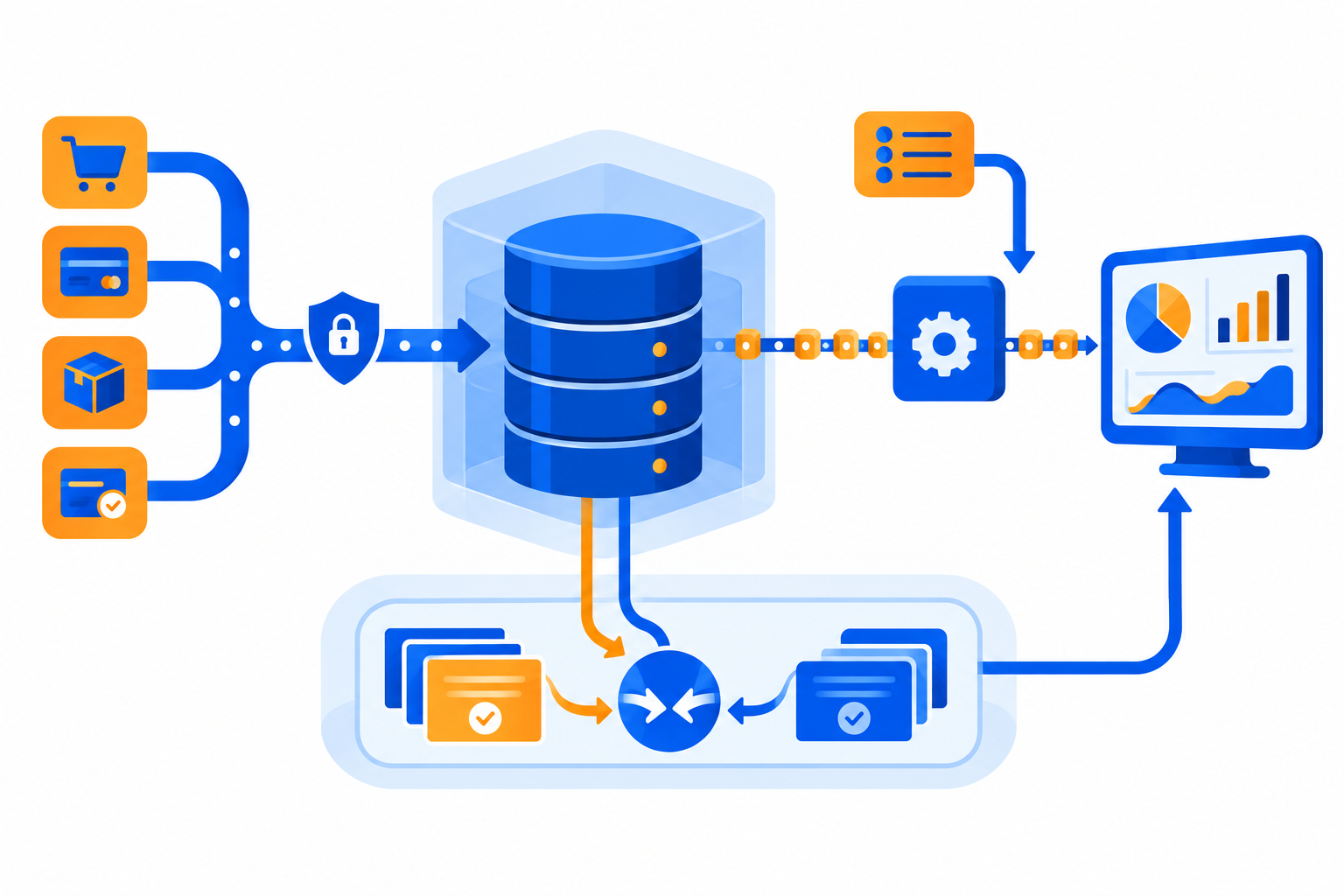
BI modernization does not automatically begin by replacing a legacy system. The first question is narrower and more business-focused: can the existing source environment make changes available for analysis without hindering daily transaction processing? That boundary determines whether a dashboard with current data is technically responsible, regardless of the desired visualization or the ambition to further digitize processes.
Database characteristics are decisive in this regard. A legacy database that supports transactional log extraction can make changes available without requiring analytics to repeatedly read the production tables. Advanced snapshot isolation can also create room to query data without blocking operational transactions. If that capability is absent, real-time extraction is not a neutral addition: information needs and production load become directly intertwined. This first requires an explicit assessment of isolation and extraction capabilities, rather than an assumption based on the age of the system.
The pattern of changes then guides the integration layer. Applications in which new transactions are mainly added are suited to passing those additions on as a stream of changes. This makes it possible to make operational data available for analysis outside the core system. An environment with many retrospective corrections, changes to existing records, and periodic correction batches requires something different. The receiving layer must then be able to update existing information and identify differences from the source. Without these two capabilities, a dashboard may refresh quickly while still showing an outdated or incomplete reality.
A phased route therefore only creates room when the integration layer respects the source's actual change behavior. Laravel can form an application layer within such a phased redevelopment, but choosing it does not remove the underlying conditions of database isolation, change tracking, and reconciliation. Direct replacement is likewise not a solution for a source that contains uncertainty about what changed and when. It must first be clear which changes can be read safely, which can be processed again, and where a difference check remains necessary. Only then does a defined modernization path emerge that does not subordinate the continuity of the existing process to a dashboard requirement.
Risks of missed checks in legacy systems
Skipping critical checks before implementing real-time BI creates two structural risks. First, frequent direct querying of the primary production database can increase the load on operational processes. If that load is not assessed in advance, queues or time-outs may occur in activities such as order entry or checkout transactions. The usual response is to reduce the refresh frequency to nightly batches, causing BI to lose its intended real-time nature.
A second, less visible risk arises when source data changes unnoticed. Administrators may add new status codes or values without the reporting layer being prepared for them. If this layer silently filters out unknown values, teams make decisions based on incomplete figures without an error message appearing. This results in management information that appears internally consistent but actually excludes transactions. The discrepancy is often only discovered during in-depth investigation of differences between reporting and the source.
Checks must therefore make both the technical load and the completeness of the transmitted data visible. Both determine whether current reporting remains useful for decision-making.
What should be verified in legacy systems?
When assessing legacy systems for BI modernization, it is essential to look beyond the presence of tables and data. The core question is whether the desired analyses can be performed without disrupting operational processes. Therefore, map which analyses take place on the source, which tables are involved, and whether those tables are also used simultaneously for operational changes. This clarifies whether the chosen extraction method fits the load on the production environment.
This is not a judgment of the value of the legacy system itself, but a question of whether the system is suitable as a direct source for BI analyses under load. Where it is not, the assessment may show that a different extraction method, isolation approach, or intermediary layer is needed.
Test this suitability with a Proof of Concept based on real historical production data. Define measurable criteria in advance, such as the percentage of error-free data records, the completeness of changes, and the impact on source load. This makes deviations visible that may go unnoticed in a standard presentation, such as missing values, unexpected data combinations, or differences between source and reporting. The trial thus provides a substantiated basis for deciding whether to proceed, tighten conditions, or resolve bottlenecks first.
Checklist for evaluating legacy systems
Use this check as a focused assessment of the extraction method. The outcome determines whether the dashboard view aligns with the current source state, not merely whether a connection can technically retrieve data.
- Map the complete change history. Record which tables or datasets are relevant for reporting and investigate for each set how additions, changes, and deletions become visible. An extraction that periodically selects based on an
updated_attimestamp leaves physical hard deletes out of view when they are not recorded as a change. Multiple status changes within a single polling interval can also disappear from observation: the extraction then sees at most the state at the moment of retrieval, not what happened in between. Therefore, compare the transmitted data after a trial period with the actual operational database state. Explicitly check whether a deleted record also disappears from reporting, whether a corrected status is processed correctly, and whether temporary changes matter for the selected KPIs. Also note whether the source offers another form of change tracking besides polling. The key question is not how often data is retrieved, but whether the chosen method records all events needed for reporting to align with the source. When this cannot be demonstrably achieved, a real-time or near-real-time view is not yet reliable enough for decision-making.
What can go wrong without checks?
The greatest risk of an unprepared integration is not always a visible technical error. A dashboard can continue refreshing while still showing incorrect, incomplete, or differently interpreted data when changes to the source are not monitored.
- Schema and meaning changes reach reporting without safeguards. Without documented agreements between the operational source system and the BI pipeline, field types can change, mandatory fields can disappear, or new values can be added without the receiving process expecting them. This leads to a visualization that reads data incorrectly, excludes it, or assigns a meaning that no longer matches the source. A data contract is a documented agreement between those responsible for the source and BI processing about the data exchanged between those layers. Among other things, it describes types, mandatory fields, and semantic rules, and the receiving process checks these agreements before changed data is processed further. This intercepts an uncoordinated change before it affects the visualization. The practical consequence of skipping this check is that a team may only discover after using the dashboard that figures no longer carry the same business meaning. The error is then not solely in a field name or code, but in the absence of a boundary where source changes are tested before affecting management information.
How do you apply these checks in practice?
Apply the check not only to fields and connections, but also to the meaning the organization assigns to the outcome. For each intended KPI, begin with one formal business owner who has decision-making authority over its definition. That role establishes, for example, exactly what is included in “realized net revenue.” This clarifies which transactions, corrections, and exceptions belong in the KPI before a technical layer translates the definition into data logic.
The same definition is then compared against the available source data. If a required status, correction, or exclusion does not occur unambiguously in the source, that is not a question an integration layer can resolve on its own. The business owner then decides whether the definition should be adjusted, whether the source data must first be supplemented, or whether the KPI is not yet suitable for current reporting. This sequence prevents technical choices from inadvertently defining a business concept.
The practical application therefore consists of repeatable alignment: select a KPI, appoint an owner, document the definition, test it against the source, and record ambiguities as explicit decision points. Only when the owner has established a uniform interpretation can the integration apply that interpretation consistently. This ensures semantic decisions are made where they belong, rather than implicitly in the technical layer.
This approach limits the trial to a defined question rather than a broad promise about all business data. It enables the organization to determine for each KPI whether initial reporting rests on a shared and workable definition.
Frequently asked questions about legacy system evaluation
The questions below help place that trade-off within the assessment of BI readiness.
- Must a core system be completely replaced before current BI is possible?
Not necessarily. Full replacement of a core system can be a lengthy process and involve significant continuity risks. This does not make that route self-evident when the existing system still supports the primary process. Phased modernization can begin with a decoupled API layer around the existing system. Through that layer, insights can become available step by step, depending on the source, the chosen extraction method, and the scope of the first KPIs.
Does the risk then disappear completely?
No. The phased route exchanges part of the replacement risk for temporary management of a hybrid architecture. The core system remains in place while an API or integration layer functions alongside it. During the transition, the organization must therefore account for two cooperating components rather than one new end state. This is a deliberate trade-off: earlier usable insights in exchange for temporary additional complexity.
When does this route fit an assessment of BI readiness?
When the question is whether data from an existing core system can be made available without immediately replacing the entire application. The assessment then focuses on what can be safely exposed through an intermediary layer and which parts can be modernized separately later. The phased approach is not an argument for ignoring source problems, but a way to limit replacement pressure while the organization accounts for a hybrid environment.
Key considerations for BI readiness
An objective assessment of BI readiness requires the willingness to explicitly recognize a “no-go” when source data or KPI definitions do not yet meet the requirements for reliable real-time dashboards. An integration partner who indicates after data discovery that rollout is not yet responsible prevents dashboards from being built on an uncertain foundation. The test is not whether a dashboard is technically feasible, but whether the organization can use the results without doubt. When data or definitions fall short, this limitation must be clearly addressed before further investments in integration are made. This transparency limits the project to what is demonstrably ready, or postpones the start until the necessary conditions have been met. Rushed visualization without this assessment increases the risk that teams steer on information that is operationally or financially unreliable.
- Treat a “no-go” as a full-fledged outcome of data discovery. Only when source data and KPI definitions demonstrably meet the requirements is phased BI modernization responsible.