

To justify BI integration for compliance, the business case should focus on reducing audit delays and additional costs caused by fragmented source systems and the lack of verifiable data lineage. A phased implementation with a Proof of Concept using your own historical data can increase the likelihood of approval, while a conservative approach to time savings prevents unrealistic FTE claims from undermining the business case.
Justifying BI integration for compliance
BI integration in compliance reporting offers benefits, but justifying its ROI can be complex. Here are some key considerations for a defensible business case.
- Identify the impact of fragmented source systems on audit delays and audit costs.
- Use a phased approach with a Proof of Concept to test assumptions about data quality.
- Assess time savings conservatively and avoid direct FTE claims without a reallocation plan.
- Distinguish between direct process hours and avoided risks in the financial rationale.
- Ensure a transparent overview of Total Cost of Ownership, including ongoing costs.
The boundaries of BI integration for compliance reporting
BI integration for compliance reporting is not primarily about a new reporting screen. The actual challenge is connecting ERP, CRM and other source systems whose data is needed to make a report traceable. API integrations and middleware can provide the connecting layer: they bring data from separate systems together without requiring an organisation to replace its operational systems directly. The business question is then not only whether the data can be collected, but also whether the route from source to report remains sufficiently controllable.
This boundary is especially visible in existing ERP systems. The availability of clear API interfaces, or the ability to use a read-only database replica, determines whether an integration is feasible without risking disruption to production. A read-only approach limits intervention in the existing system because the reporting solution reads rather than writes. If such secure access is unavailable, the investment becomes broader than BI alone: technical access to the source then becomes part of the decision.
As a result, ROI is difficult to present as a single figure. Part of the value lies in visible work, such as fewer manual steps in data collection. Another part lies in the ability to substantiate data flows. The latter may be commercially relevant, but does not automatically translate into direct savings. A credible business case therefore makes clear which effects are measurable and which primarily strengthen the controllability of reporting.
Fragmented time savings also deserve cautious treatment. Twenty fewer minutes of work per employee only become a reduction in labour costs when there is a concrete plan to deploy that capacity differently or actually reduce it. Without such a plan, it is available capacity, not realised savings. This distinction protects the business case from unrealistic FTE claims and clarifies what the investment does and does not aim to achieve: reliable connections between systems and better-substantiated reporting, within the technical boundaries of the existing systems landscape.
Why BI integration for compliance remains challenging

BI integration for compliance is often considered when reporting is still achievable, but only through intensive manual work. Employees collect data from different ERP and CRM systems, combine it in spreadsheets and must perform reconciliations periodically. This creates a process in which the reliability of definitions, versions and origins remains dependent on individual actions and local interpretations.
The result is the emergence of shadow records: teams maintain their own spreadsheet versions, creating an alternative reality for reporting purposes alongside the operational records. Entities may also be defined differently across operational and financial domains, putting the consistency and explainability of reports under pressure. Audit preparation therefore requires not only providing files, but also explaining discrepancies between overviews and reconstructing decisions regarding definitions.
The challenge in substantiating the ROI of BI integration is that this manual burden is spread across multiple processes and cost centres. Reconciliation, version control, audit checks and governance around definitions are rarely visible as separate budget items. At the same time, an integration project involves more than the initial build: ongoing costs for SLAs, API maintenance, security patching, hosting and governance are often underestimated or not structurally included in the multi-year budget.
The result is that the return on BI integration remains difficult to quantify as long as the current manual way of working, the expected new processes and the ongoing management burden are not described separately and specifically. Without this rationale, there remains a risk that the investment will be assessed on visible reporting functionality while the underlying complexity and costs remain unaddressed.
When is BI integration for compliance the right choice?
BI integration for compliance is particularly relevant when your organisation is dealing with fragmented source systems and the absence of verifiable data lineage. In this situation, the lack of a demonstrable origin for data leads to substantial audit delays and direct additional costs because external auditors must spend extra review hours validating sample data. The value of integration then lies in being able to demonstrate the relationship between source data and reporting outcomes, for example as part of broader CSRD readiness.
The likelihood of business-case approval increases when you choose a phased implementation supported by a Proof of Concept (PoC) using your own historical data. By first using a PoC to test whether the desired data flow and definitions work in practice, assumptions about data quality and usability become concrete. Historical transaction data serves as a benchmark because it reflects your organisation's actual patterns and exceptions. This prevents decisions from being based solely on theoretical benefits or future scenarios.
A phased approach reduces governance risk compared with an all-encompassing 'big bang' scenario. The first phase can focus on a defined reporting need, after which the results of the PoC guide further expansion. As a result, approval does not have to rely on the assumption that all systems and processes can be integrated successfully in one go. The business case thus gains a review point between the initial investment and any follow-up steps.
BI integration is less suitable when the need is limited to a visual dashboard without requirements for traceable origin or audit delays. The approach is appropriate when the costs of additional validation, the burden of fragmented sources and the need for evidence come together. In those cases, the investment is reduced to a demonstrable use case with historical data and manageable risk, increasing the likelihood of approval.
Key evaluation criteria for BI integration
After choosing a defined first phase, the proposal must be assessable against fixed points. The criteria below connect assumptions about capacity to demonstrable performance in your own data.
| Evaluation criterion | What is assessed | Meaning for the business case |
|---|---|---|
| Conservative valuation of time savings | When modelling time savings, finance can include only the portion of theoretically saved hours that can demonstrably be reallocated. The remainder does not automatically count as a financial benefit. | This prevents a calculation of fewer manual hours from being equated directly with full savings. The business case remains testable when it specifies which portion is included as reallocable capacity and which is not. This makes the financial assessment independent of the assumption that every freed-up minute leads to lower labour costs. |
| Evidence using your own historical transaction data | Productivity and quality claims can be substantiated through a defined Proof of Concept using your own historical transaction data. Predefined acceptance criteria determine when the trial is considered sufficient. | This criterion shifts the discussion from general expectations to observable results in your own context. The acceptance criteria clarify in advance which outcome counts; this prevents changing measures of success afterwards. For decision-makers, it is a concrete signal that the investment does not rest solely on assumptions. For the project, it sets the boundary of the first phase: only the agreed productivity and quality claims are subject to testing. A positive trial supports expansion, while a divergent outcome becomes visible before the full investment is committed. |
A practical framework for BI integration decisions
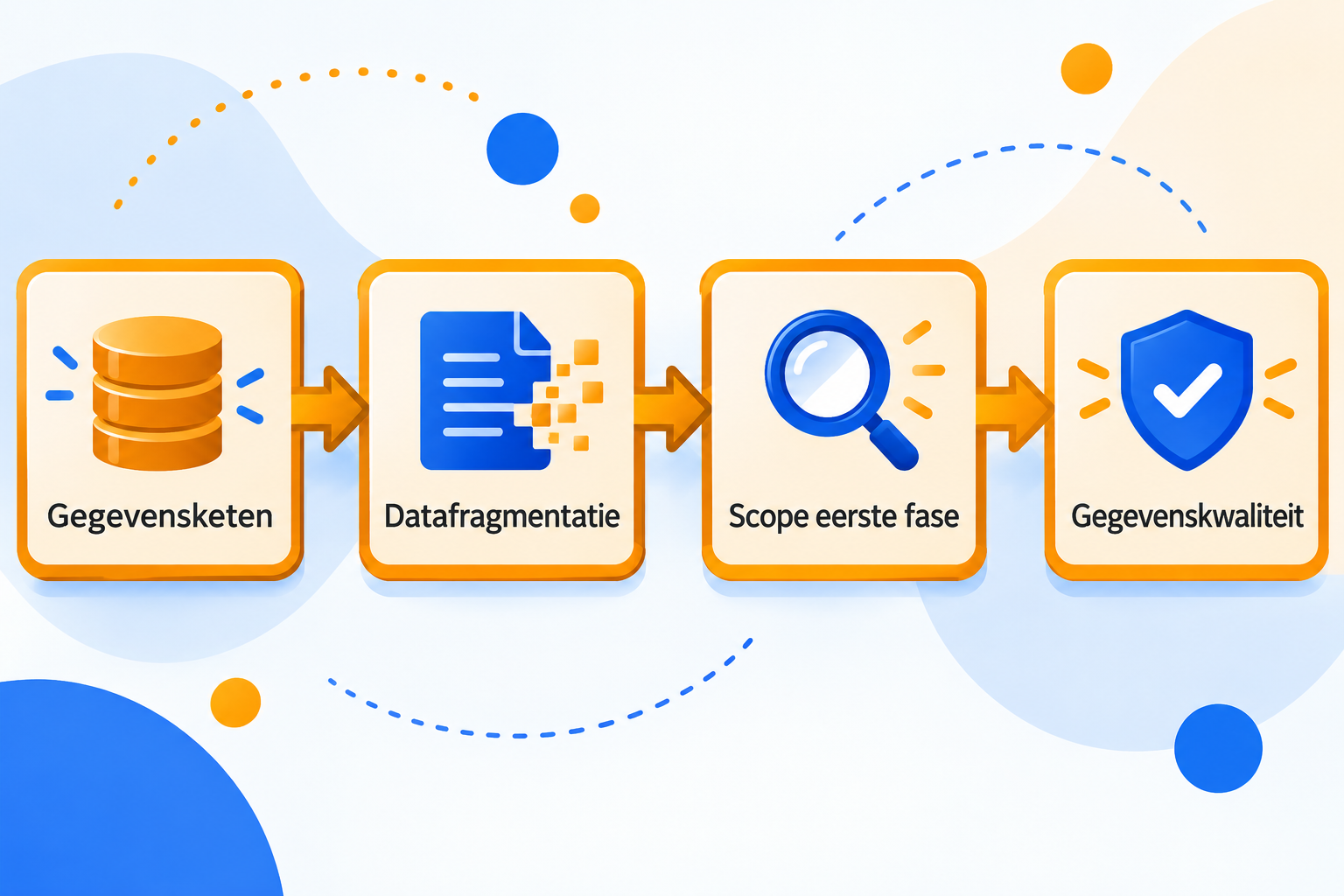
A practical framework for BI integration decisions prevents the investment from being assessed as a visual dashboard project while the underlying data fragmentation remains. The following steps help maintain a focus on integration value and avoid the dashboard trap:
- Map the data chain. Start by explicitly documenting the route compliance figures take: which source systems do they come from, which data is combined and where can discrepancies arise? This reveals whether the proposal genuinely addresses the integration of ERP, CRM and other systems, or merely changes the presentation of existing data.
- Assess the impact on data fragmentation. Examine whether the proposed work addresses error-prone fragmentation in the data foundation. If only the reporting view changes, manual checks and discrepancies in the source chain remain, regardless of how convincing the dashboard looks.
- Make the scope of the first phase explicit. Define which parts of the data foundation are included in the first phase and which remain outside consideration. This prevents a limited reporting effort from being assessed as though all data-quality and governance issues have already been resolved.
- Link investment value to data quality. The value of the proposal depends on the extent to which the underlying infrastructure is improved. A proposal that leaves fragmented infrastructure untouched warrants a different return expectation than one that demonstrably improves integration and data quality. Also define who has access to which data, for example through role-based access control (RBAC).
Frequently asked questions about BI integration for compliance
The most common objection is not about technical feasibility, but about how benefits may be included in the financial rationale.
- Should the business case be based primarily on process hours or avoided risk?
Direct process hours generally form the most defensible basis. They can be linked to work currently being performed, such as manual processing and reporting checks. However, that basis may be conservative because it does not reflect all consequences of inadequate data control. Including avoided regulatory fines and other risks can add strategic urgency, but finance may challenge these items as hypothetical. That is not a reason to exclude risk from consideration, but it should be treated differently from direct process capacity. Present direct hours as the primary, measurable layer of the rationale. Present risk as a separate layer that describes potential exposure, not as guaranteed savings. This means a decision does not have to depend on a predicted fine that may never occur, while the organisation still makes clear why controllable reporting matters. This structure also clarifies where discussion belongs: the level and realisation of process hours are operational questions; the valuation of avoided risk is a governance decision. A proposal that combines both items into one hard return invites debate about assumptions. A proposal that keeps them separate shows which part of the value is demonstrable and which part remains dependent on uncertain events. Finance can then determine how much weight to give risk reduction without rejecting the direct process rationale.
Key considerations for BI integration decisions
A BI integration proposal becomes manageable when the investment does not end with the initial development estimate, but is assessed as a multi-year operational commitment.
- Ask for one transparent TCO overview. A useful signal of confidence is an integrated multi-year overview of Total Cost of Ownership. Alongside development costs, this includes hosting, monitoring, support SLAs and API lifecycle maintenance. These items belong to the same business decision, even when they become visible at different points during the term. Hosting and monitoring are part of the ongoing environment in which the integration operates. Support SLAs describe the ongoing support around that environment. API lifecycle maintenance makes clear that connections are not a one-time expense, but require maintenance throughout their existence. By budgeting these costs transparently, the organisation avoids having an initially limited investment later assessed without the management burden associated with it. This overview also establishes the boundary for a fair comparison between alternatives: a lower development amount says little when hosting, monitoring, support or maintenance are excluded from the estimate. The decision is therefore based on the full financial and operational commitment, not just the first project invoice.