

Selective Laravel support is suitable for systems that are architecturally decoupled from core systems and where internal IT capacity is sufficient for monitoring and triage. Broader managed ownership is needed when internal IT bandwidth is insufficient for vendor coordination and log analysis.
Evaluating Laravel support options
When choosing between selective Laravel support and broader managed ownership, several factors play a role. It is important to find the right balance between internal capacity and external support to ensure continuity.
- Assess whether the application is architecturally decoupled from core systems to make selective support possible.
- Evaluate internal IT capacity to independently carry out monitoring and triage.
- Consider broader ownership if internal IT does not have sufficient bandwidth for coordination and analysis.
- Identify dependencies between systems that may affect the choice of a broader support scope.
When is selective Laravel support sufficient?
Selective Laravel support is not the same as limited management without consequences. It is an appropriate boundary when one custom system can operate sufficiently independently and incidents remain within a recognisable technical boundary. This boundary exists when the application is architecturally decoupled from core systems: data exchange then takes place through asynchronous interfaces, and circuit breakers limit the propagation of errors. A problem in a dependent system does not therefore necessarily block the entire Laravel system. Support can then remain focused on the application layer, without one party having to take on day-to-day responsibility for the entire chain.
Architecture alone does not determine feasibility, however. Selective support transfers part of the operational responsibility to the internal organisation. It must have sufficient technical capacity to follow monitoring, interpret an incident and determine which vendor needs to act first. Vendor triage also remains an internal responsibility: someone must be able to assess whether an issue belongs in the Laravel application, an integration or another system. This requires not only available hours, but also the ability to maintain control during an incident.
The practical test is therefore twofold. First: can the application absorb a disruption in a dependent system without operations coming to an immediate standstill? Second: can the internal team actually carry out the signalling, recovery actions and coordination alongside its other tasks? If both questions can be answered positively, selective support provides a clear and proportionate scope. The Laravel partner then handles defined application questions, while internal IT safeguards the relationship with the rest of the landscape.
If either condition is missing, a minor disruption can quickly turn into a boundary dispute. Consider an API authentication issue involving an external timeout. After investigation, a selective application partner may determine that the cause lies outside the agreed scope, while the ERP vendor points to standards compliance. In the meantime, internal IT remains responsible for mediation and possibly manual data recovery. Selective support is therefore viable where there is both technical isolation and demonstrable internal coordination capacity; not simply because only one system appears unstable at that moment.
The uncertainty of choosing the right support scope
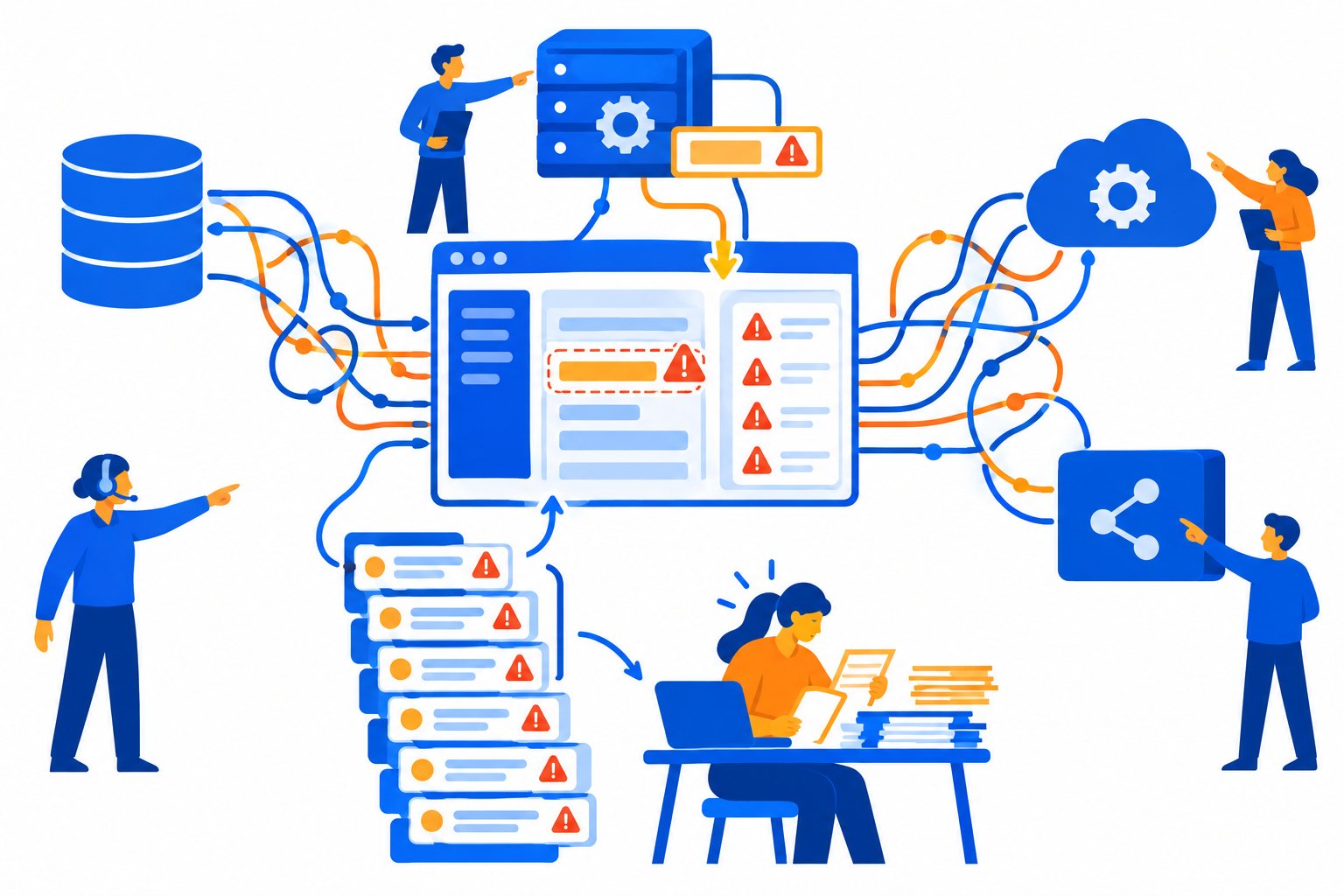
Determining the right support scope for business-critical Laravel and custom applications creates a fundamental uncertainty for many organisations. The trigger is often a visible incident in one system, but the underlying question is broader: is the problem truly isolated, or are there structural dependencies that increase the risk of disruptions? In a landscape where applications, ERP systems and external vendors are interconnected, a change outside the visible system can unexpectedly affect internal processes. For example, a field change in an external ERP system can lead to validation errors in Laravel processes, causing tasks to accumulate and shifting operational pressure to manual workarounds. It is not always clear where the incident starts or who is responsible for recovery.
This uncertainty is amplified when multiple vendors are involved, each with its own defined responsibility. Without central coordination, there is a risk that parties refer to one another during cross-boundary incidents, leaving nobody to take ownership of the overall recovery process. The organisation is then left with formally divided contracts, but lacks a single point of contact for coordination and progress during a disruption. This creates decision pressure: is it sufficient to bring only the most unstable system under management, or does the interdependence of systems and vendors call for a broader managed continuity approach? As long as the impact of dependencies and ownership is not clearly understood, it remains difficult to determine which support scope truly safeguards continuity.
When does the choice between narrow and broad support arise?
The choice between selective support and broader managed continuity becomes relevant once internal IT capacity is insufficient to consistently organise both vendor coordination and log analysis. This is particularly the case in application landscapes where multiple systems and vendors are connected and incidents are not confined to one application. In this context, a narrow support scope means that the internal organisation remains responsible for coordinating recovery actions, analysing incidents and aligning the different parties. When available IT bandwidth is limited, this coordination burden during incidents may outweigh the savings from a broader service contract. The lack of central coordination then means that scarce internal capacity is largely consumed by crisis triage and vendor coordination, leaving less time for strategic digitalisation projects. The decision to broaden the support scope therefore stems not only from technical complexity, but above all from whether the internal team can genuinely continue to maintain operational control without compromising other priorities.
Key criteria for evaluating support options
When assessing support options for Laravel and custom applications without a complete internal IT team, several core criteria determine whether selective support is sufficient or broader managed continuity is necessary:
- Source of instability: Investigate whether the visible issue actually originates in an application, or whether the cause lies in underlying systems such as databases or legacy interfaces. Symptom-driven contracting—where only the front end is managed—can mean that the real source of instability remains out of view. This increases the risk of recurring incidents because the underlying cause is not addressed.
- Dependencies between systems: Map the extent to which the application depends on other systems. If delays or disruptions in connected systems directly affect the visible application, there is a chain dependency. In such a situation, a narrow support scope is often insufficient because incidents cannot be resolved within a single management boundary.
- Complexity of integrations: The more integrations and data exchanges there are between applications, the greater the likelihood that incidents will spread across multiple systems. This makes it difficult to keep ownership and incident follow-up clear with a limited support scope.
- Allocation of responsibility: Evaluate whether the selected support scope actually aligns with the technical causes of disruptions. When responsibility for underlying systems or integrations falls outside the contract, there is a risk that no one takes ownership of the source of the problem.
These criteria help organisations determine whether selective support is sufficient or whether broader managed continuity is needed to prevent coordination issues and recurring incidents.
A practical decision framework for support choices
Use the actual path of a cross-boundary incident as a test for the selected support scope. The aim is not to assume broad managed ownership in advance, but to make visible what work remains internal under a limited contract.
- Step 1: draw the boundary of the intended support. State specifically that support is limited to the application layer of one custom system. Separate this boundary from hosting, the Laravel specialist and the ERP system, so that it is clear not only who implements a change, but also which components fall outside the assignment. Step 2: test an incident that crosses that boundary. Establish what happens if the cause does not lie exclusively in the application layer. This creates a situation in which multiple parties must each provide information about their own part. Step 3: assign the internal coordination task. With selective support, the internal IT organisation handles triage between the hosting provider, Laravel specialist and ERP vendor. This includes bringing together signals, monitoring progress and directing questions back to the party able to answer them. This task is a fixed part of a narrow scope, not an occasional exception. Step 4: determine whether that task is feasible. Assess whether the internal organisation has sufficient capacity during a boundary-crossing incident to coordinate the three parties. This depends not only on technical knowledge, but also on the availability to maintain alignment until it is clear where the next action lies. Step 5: translate the outcome into the scope. If this coordination role consciously remains internal and is feasible, support can remain limited to the application layer. If the organisation cannot carry this triage responsibility, the desired continuity requires a broader allocation of responsibilities. The outcome therefore does not describe which vendor owns everything, but who organises coordination across the agreed boundaries.
Frequently asked questions about support choices
These questions often arise when organisations need to organise an existing application, a limited internal team and multiple vendors alongside one another.
- “Is broader support needed as soon as there are multiple vendors?”
Not automatically. Multiple vendors alone do not prove that one party must take on broader responsibility. The relevant question is whether the boundaries between those vendors can be made explicit during the intake and whether the organisation knows who performs which work. Transparent delineation means that a managed service partner specifies what does and does not fall within the scope. This keeps visible which tasks remain with internal IT or other vendors, rather than leaving the extent of the service unclear. - “Is selective support an incomplete choice?”
That does not follow automatically either. Selective support can be a deliberate allocation of responsibilities when internal capacity is sufficient for the tasks that remain outside the external scope. An honest assessment may therefore also conclude that outsourcing is not necessary. That outcome is only credible if the remaining tasks are not omitted: the organisation must be able to see which responsibilities it retains and what the assessment of its capacity is based on. - “Why must the scope be discussed so precisely during the intake?”
Because a management agreement is only operationally useful when boundaries are understandable in advance. During a disruption, vague wording leads to discussion about what a party will or will not still handle. An explicit intake makes it possible to define the support without pretending that one contract covers all systems involved. It also makes room for a limited assignment when that assignment genuinely fits the internal organisation. - “Does a transparent scope mean all risks have been removed?”
No. Transparency does not replace technical or organisational capacity. Above all, it prevents expectations from remaining hidden. By clearly stating what falls outside the scope, it becomes visible which dependencies and coordination tasks are assigned elsewhere. This gives management and IT a more concrete basis for assessing whether the selected allocation aligns with the available people and responsibilities.
Important considerations when choosing the right support scope
The selected support scope does not need to be final or as broad as possible in one go. A phased approach makes it possible to test the boundary between selective support and broader responsibility against a concrete process, rather than against abstract expectations about service delivery. The discussion then shifts from general promises to a defined question: which data flow, application or integration must demonstrably function more reliably, and under what circumstances has the first phase succeeded?
- Start with a benchmark that fits the operational situation. Agree in advance what counts as a sufficient result, such as reducing errors in data flows or a go-live without production downtime. A Proof of Concept using your own data provides a limited, testable step. The outcome shows which assumptions hold up before responsibilities, integrations or rollout are expanded further.
- Treat hardening and integration as separate moments in the scope. An initial demonstrable result is not the same as broad operational responsibility. By visibly placing these components one after the other, it remains clear when the assignment shifts from testing to strengthening the solution and connecting it to the existing environment. This prevents a pilot from automatically being interpreted as a commitment covering all surrounding systems.
- Use phased rollout to confirm the ownership boundary. Each phase makes clear who assesses, who carries out the work and which success standard applies. This tests not only the technology, but also the practical division between the internal organisation and external support. If a phase shows that internal coordination cannot sustain the intended continuity, this is a substantiated signal to redefine the scope. If the allocation proves workable, broader ownership does not need to be assumed in advance.
- Give measurable outcomes more weight than general SLA language. A predefined standard makes it possible to discuss whether the selected support aligns with the process that needs protection. This places a financial and operational boundary around the next step: expansion is only justified when the pilot or rollout makes clear what additional responsibility is needed. Without that boundary, a broader scope can add costs without making clear which process risk it covers.