

To maximise the benefits of business intelligence in healthcare, start by semantically harmonising data from different systems. Use a modular API layer to deliver targeted insights without full system integration. Reduce fragmented data through clear architecture and standards agreements, and test the initial data flow with a Proof of Concept for data quality, traceability and access security.
Maximise BI benefits in healthcare
Implementing business intelligence in healthcare requires a focused approach: make data from different systems comparable, select a clearly defined process, and establish agreements on quality, access and expansion early on.
- Ensure semantic harmonisation to make data from different systems consistent.
- Use a modular API layer for targeted BI insights without full integration.
- Limit the initial scope so that not all dispersed data becomes part of the project at once.
- Start with a Proof of Concept to test data quality, traceability and consistency.
- Document architecture, standards and access agreements before connecting additional sources.
Why semantic harmonisation is crucial for BI in healthcare
Business intelligence in healthcare does not start with a dashboard, but with the meaning of the data brought together in it. Healthcare information is often held in different systems, such as an EHR, rostering software and billing systems. At first glance, these systems may contain data on the same subject, while the terms, recording methods or codes used differ. A report that merely combines this data technically therefore does not yet create a reliable basis for comparison.
Semantic harmonisation aligns that meaning. Healthcare information building blocks, often referred to as zibs, describe standardised clinical data concepts, such as an observation or healthcare problem; they do not replace source recording, but help systems interpret the same concepts unambiguously. Together with standardised coding, zibs make data from heterogeneous systems more comparable. For BI in healthcare, this is the difference between an overview that shows multiple sources and reporting in which outcomes genuinely rest on the same definition.
This is particularly relevant when management or operations want to combine information from different processes. A concept that is recorded differently in the EHR than in rostering software or billing can lead to differing counts or unexplained discrepancies without harmonisation. The reporting may appear complete, but the underlying comparison is not unambiguous. This undermines the usefulness of a BI outcome, because the reader cannot determine whether differences arise from the healthcare processes themselves or from differences in recording.
The strategic boundary therefore lies before the choice of visualisations or reporting formats. First, it must be clear which healthcare concepts are used in the systems involved and which standardised meaning applies to them. Zibs provide a shared semantic foundation for this and limit the room for interpretation that arises when individual systems each use their own language.
Semantic harmonisation does not replace source data, nor does it automatically resolve all quality issues. However, it enables a necessary form of comparability: the same healthcare concepts have the same meaning throughout the BI chain, regardless of the system from which the data originates. This makes the discussion of differing outcomes more concrete. The question shifts from “which dashboard is right?” to “which definition and coding underlie this outcome?”. For an organisation with dispersed healthcare data, that shift is the starting point for reports that can be read consistently across processes and systems.
How a modular API layer can deliver rapid BI value
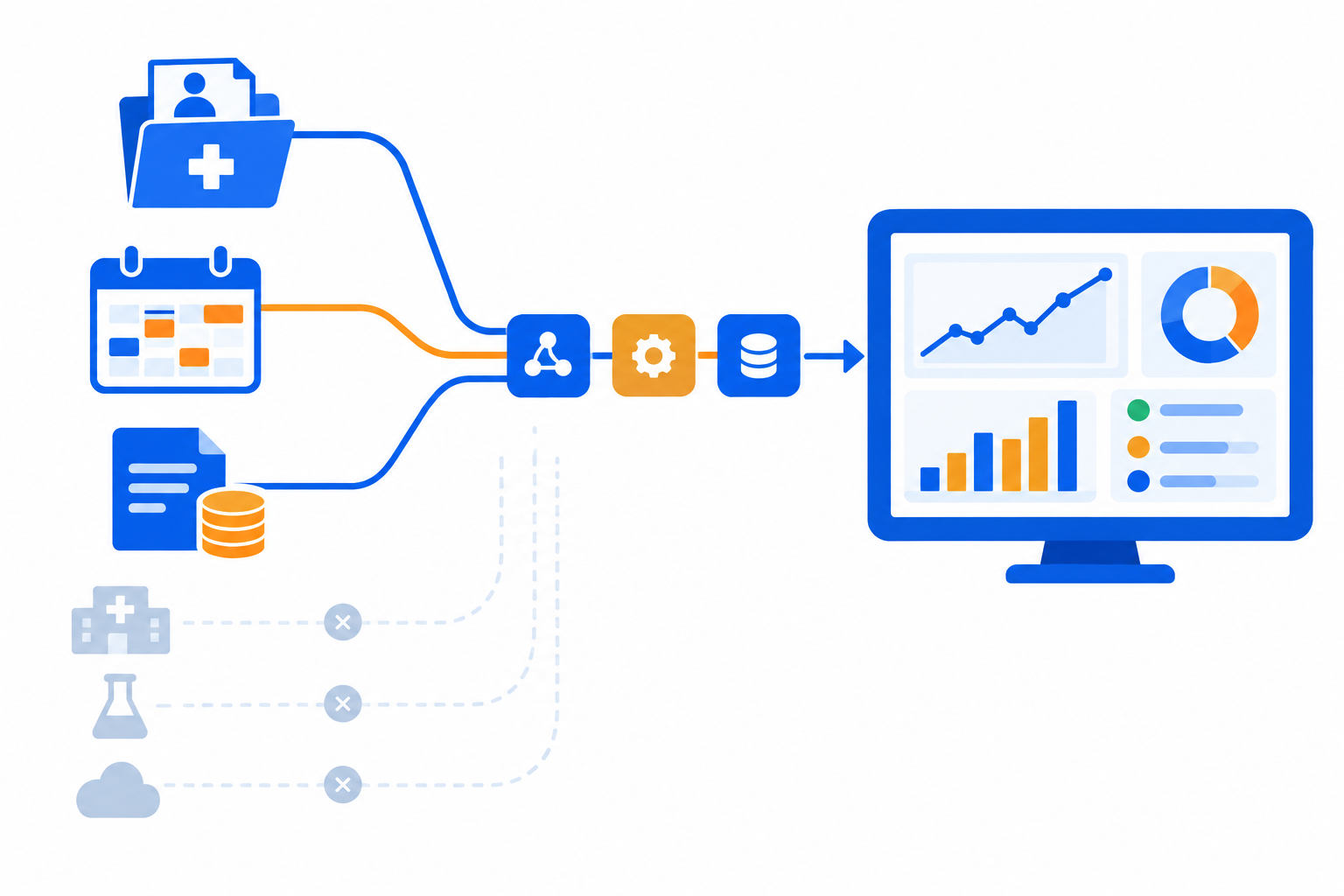
A modular API layer makes it possible to create dashboards quickly for a specific healthcare process, even when data is spread across multiple systems. By exposing only the sources necessary for one specific information question, insight can be gained within a few weeks without immediately needing an entirely new data landscape. This limits the initial scope and prevents the organisation from immediately facing the complexity of full system integration.
This acceleration remains useful only when every connection fits within clear architecture agreements and standards. Each new connection adds a transformation to the landscape. Therefore, document which data is exchanged, what it means and where the transformation takes place. This keeps the API layer a reusable connection for well-defined information questions, rather than a collection of separate integrations that later become difficult to manage.
Risks of fragmented data for BI projects
Fragmented data affects not only the comparability of figures, but also their traceability. Differences in definitions, recording methods or timeliness between source systems can mean that an outcome cannot easily be traced back to the source, the transformations applied and the definition used. Without a formal data quality framework with documented controls, ownership and Data Lineage, it remains unclear whether discrepancies in reporting arise from process differences or inconsistencies in the underlying data. This slows down the assessment of figures and undermines trust in BI outcomes.
The risks increase when access to data and changes in the data flow are not visible. Row-Level Security (RLS) can restrict access to the rows relevant to a user or role, while Column-Level Security (CLS) can restrict access to individual data fields. Audit logging makes changes and consultations more traceable. These mechanisms do not solve data quality issues, but they do make it clearer who can see which data and how a BI outcome was produced.
A targeted Proof of Concept using your own anonymised data can reveal these issues early. In doing so, test not only whether the dashboard answers the desired question, but also whether key figures can be traced back to their source and transformation and whether access rights work as intended. This creates a substantiated basis for further rollout, rather than a later discussion about figures whose origin is unclear.
Practical steps for addressing fragmented data
A workable first step is to define one healthcare process for which a dashboard can genuinely be used. This scope determines which data sources are relevant and prevents all dispersed data from becoming part of the project at once. The modular API layer then focuses exclusively on the data required for that process. This creates a clear initial connection between existing systems and business intelligence, rather than a broad programme whose value becomes visible only late in the process.
The practical sequence consists of three related choices. First, give the selected healthcare process a clear boundary: which information question is central and which systems provide the data for it? Next, determine which data will be made available to the dashboard through the targeted API layer. Finally, document the architecture and standards agreements that this connection must meet. Also specify which source owns the data, how definitions are managed and which transformations are applied for reporting.
The benefit of this approach is not only the speed with which an initial dashboard can become available. The organisation also sees which expansion logically follows and which expansion still depends on additional agreements. A new source or healthcare process therefore does not become an automatic addition, but a step assessed against the same data definitions, quality controls and responsibilities. The phased growth of data analysis and BI in healthcare organisations aligns with this approach: maturity develops through successive steps, not by introducing all possibilities simultaneously.
The modular API layer remains a means, not an end. It provides room to start in a targeted way, while the initial phase also clarifies the working method the team needs for management, validation and expansion. The concrete outcome is therefore twofold: a dashboard for the selected process and a shared approach for connecting the next data source.
Key considerations for successful BI implementation in healthcare
The first BI release in a healthcare organisation is manageable only when the boundaries of the data flow are taken as seriously as the content of the dashboard. Semantic harmonisation keeps healthcare concepts comparable across the systems involved, while a targeted API layer makes the initial information for one process available. For personal data and healthcare data, the applicable requirements of the GDPR and the NEN 7510 information security standard must also be incorporated into the design. This gives the implementation a technical, semantic and organisational boundary.
Make access and traceability part of the first release. A dashboard for a specific healthcare process has lasting value only when it is clear which data it contains, who may consult it and how the outcome can be traced back to the source. RLS and CLS can help restrict access at row and field level. Data Lineage and audit logging then support the traceability of data and changes within the BI chain.
This design aligns with the need to process healthcare data carefully. Rather than adding security only after reporting is working, access rights, logging and traceability are incorporated into the data flow itself. This enables the team to check not only the definition when an outcome differs, but also the source and transformation that preceded it.
When expanding, the central question is therefore not only whether a new connection is technically possible, but also whether it can follow the same access, traceability and architecture agreements. This keeps BI growth manageable without losing the usefulness of the initial insights.