

Developing a proof of concept (PoC) for a new web application in the graphic industry starts with a thorough intake of the workflow and data flows, followed by a phased approach that isolates technical risks and establishes measurable criteria. Shop-floor involvement helps uncover hidden process dependencies and keeps validation realistic.
PoC development process in the graphic industry
A PoC for a web application in the graphic industry reduces technical and operational uncertainties to a testable trial. The focus is on the actual workflow, the systems involved, and the criteria the selected application must meet.
- Start with a detailed intake of the current workflow and data flows.
- Select one representative process route to test technical integration risks.
- Set measurable criteria in advance for turnaround time and error tolerance.
- Involve shop-floor experts to identify hidden process dependencies.
- Use realistic test files to validate the PoC against operational requirements.
The importance of a phased approach in a PoC
A PoC for a web application in the graphic industry is most useful when it does not try to replicate the entire chain at once. The trial is given a limited initial phase with one clearly defined question: which step in the intended workflow must demonstrably work before further investment is justifiable? This scope prevents a convincing presentation from being confused with proof that the selected application can work in day-to-day practice.
This requires a benchmark defined in advance. For a specific trial, quantitative thresholds can be agreed for turnaround time, error tolerance, and status verification. These are not general quality labels, but testable outcomes that fit the selected workflow. When the same benchmark is known in advance by both the client and the development partner, there is less room to interpret a result more favourably or unfavourably afterwards. Assessment shifts from impression to demonstrable behaviour.
The graphic shop floor requires extra care in this phasing. In a print shop, operators may routinely correct customer files manually before the next step takes place. If those corrections remain out of view, a trial for automated intake may wrongly appear to work well. The trial then processes only clean input, while the intended application must be able to handle the files that raise questions in practice. The result is a false-positive view of feasibility.
A phased approach makes this risk manageable. First, it is established which production files are representative and which corrections currently take place implicitly. These cases are then tested within the agreed benchmark. Only when the outcome is sufficiently clear is there a sound basis for the next decision. The PoC therefore remains small, while the uncertainty it investigates is concrete and operationally relevant.
First steps in a PoC project for web applications
A PoC project for a web application in the graphic industry starts with an intake aimed at uncovering the actual workflow and the underlying data flows. This phase considers not only the desired user interaction, but above all how production, design, and handover processes currently operate. This reveals which data enters, is modified, and is passed on, and where existing systems, such as a print MIS or prepress automation, play a role. The intake thereby sharpens the functional question and technical context of the PoC.
The subsequent workflow discovery maps the selected process route from the phased approach. Not all exceptions or variations need to be included immediately, but within this route, technical integration risks and operational complexity must be made visible separately. For example, by using a Laravel solution, data exchange and required transformations can be tested without burdening the full system. This makes assumptions about API integrations, file processing, or data integrity testable at an early stage.
When integration with an existing print MIS is required, this phase also determines how the data flow will operate. A commonly used approach is to deploy a read-only API layer, allowing the PoC to read information from the existing system without unwanted changes to operational databases or machine schedules. The production environment thus remains outside the trial, while the feasibility of data access and workflow integration is examined.
After these steps, there is not yet a fully developed technical blueprint, but there is a clear problem definition, a known data route, and a defined test area. This provides a useful starting point for further development.
Risks of a PoC without shop-floor involvement
A PoC may look technically convincing yet prove unusable once it reaches the shop floor. This risk arises when the trial is initiated solely by IT or innovation managers and prepress managers and order preparation staff do not actively participate. They often know the information flows that follow the initial input: which data is added, where post-processing takes place, and which exceptions become visible only after a file or order arrives. If this knowledge is missing, the prototype may show an incomplete route.
The consequences are practical. For example, a web application may handle an input action well, while a necessary subsequent action or handover has not been included. The trial then confirms only that an isolated step is possible, not that the workflow remains usable. In the graphic context, that distinction is significant: information required for post-processing but absent from the prototype only becomes apparent later as missing context. Remedying this then means that earlier assumptions must be examined again.
Shop-floor involvement is also needed to test technical choices under representative load. Heavy graphic file intakes may raise the question of whether a request is processed directly within the web request or in the background in a queue. A PoC can test this distinction, for example with Laravel Horizon, by examining whether worker processes continue working during peaks in simultaneous transactions rather than stalling. The people who carry out intake and post-processing determine which files, volumes, and timings are representative for this purpose.
That involvement does not have to make the PoC broad or slow. It focuses on the employees who genuinely know the selected process flow and on the information they need to take the result further. Their assessment goes beyond whether a screen feels logical: they can indicate whether data is available at the right time, whether an exception is missing, and whether the trial supports the practical handover.
Applying a PoC in the graphic industry
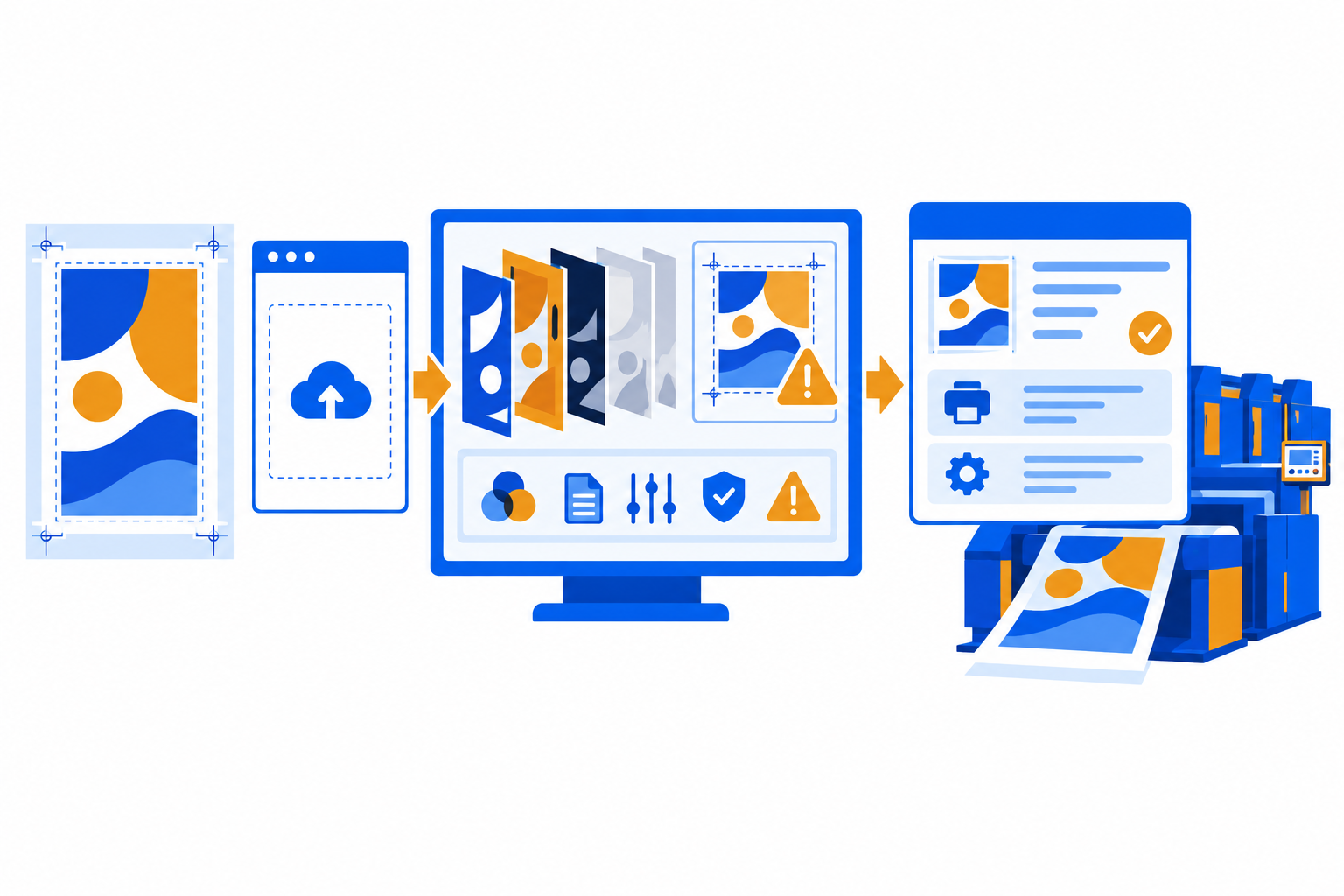
A clickable design can be useful for discussing interactions, but it does not automatically test what happens once real graphic input passes through the intended workflow. For this reason, a practical PoC shifts from abstract Figma wireframes to validation linked to realistic payloads. Consider a PDF/X-4 file with Pantone colours, bleed, and metadata requirements from the prepress engine. Such input reveals whether the assumed route also holds up when the characteristics of an actual file form part of the test.
This approach exposes hidden issues earlier than a demonstration with simplified examples. Not every issue has to be technical in nature: the test may also show that a status, exception, or handover moment needs to be interpreted differently. Its value lies in the confrontation between the interaction design and the characteristics of the material that must be processed through that interaction.
There is a clear choice when defining the scope. A broad, superficial layer can show several process steps in mock-ups. This provides a view of the possible scope of the application, but often leaves the key technical and process dependencies unresolved. The previously selected process route can therefore be tested as a vertical slice, for example from upload to MIS order entry. The trial remains limited in scope, while the route is complete enough to find errors and missing assumptions.
Which form is appropriate follows from the question at hand. When visual feedback is primarily needed, a broad sketch can be useful as a discussion tool. When uncertainty lies in actual processing and integration, a vertical slice provides more evidence. This prevents the trial from producing many screens without answering the question that determines further development.
Frequently asked questions about PoCs in the graphic industry
Frequently asked questions about PoCs in the graphic industry often focus on the trade-off between speed and technical depth, and on how a development partner deals with uncertainties during the project.
- What is the difference between a quick visual prototype and a technical PoC in Laravel?
A visual prototype quickly provides insight into screen layouts and interactions, but leaves the underlying architecture and integration with existing systems out of scope. This is useful when the question primarily concerns user experience. A technical PoC in Laravel, by contrast, focuses on actually testing backend processes and data exchange, for example with an existing MIS or prepress workflow. This approach requires more preparation, but immediately shows whether the intended integrations and data flows are technically feasible. The choice between the two forms depends on the uncertainty you want to address: usability or integration. - How is trust built in the PoC process?
In addition to the agreed assessment criteria, trust is built by keeping execution and assessment transparent. Record which production files were used, which exceptions are deliberately outside the scope of the trial, and who assesses the outcomes. An explicit stopping point also helps: a technically infeasible integration does not need to be taken into the next phase. This keeps clear what a Go or No-Go decision is based on.
Key considerations for a successful PoC
A successful PoC in the graphic industry makes technical details and operational dependencies open for discussion at an early stage. The intake therefore focuses on concrete integration points, such as existing graphic interfaces, the version of the print MIS, and specific prepress exceptions. This clarifies which data and process steps are genuinely relevant to the trial.
- The quality of the intake meeting determines what the PoC can test.
By explicitly discussing technical details and workflow exceptions, a more realistic picture of the situation emerges. This reduces the chance that the PoC aligns with a simplified model rather than the actual way of working. - Measurable criteria must align with the identified dependencies.
Defining measurable criteria only makes sense once it is clear which interfaces, file flows, and exceptions fall within the scope of the PoC. Otherwise, the result of the trial may not answer the actual integration or workflow question. - Unidentified dependencies obscure the follow-up decision.
When relevant interfaces or exceptions are not explicitly included, a budget decision may be based on an incomplete picture. Risks and costs then become visible only before a full implementation is considered.
Next steps for your PoC project
The next step is to select one defined intake or handover flow and collect files that reflect day-to-day practice. Also record which manual preflight corrections operators currently perform. When a PoC for automated intake is tested only with clean examples, it can create a false-positive impression. Production files containing the deviations that are normally corrected make the outcome useful for the follow-up decision.
Based on that selection, the PoC can specifically test what the selected web application does and does not process. This creates a decision based on demonstrable behaviour in the workflow, rather than on an ideal example.