

A startup can only responsibly scale an AI PoC when predefined acceptance criteria are repeatedly met on a fixed, representative evaluation set, uncertainty is visibly routed to human review, and the application stops invalid or anomalous output before further processing. If quality, auditability, exceptions, and the required review workload do not remain manageable, the use case must be narrowed or product investment must stop.
In brief: from AI PoC to production
A production application requires more than a convincing demo: the chosen workflow must remain measurable, controllable, and investigable under repeatable conditions.
- Measure quality against predefined, representative cases and repeat that assessment when prompts or external AI services change.
- Assess not only whether answers appear correct, but also whether ambiguous input and uncertainty become visible as exceptions.
- Make a deliberate choice between further improving AI behaviour and application controls that determine which output may actually proceed.
- Make outcomes verifiable for users against the underlying source, so they can confirm, correct, or reject them.
- Define in advance which results may proceed automatically and which always require human assessment.
- For each processing event, retain the relationship between the instruction used, duration, controls, and any subsequent changes, so deviations can be reconstructed afterwards.
When can an AI proof of concept go beyond a demo?
An AI proof of concept can go beyond a demo when the same quality proves repeatable on a fixed evaluation set. Such a set is also called a golden evaluation set: a fixed collection of representative cases against which you consistently measure changes using the same standard. A convincing answer to one selected example is not enough. The question is whether, in a subsequent assessment of the same predefined cases, the system still produces outcomes that meet your acceptance criteria.
A demo mainly shows that an idea appears technically possible. Someone chooses favourable input, asks a question, and sees a usable answer. That can be a good initial indication. But a production application does not process only carefully selected examples. The same types of documents, questions, or data recur repeatedly, alongside variants that are less tidy, incomplete, or unexpected.
Therefore, turn the PoC into a testable trial. Fix the evaluation set and determine what constitutes a useful outcome for each case. This may mean that the AI provides a correct classification, extracts the correct data, or indicates that the input is not reliable enough for automated processing. Do not adjust the set during the process to make the outcome look better; its stability is precisely what makes comparison possible.
Repeat the assessment when you modify the PoC and when the external AI service changes. External LLM providers can update model weights and system instructions under floating version labels. As a result, quality can gradually deteriorate without any change to your own application code: a form of semantic drift. Automated regression tests on the same evaluation set make that shift visible before you accept a change as normal behaviour.
This is not a universal accuracy threshold. Appropriate acceptance depends on the specific workflow and on what an error causes within it. The distinction is nevertheless clear: a demo shows that an outcome is possible; a PoC that justifies further development shows that you can measure quality repeatedly and recognise deviations. Only then does a basis emerge for further developing the AI step in a Laravel application, without treating the demo as evidence of lasting quality.
Why a convincing AI answer may still not safely proceed through the workflow
Exception masking occurs when an AI system does not show that multiple interpretations are possible for ambiguous input, but presents one interpretation as an ordinary, definitive answer. Ambiguous input may consist of a question or data that can be read in more than one way. The risk is not only an answer that is substantively incorrect. The uncertainty preceding that answer is not visible to the rest of the process.
As a result, an uncertain outcome takes the same form as a reliable one. An application, employee, or subsequent step sees no distinction between an answer with sufficient grounding and one for which the model has supplied an interpretation. If no explicit fallback is activated, the deviation does not appear as an exception either. It may be treated as regular input, while the incorrect interpretation has already arisen at the start of processing.
This becomes risky once the AI outcome does not stand alone, but supplements data, influences a follow-up action, or serves as input for an operational core system. The error can then propagate without the point at which the input was ambiguous still being recognisable. A plausibly phrased answer makes this harder: the wording provides no visible sign that the system lacked sufficient basis to choose one meaning with certainty.
The relevant question for the workflow is therefore not whether every ambiguous case leads to an error, but whether uncertainty is still visible before the outcome has consequences. If it is not, an apparently normal answer receives a status it has not earned.
When further prompt iteration should give way to controls in Laravel
The choice is not only about the final percentage point, but about which risk you can influence at that moment. Prompt iteration improves AI behaviour in the proof of concept; hardening in Laravel determines which outcomes the application processes under fixed conditions.
| Aspect | Further prompt iteration | Hardening in Laravel application software |
|---|---|---|
| Purpose of the investment | Make the AI better fit the defined task by refining prompts. | Add fixed controls around the processing of AI output in the workflow. |
| What you manage | The quality of the answer within the prototype environment. | The conditions under which an answer may be used in the application. |
| Type of error control | Reduces errors arising from the AI's interpretation. | Deterministic validation layers give the same judgement for the same input every time. They can stop output when it does not meet predefined rules. |
| Role of database cross-checks | The database can provide context for the answer, but is not central to iteration. | Database cross-checks compare AI output with data already present in the system before the workflow proceeds. |
| When this route is appropriate | When the PoC does not yet sufficiently show how the AI performs the intended task. | When the PoC provides sufficient insight into behaviour and known risks can be constrained through fixed rules or existing data. |
| Limitation | A better prompt does not add application rules or data validation. | Application controls do not automatically improve the substantive quality of the AI outcome; model evaluation remains a separate component. |
| Decision question | Does a next prompt adjustment demonstrably produce better outcomes for the defined task? | Which outcomes may Laravel process only after fixed rules and database data have been checked? |
Can a user verify the AI outcome themselves?

Include verifiability as a separate part of your scorecard. An outcome is easier to verify when the user sees not only a conclusion, but can also immediately return to the source document, page number, and passage on which that conclusion is based. This makes the outcome discussable within the workflow, rather than something that can only be accepted on trust.
| Scorecard question | Verifiable outcome | Opaque outcome |
|---|---|---|
| Where does the extraction or conclusion come from? | The outcome contains a direct, clickable link to the source document. The user can open the origin without having to search for it. | The outcome does not cite a source. The user sees only the AI's wording and must determine for themselves what it may be based on. |
| Can the user find the precise context? | The reference includes a page number. This makes clear where in the document the relevant information is located. | The user receives at most a general reference to a collection of documents, or no indication at all of where the information was found. |
| Is it visible which text supports the outcome? | The relevant passage is highlighted. The user can compare the AI outcome with the source and see whether the interpretation fits the text. | The user reads a conclusion without the underlying passage. As a result, it is not immediately visible whether the AI omitted details, misread them, or reasoned too far beyond them. |
| What can the user do when in doubt? | The user can consult the source and confirm, correct, or disregard the outcome. The AI then functions as a verifiable assistant. | Doubt leads to manual searching or blind trust. The outcome remains an intermediate step in the workflow that is difficult to assess. |
| What do you test in the PoC? | Test whether every relevant extraction or conclusion returns the correct source, page, and highlighted passage. | Do not test only whether the answer sounds convincing. Without verification context, good wording remains insufficient evidence that users can assess the outcome. |
Which outcome may proceed, and which goes to human review?
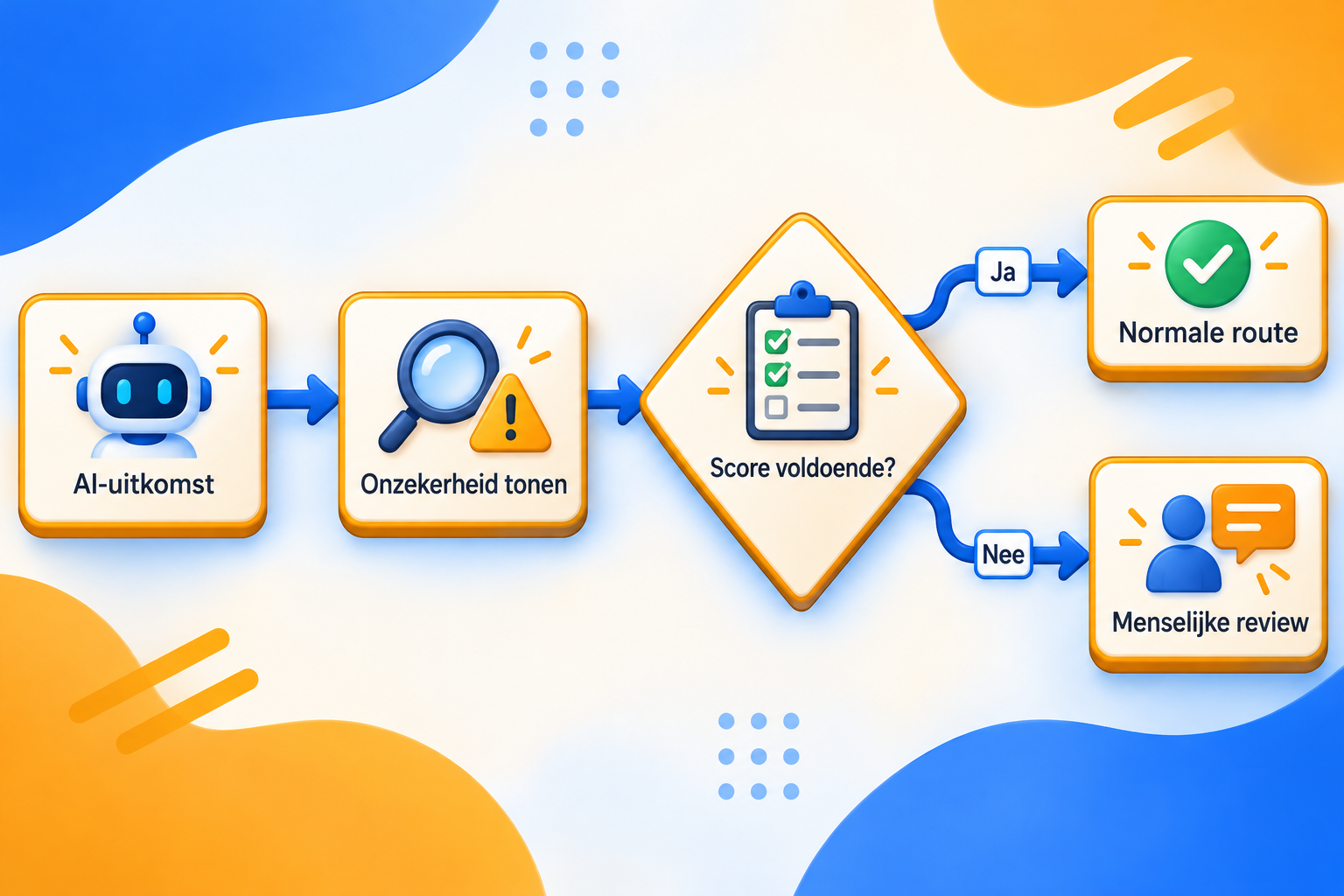
Before the next test, define when an AI outcome may proceed automatically and when an employee reviews it. The rule consists of a predefined acceptance threshold, visible uncertainty, and an automatic route to human review. This turns uncertainty into a recognisable process outcome rather than an implicit assumption.
- Set the acceptance threshold in advance. Link the threshold to one defined workflow and specify which outcomes you accept within that workflow without human assessment. The threshold is not a general quality standard for all AI applications. It indicates the point at which this specific outcome has sufficient basis for the chosen automated step.
- Also define a limit for the review workload. An acceptance threshold is only operational when you determine in advance how many outcomes may go to human assessment. For example, you can test whether the selected workflow remains below a limit of 3.0% manual review; if that standard does not fit the risks or available capacity, you deliberately choose a different limit. This makes review workload a measurable condition for scaling.
- Treat the threshold as a decision rule, not a cosmetic score. A reliability score only gains meaning when the application attaches a consequence to it. Above the defined threshold, the normal route follows. Below that threshold, there is no automated handling as if the outcome were certain.
- Make uncertainty explicitly visible. The prototype must be able to state: “I am not sure.” This allows the user to see that the AI is not offering a definitive outcome. This explicit uncertainty prevents a questionable interpretation from receiving the same status as an outcome with sufficient confidence.
- Activate human review automatically. When the reliability score falls below the predefined acceptance threshold, the outcome goes to a human review workflow.[1][2] The employee then assesses the exception instead of the workflow processing the outcome without an intermediate step.
- Check the complete route. Do not only check whether the model can give a low reliability score, but also whether that score is visible, review is actually activated, and the outcome does not simultaneously proceed through another automated route. The value lies in the coherence between assessment, fallback, and human decision.
- Use the outcomes to assess the review workload. During the trial, track which cases fall below the threshold and why. This makes visible whether the selected workflow requires an acceptable amount of manual checking and whether the exceptions are recognisable to the people handling them.
What should you be able to retrieve for each AI transaction?
For each AI transaction, the full chain from request to downstream processing should be retrievable. OpenTelemetry can help monitor and log that context in a standardised way. This enables investigation when an outcome later raises questions or is unexpectedly used in a subsequent step.[3]
- Which prompt version is associated with it?
Record which version of the prompt was used for the individual transaction. Without that context, it is difficult to distinguish whether an anomalous outcome results from the input or from a change to the instruction given to the model. - Why do you record token consumption?
Token consumption belongs to the same transaction context. This keeps visible how much model usage a specific processing event involved. It is not a standalone cost estimate, but data that should be retrievable alongside the relevant outcome and processing event. - What does inference latency tell you?
Record inference latency for each transaction. This shows how much time the model step took for that specific processing event. In the event of an unusual user experience or delayed workflow, you can therefore distinguish the model step from other parts of the chain. - Which validation results do you record?
Store the result of the controls associated with the AI outcome. This allows you to see afterwards not only what the AI produced, but also how that outcome was assessed by the application before the next step took place. - Why do database mutations belong in the same overview?
An AI transaction does not end with the model's answer when that answer influences data further down the workflow. Therefore, also record downstream database mutations. This keeps traceable which database change belongs to which prompt version, latency, and validation outcome. - What does that coherence provide?
You can reconstruct an individual outcome as a single chain: prompt used, model usage, duration, validation, and any mutation in the database. That is more concrete than an isolated error message or only an end result. Logging does not prevent incidents, but without coherent transaction context, the investigation of a deviation remains incomplete.
This recording also supports a deterministic fallback: when controls stop an outcome, it must be visible afterwards which rule did so and which route was then chosen.
Further development is only defensible when uncertainty remains manageable
The judgement is clear: a larger investment in a Laravel production application is only defensible when AI outcomes remain verifiable within the selected workflow and an error cannot be processed further without notice. The evaluation set, acceptance threshold, and fallback must not merely exist; they must work together in practice.
This is also a financial boundary. Those who continue building without sufficient evidence are financing not only the production application, but potentially also the remediation work that arises when incorrect output has already become part of the process. Employees then need to perform additional retrospective checks, correct errors, and adapt working methods around an AI step that was supposed to support their work. The costs therefore lie not only in development, but in the continuing burden of a workflow in which unreliable outcomes have already gained influence.
Operationally, what matters most is whether deviations remain visible and investigable before they affect subsequent steps. The previously defined controls, human assessment, and processing records together form the boundary between a manageable AI application and an outcome the organisation is forced to trust. If that boundary cannot demonstrably hold, stopping or redefining the use case prevents uncertainty from being embedded in the application. That is not a failure of the proof of concept, but a substantiated decision not to make a product investment before the error burden and required control activities are manageable.
Define the use case and benchmark before the next development decision
Schedule a half-hour conversation about the process, intended use case, and benchmark needed in advance for a careful development decision. Together, you can clarify which problem a PoC should test, which signals are sufficient, and which conditions are decisive. The outcome may be that further development is promising, but also that it is not appropriate now. That clarity is precisely what helps you choose the next step deliberately.