

The minimum due diligence for quickly selecting a secure Laravel partner before an audit or compliance deadline consists of three elements: verifiable criteria for data access and code integrity, a limited initial engagement such as a phased model or Proof of Concept using your own data, and verification of CI/CD scans, MFA, and dependency hygiene.
Critical considerations when selecting a Laravel partner
Under time pressure, partner selection does not have to come down to general security promises. A defensible choice starts with a small set of checks that can be specifically assessed and documented before signing.
- Assess whether the partner applies Laravel security visibly in the codebase, rather than merely referring to it in general working practices.
- Define a clearly scoped initial engagement with measurable acceptance criteria.
- Verify automated CI/CD scans, MFA for development access, and dependency hygiene.
- Document the scope, responsibilities, temporary solutions, and handover documentation.
- Link temporary measures to a clear end date.
Essential criteria for selecting a secure Laravel partner
An audit or compliance deadline shortens the time available for partner selection, but not the need for a verifiable initial engagement. A full supplier assessment or review of all future code is often not feasible just before signing. Therefore, focus the minimum assessment on what makes the start manageable: demonstrable Laravel security expertise, a clearly defined initial scope, and predefined acceptance criteria.
Laravel expertise is only relevant when the partner can explain how security is incorporated into the codebase. CSRF protection, Eloquent mass-assignment guards, and rate limiting are concrete topics to discuss. It is also relevant how authorization is configured through the Laravel Policy Engine or Role-Based Access Control (RBAC), so that access is not based solely on assumptions or isolated checks. The question is therefore not whether a party mentions Laravel, but how these features are applied and tested during development.
The initial engagement must then be small enough to link outcomes to a clear cause. A Proof of Concept using your own data or a separate hardening phase limits the work area and makes acceptance easier to assess. Document the expected results, who receives access, which data is used, and under what conditions a next phase will be considered.
The required documentation does not need to be a complete file covering every future detail. It must, however, clarify what falls within scope, which acceptance criteria apply, how data access is arranged, and which technical security principles are demonstrably part of the Laravel codebase. Measurable criteria prevent a general impression of security from later replacing a verifiable delivery.
This keeps the initial decision commercially and operationally bounded. The organization first assesses whether the partner can deliver the agreed security and results within a controlled engagement before a broader technical dependency arises.
Risks of skipping essential checks
This section concerns the risks before contracting. When essential checks are skipped, the agreements needed to steer the initial engagement are missing: who has access to data and environments, what code integrity is expected, and based on which criteria delivery is accepted. Discussions about responsibilities and security levels then shift into execution, when changes have a greater impact on planning and progress. Unclear agreements on access, dependencies, or handover can also raise audit questions that cannot easily be answered with general assurances. The practical consequence is that the organization must document, at a minimum, what it wants to be able to verify in advance; execution can then demonstrate whether those requirements have been met.
What should be validated and why
The pre-contract assessment does not need to be a manual penetration test of every candidate. Instead, request evidence and explanations for several practices directly relevant to the initial scope. Verify whether automated CI/CD scans are part of the process, whether MFA applies to development and administrative access, and how dependency hygiene is managed. For Laravel projects, this may include the partner explaining how Composer Security Audit is used and whether a Software Bill of Materials (SBOM) is available for the relevant delivery.
Also ask how security controls are tested. For authorization, for example, it is relevant whether Laravel Policies and roles are tested for unwanted access, rather than merely checking whether a user can log in. For incidents and operations, it is useful to see which escalation arrangements, logging, and handover information are available for the initial phase. This validation makes the selection more specific: not a general promise about security, but visibility into the controls the partner actually performs and can explain.
Further depth can be added after contracting. For the initial decision, the main point is that the basic controls, responsibilities, and method of demonstrating compliance do not remain open.
Checklist for minimum due diligence
Use this checklist to document the checks mentioned above when selecting a Laravel partner for custom software and managed services. The emphasis is on transferability, verifiability, and future maintenance:
- Request a specific substantiation of Laravel ecosystem standards. Have the partner explain how standard Laravel mechanisms for authorization, middleware, logging, and dependency management are applied. Where relevant, also ask which scan outputs, Composer Security Audit results, or SBOMs are available with the initial delivery.
- Document deviations from standards explicitly. Record which elements deviate, why this is necessary, and how the deviation will later be assessed or phased out. This keeps the code more transferable and less dependent on individual developers.
- Assess the transferability of the initial delivery. Structure the initial scope so that another party can assess and maintain the code, access rights, and relevant documentation if the team or priorities change.
- Ask how security and continuity measures are ensured. Have the partner explain how MFA, access management, logging, dependency controls, and incident handling are arranged within the initial scope. Ask specifically how authorization errors in RBAC or Laravel Policies are prevented and checked.
- Limit temporary improvisation to what is strictly necessary. Allow temporary solutions only when they are documented with an owner, end date, and handover documentation.
Consequences of skipping essential steps
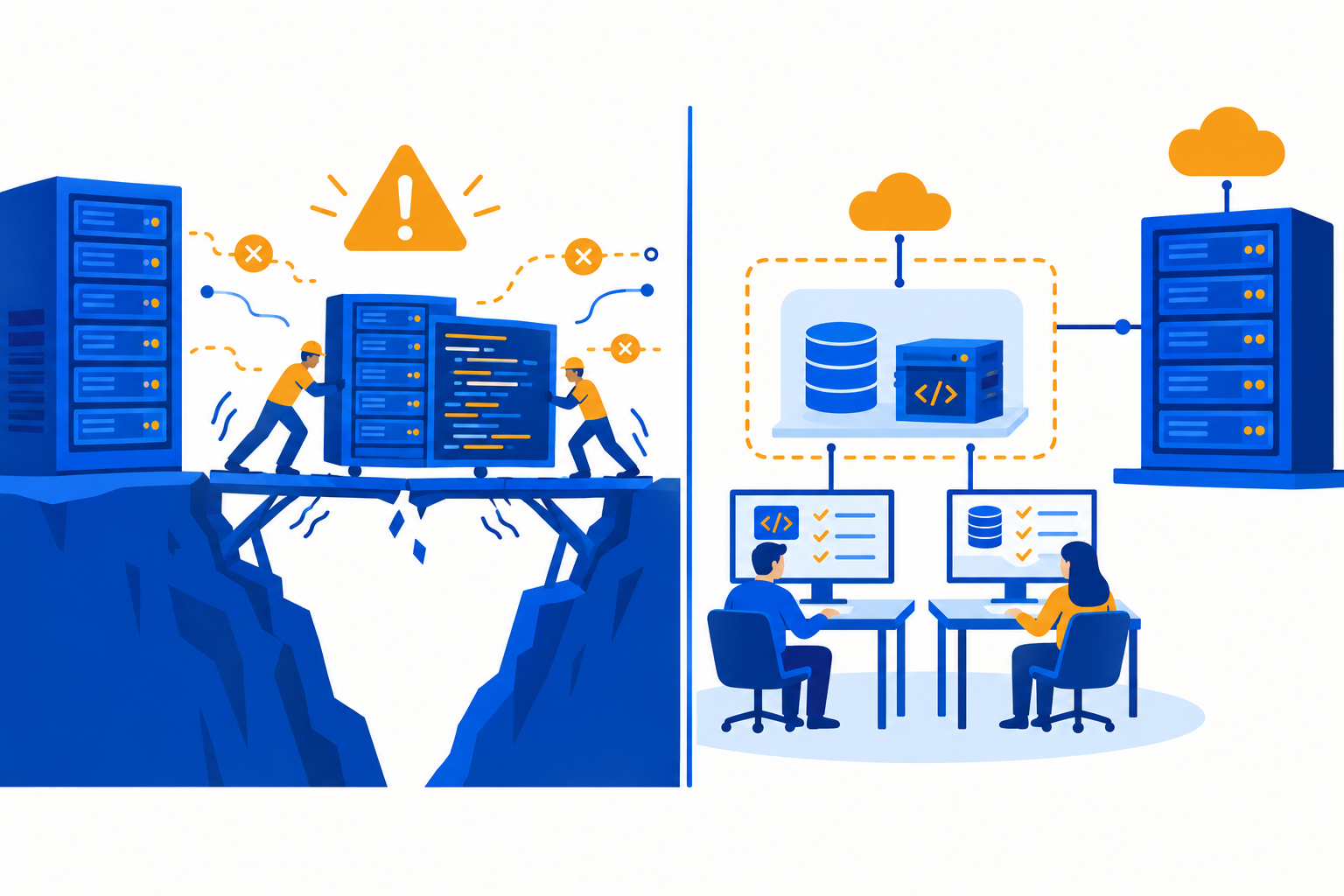
Where the previous section concerns missing checks before contracting, this section concerns the design of the transition. The error with the greatest operational impact is treating a full direct handover as a quick way to remove uncertainty. In that case, the transition, working method, and solution all change at once. If execution stalls, it becomes difficult to determine where the cause lies and which element needs to be remedied.
A limited Proof of Concept using your own data separates these questions. Within a clearly defined scope, the organization can assess whether access, working methods, security controls, and delivery function before the full transition depends on them. This does not assess the entire future collaboration, but it does create a useful decision point for expansion, adjustment, or termination.
This approach temporarily requires dual governance: the existing situation and the new trial operate alongside one another. Therefore, document in advance who assesses progress, which results are sufficient, and when the trial ends. Without this governance, a limited phase can still drag on without a clear decision.
The appropriate initial engagement is therefore not only technically bounded, but also closed from a governance perspective. A clear end date, decision points, and responsibilities keep both financial and operational exposure tied to the limited scope.
Essential recommendations for secure partner selection
Under time pressure, the quality of the initial conversations is often more informative than the size of a proposal. A party that immediately jumps to a broad solution has not yet demonstrated that it understands the boundaries of the engagement. Therefore, keep the focus on the business process context, technical constraints, and whether the proposed approach is responsible within the available capacity.
- Assess whether the partner first analyzes the process and identifies technical boundaries. A discussion of the business process clarifies what the Laravel engagement needs to support. The partner should not omit technical constraints, access risks, and limitations to make the start appear simpler. A useful test is whether these points are explicitly raised early and can be included in the initial scope. This should also include room for a negative recommendation when an engagement is unsuitable because of its risks or dependencies. This gives management teams a clear link between the financial commitment, the limited initial phase, and the decision required afterward.